2025 AIChE Annual Meeting
(694b) What Is the Ideal StructuRe for Si As Anodes for Li Ion Batteries?
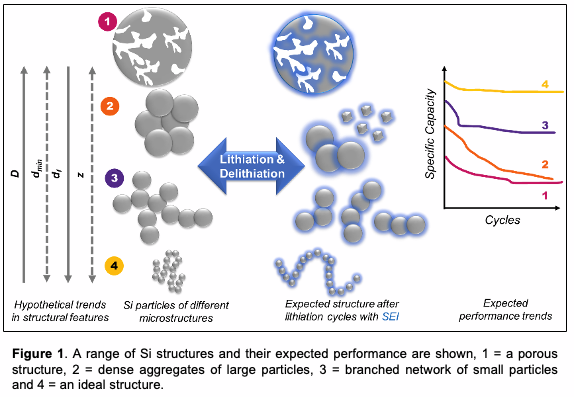
Significant research is focussed on improving the performance of Li ion batteries (LIB), including increasing energy density, enhancing cyclability and stability, enabling fast charging and reducing costs. The use of Si in anodes to either blend with or replace graphite is one promising avenue to achieve these goals because Si provides ten times higher theoretical capacity when compared with graphite and it is also naturally abundant. This represents a significant impact on a conventional technology when compared to the uncertain future of various post-lithium-ion-batteries. However, there are many issues in using high Si content due to nearly threefold expansion of Si upon lithiation, leading to mechanical breakdown and loss of performance within a few cycles. This leads to the challenge of simultaneously optimising the stability, capacity, lithiation rates and solid electrolyte interphase (SEI) formation. Researchers are exploring many strategies to overcome such challenges but limiting focus on creating Si-C composites or engineering particle geometries. However, it is unclear what is the ideal porous structure to meet the desired performance specifications. Using fundamental physics and literature results, this article proposes governing equations to correlate structural features with performance, which can provide guiding principles to design p-Si structures. The structural features include nano-scale primary particles, and their meso-scale connectivity, degree of aggregation and tortuosity. We hypothesize that hierarchical aggregates of sub-micron networked particles will have enhanced rate of lithiation yet with mechanical stability to withstand swelling via accordion expansion or disinterspersion (DI). Preliminary evaluation of these principles is presented using existing literature data and future research avenues are outlined. It is anticipated that these guiding principles will prove valuable for those developing Si for LIB anodes, thereby accelerating their commercial uptake.