2025 AIChE Annual Meeting
(209h) Visual Chemical Engineering in the Classroom
Concepts which lean heavily on spatial reasoning about complex geometries appear frequently in chemical engineering (e.g., turbulators in heat exchangers, catalysis in packed beds, and spray nozzles in scrubbers). Traditionally, students and instructors rely on textbooks or internet resources for existing graphics, or invest time creating simplified hand/computer drawn pictures. While these may be sufficient in some cases, they usually need to leave out important dynamics.
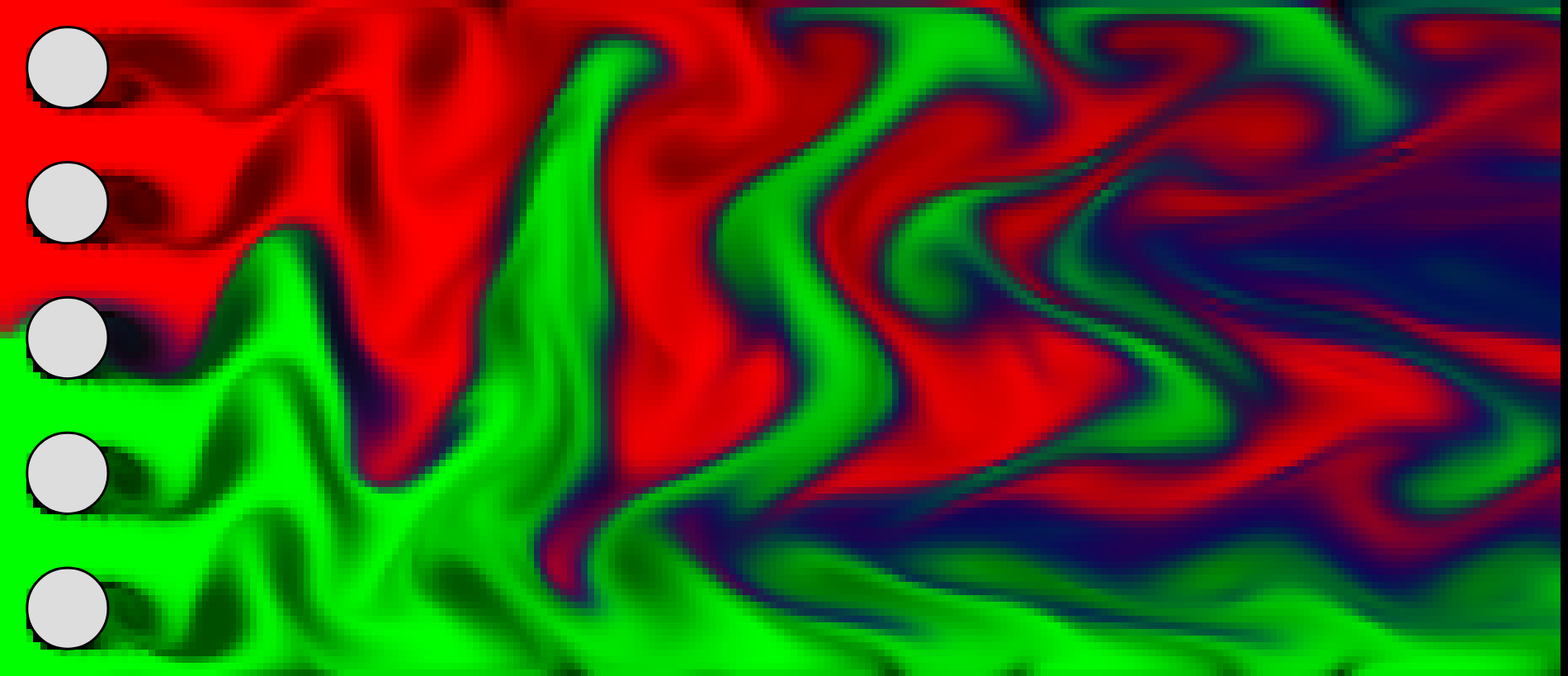
In this presentation, I focus on simulations of reactive fluid flow. Relevant numerical methods for this fall under the categories of “Computational Fluid Dynamics,” “Lattice Boltzmann Methods,” finite difference methods, and integration schemes for reaction kinetics.
Graphics Processing Units (GPUs) are required because interactive simulations are computationally expensive and the algorithms need to be parallelized in order to run in real time. I employ computer graphics methods to generate visuals from data such as cube marching for generating fluid meshes, volume rendering for displaying 3D data, and lighting/shading algorithms (e.g., Blinn-Phong, ray tracing).
Examples of concepts which could benefit from visualization include complex/multi-species reactions, free surfaces (such as a moving air-water boundary), momentum and energy transfer, multiple phases/phase transitions, and forcing/mixing. My hope is that these graphics help in teaching concepts in courses such as reaction engineering, heat and mass transfer, fluid mechanics, control systems, thermodynamics, separations, and reactor design. In addition, they can be used by students as a visual aid for technical communication, enrichment, or research.
My goal is to fill an existing gap in the classroom and lower the barrier for instructors trying to provide a robust mental model of these complex topics.
Figure caption: Simulation of reactive flow where two species (red and blue) mix as the flow past turbulators and react to form a blue species downstream, made using a finite difference scheme for fluid simulation and Javascript.