2025 AIChE Annual Meeting
(715b) Viral Escape-Inspired Framework for Precision Structure-Guided Protein Biosensor Development
Authors
Mohammed Sakib Noor - Presenter, Iowa State University
Yee Chuen Teoh, Iowa State University
Sina Aghakhani, Oklahoma State University
Guiping Hu, Iowa State University
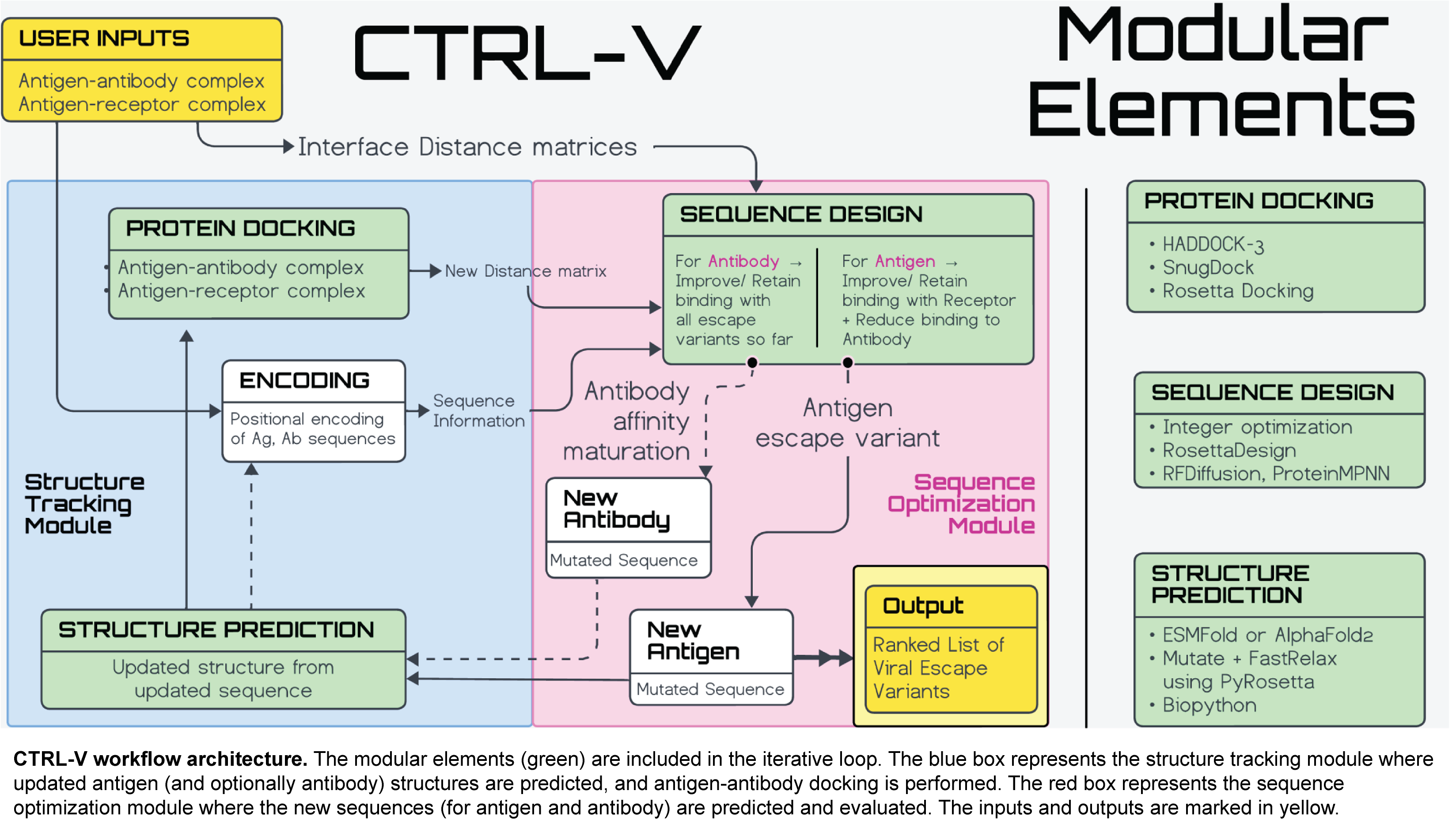
A generalizable computational platform, CTRL-V (Computational TRacking of Likely Variants), is introduced to design selective binding biosensor proteins. Severe acute respiratory syndrome coronavirus 2 (SARS-CoV-2) has been construed as a lethal, evolving biosensor that has iteratively evolved to distinguish and selectively bind to human entry receptors over neutralizing antibodies. CTRL-V prioritizes mutations that reduce antibody binding while enhancing/retaining binding with the host entry receptor. CTRL-V categorized 20% (of the 39) reported SARS-CoV-2 point mutations across 30 circulating, infective strains responsible for immune escape from commercial antibody LY-CoV1404. Specifically, CTRL-V successfully identifies ~70% (five out of seven) single point mutations (371F, 373P, 440K, 445H, 456L) in the latest circulating KP.2 variant and offers detailed structural insights into the escape mechanism. Understanding how a virus is likely to mutate provides significant biotechnological advantages nationally and globally, enabling the design of broadly neutralizing antibodies that remain effective against future escape variants. This foresight is crucial for maintaining effective countermeasures against emerging viral threats. Additionally, the growing need for biosensors in environmental monitoring, health diagnostics, sustainability, and energy applications underscores the importance of predictive technologies like CTRL-V. We demonstrate three versions of CTRL-V and use integer optimization, stochastic sampling using PyRosetta, and deep learning-based ProteinMPNN for structure-guided biosensor design. We validated our approach using the well-studied Raf-Ras-Rap1a signaling pathway system, demonstrating that CTRL-V can be effectively applied to non-viral protein interaction systems. This broader applicability means our platform can be adapted to design proteins that discriminate between various molecules, potentially leading to better biosensors for environmental monitoring, healthcare diagnostics, and other applications. By providing detailed structural insights into why specific mutations affect binding, CTRL-V represents a promising protein-based biosensor design platform with diverse applications across chemical engineering fields.