2025 AIChE Annual Meeting
(569d) Technosphere-Wide Life Cycle Optimization Under Uncertainty Via Chance?Constrained Programming in Pulpo
Authors
A key criterion highlighted in the ISO standards for LCA is the need to account for uncertainty [4]. The most commonly used approach is Monte Carlo simulation, where input uncertainty parameters, typically retrieved from background databases, are sampled repeatedly and the life cycle impact assessment (LCIA) is recalculated for each realization of the uncertain parameters (i.e., sample). This produces a distribution of impact outcomes, helping to assess whether differences between alternatives are meaningful or potentially misleading considering the full uncertain parameters space. This adds additional insights compared to the traditional assessment based solely on nominal parameters values. Another commonly used strategy is sensitivity analysis, which helps identify the most influential uncertain parameters and supports further refinement and interpretation of the results [5].
A recent systematic literature review of LCO found that only about 11 percent of the studies considered uncertainty during optimization [1], which is surprisingly low given that uncertainty can significantly affect the results and is explicitly addressed in the ISO standards. A review on the integration of LCA with chemical process design reported a higher figure of 40 percent, noting that many studies address uncertainty only qualitatively, still reflecting an arguably undesired low level of consideration for uncertainty [2].
PULPO was developed to make LCO more accessible to LCA practitioners, and incorporating functionality to address uncertainty is essential. In the original publication presenting the technology choice model (TCM) approach [6], a stochastic strategy was proposed, which relies on a conventional Monte Carlo method. This involves solving the optimization problem repeatedly, each time for a different sample of the uncertain parameters. This approach requires solving a complete optimization problem at each iteration, which can lead to a heavy computational burden and become intractable when many samples are needed for sufficient resolution.
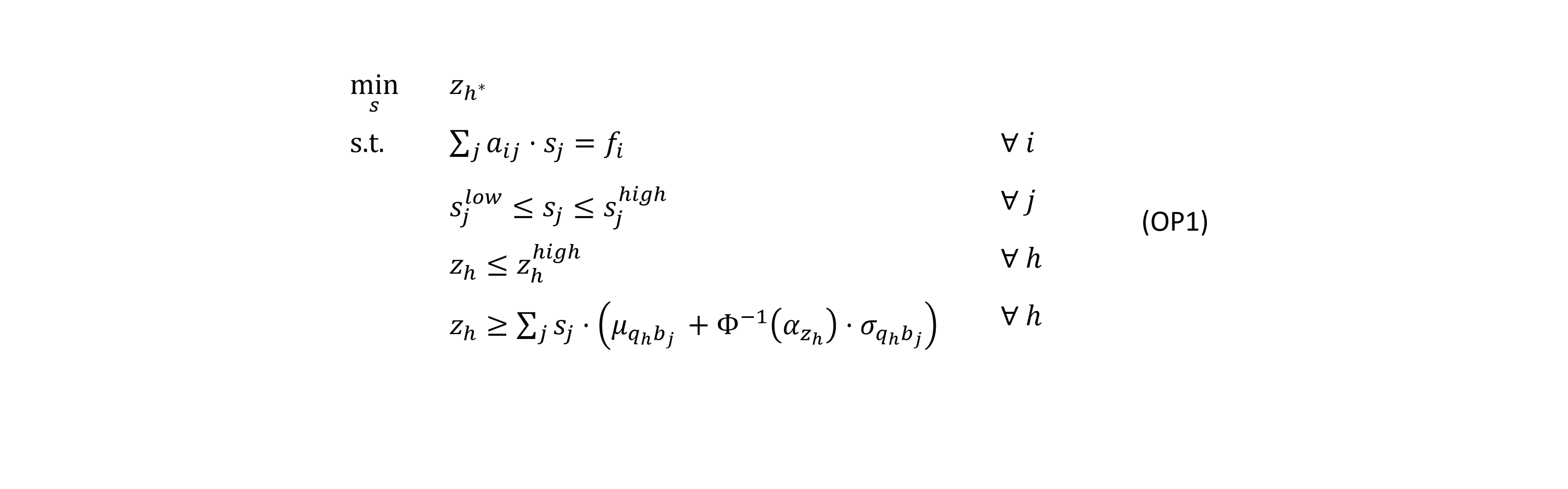
In this work, we introduce a chance-constrained (CC) [7] formulation into PULPO, allowing the specification of a risk-aversion metric (α) that incorporates the underlying uncertainties into a controlled, uncertainty-aware optimization model. This enables the assessment of different levels of risk-aversion, potentially leading to different optimal solutions that are less sensitive to parametric uncertainty [8]. Formulation OP1 presents one version of the reformulated CC problem, where chance constraints are applied to the objective impact constraint, accounting for uncertainty in both biosphere flows (B) and characterization factors (Q). The formulation assumes that the uncertain parameters are normally distributed. However, background databases do not always provide normally distributed uncertainty data. To address this, we include a method to transform the given uncertainty distributions into normal form where needed. Additionally, to manage missing uncertainty data, we propose a gap-filling strategy based on statistical analysis.
In this formulation, i is the set of products, j the set of processes, and h the set of impact categories. The impact values are zh where h* is the impact category to be optimized. The technosphere matrix is given via A and the demand vector is f. Upper and lower bounds can be specified on the scaling vector sj via sjhigh and sjlow. Similarly, upper bounds can be placed on the impact categories via zhhigh. The mean and variance of the environmental cost matrix μqb and σqb are derived from fitted normal distributions of the underlying uncertainty distributions. Here, Φ-1 is the inverse cumulative distribution function and its argument αz is the aspired risk-aversion level. This is a reduced form of the problem which does not include slack variables or environmental flow constraints for the sake of simplicity.
The resulting problem can be solved across a range of values for α: setting α = 0.5 represents the nominal case, while values of α approaching 1 correspond to fully risk-averse scenarios, effectively optimizing for worst-case uncertainty realizations. The resolution of the Pareto front is entirely at the discretion of the modeller. In practice, it may be sufficient to solve the problem for a single α value if only one risk profile is of interest. Moreover, the chance-constrained reformulation does not increase the computational complexity of the underlying optimization problem, offering a significant advantage over more demanding stochastic optimization methods.
The sampling of α described above can be interpreted as a form of ε-constrained solution to the underlying bi-objective optimization problem, where the risk-aversion level α is treated as an objective to be maximized. This reflects a general preference for robust systems, which are often desirable but tend to result in higher environmental impacts. The approach can be extended to include chance constraints on other inequalities, capturing additional parametric uncertainties such as upper bounds on the scaling vector s. These bounds may represent uncertain factors like raw material availability, processing capacities, or other real-world limitations.
The method is implemented into the PULPO Python package. To demonstrate its capabilities, we apply it to a case study on sustainable ammonia production [9,10], considering a range of technology and feedstock alternatives. The objective is to identify production systems that can meet defined sustainability targets, such as reduced global warming potential (GWP) or alignment with planetary boundaries, even in the presence of uncertainty. In cases where these targets cannot be achieved through technological changes alone, the results can inform complementary demand-side interventions, enabling the development of integrated supply- and demand-side strategies. Preliminary results show that the approach identifies varying technology portfolios depending on the desired level of risk-aversion.
References
[1] Turner, I., Bamber, N., Andrews, J., & Pelletier, N. (2025). Systematic review of the life cycle optimization literature, and recommendations for performance of life cycle optimization studies. Renewable and Sustainable Energy Reviews, 208, 115058. https://doi.org/10.1016/j.rser.2024.115058
[2] Häussling Löwgren, B., Hoffmann, C., Vijver, M. G., Steubing, B., & Cardellini, G. (2025). Towards sustainable chemical process design: Revisiting the integration of life cycle assessment. Journal of Cleaner Production, 491, 144831. https://doi.org/10.1016/j.jclepro.2025.144831
[3] Lechtenberg, F., Istrate, R., Tulus, V., Espuña, A., Graells, M., & Guillén‐Gosálbez, G. (2024). PULPO: A framework for efficient integration of life cycle inventory models into life cycle product optimization. Journal of Industrial Ecology, jiec.13561. https://doi.org/10.1111/jiec.13561
[4] ISO (2006). ISO 14044:2006—Environmental management—Life cycle assessment—Requirements and guidelines.
[5] Blanco, C. F., Behrens, P., Vijver, M., Peijnenburg, W., Quik, J., & Cucurachi, S. (2025). A framework for guiding safe and sustainable-by-design innovation. Journal of Industrial Ecology, 29(1), 47–65. https://doi.org/10.1111/jiec.13609
[6] Kätelhön, A., Bardow, A., & Suh, S. (2016). Stochastic Technology Choice Model for Consequential Life Cycle Assessment. Environmental Science & Technology, 50(23), 12575–12583. https://doi.org/10.1021/acs.est.6b04270
[7] Olson, D. L., & Wu, D. (2010). Chance Constrained Programming. In D. L. Olson & D. Wu, Enterprise Risk Management Models (pp. 143–157). Springer Berlin Heidelberg. https://doi.org/10.1007/978-3-642-11474-8_11
[8] Karimi, H., Ekşioğlu, S. D., & Carbajales-Dale, M. (2021). A biobjective chance constrained optimization model to evaluate the economic and environmental impacts of biopower supply chains. Annals of Operations Research, 296(1–2), 95–130. https://doi.org/10.1007/s10479-019-03331-x
[9] Istrate, R., Nabera, A., Pérez-Ramírez, J., & Guillén-Gosálbez, G. (2024). One-tenth of the EU’s sustainable biomethane coupled with carbon capture and storage can enable net-zero ammonia production. One Earth, 7(12), 2235–2249. https://doi.org/10.1016/j.oneear.2024.11.005
[10] D’Angelo, S. C., Cobo, S., Tulus, V., Nabera, A., Martín, A. J., Pérez-Ramírez, J., & Guillén-Gosálbez, G. (2021). Planetary Boundaries Analysis of Low-Carbon Ammonia Production Routes. ACS Sustainable Chemistry & Engineering, 9(29), 9740–9749. https://doi.org/10.1021/acssuschemeng.1c01915