2025 AIChE Annual Meeting
(209d) Teaching Chemical Engineering Analysis and Optimization Using Matlab
Authors
Our CHE5031 Chemical Engineering Analysis course has been offered mainly for graduate students at the University of Minnesota Duluth since 2015. This course aims to help students build a fundamental understanding of chemical engineering systems by developing mathematical and statistical models and simulations using digital computers (Xie and Davis, 2022). It also aims to develop a systematic understanding and a critical awareness of process optimization and analysis of results. In 2021, MATLAB was selected as the computational language in the course. As a multi-paradigm numerical computing environment and proprietary programming language developed by MathWorks, MATLAB is a powerful tool for computer-aided design and Chemical Engineering analysis. In 2024, a dual-listed undergraduate course, CHE4031 Data Analysis and Optimization in Chemical Engineering, started with less challenging content appropriate for undergraduate students.
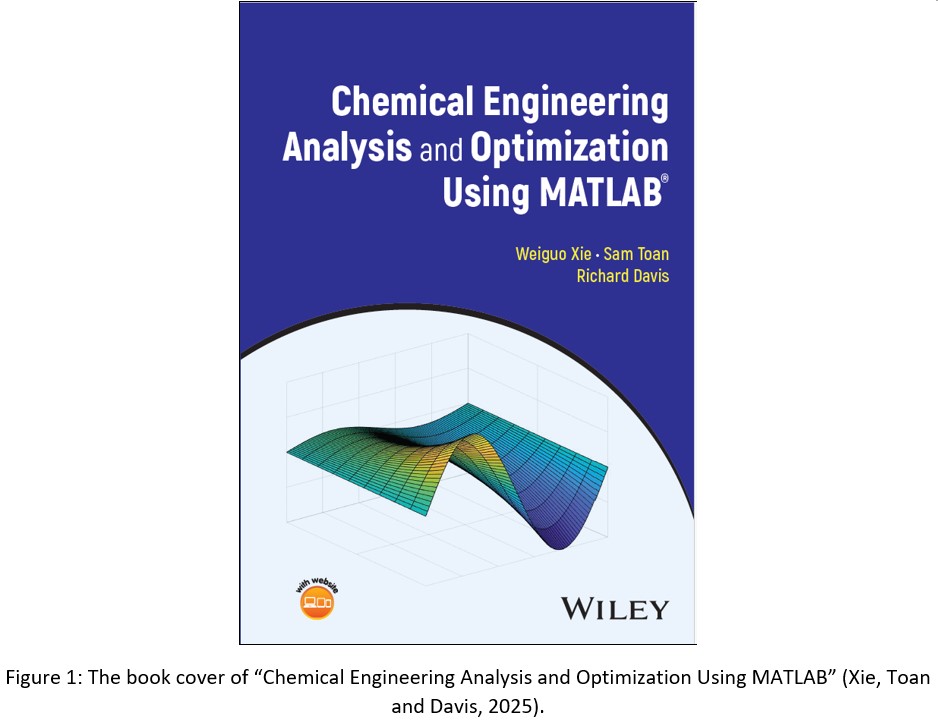
The book cover of our newly published book by Wiley, “Chemical Engineering Analysis and Optimization Using MATLAB,” is shown in Figure 1 (Xie, Toan, and Davis, 2025). It is the primary textbook for our CHE5031/CHE4031 courses to teach Chemical Engineering Analysis and Optimization. The book is organized into three major sections: the first is a review section, which includes two chapters introducing modeling in chemical engineering processes and some key MATLAB commands, functions, and toolboxes. The second section has six chapters introducing advanced algorithms and computational methods with case studies in Chemical Engineering. The third section has two chapters that integrate some algorithms and methods to tackle more complicated case studies in chemical engineering. There are several Chemical Engineering related examples in each chapter at the undergraduate and graduate levels.
Our teaching philosophy is to help students build their confidence and acquire practical knowledge, understanding, and skills, which are key to their future career success. With over 20 years of computer-aided design experience and three books (Davis, 2021; Toan, Adidharma, and Nojabaei, 2017; Xie, Toan, and Davis, 2025), we know how students get stuck in the coding hurdles and become frustrated. We also realize that some advanced computational methods can upgrade their computational skills and bring satisfaction to their work. Our course bridges the skills gap for our students, especially enabling them to use the data analysis techniques, skills, and modern engineering tools necessary for engineering practice. Significantly, this course builds their analytical skills within the framework of systematic optimization applied to chemical engineering analysis.
References:
Davis, R.A. (2021) Practical Numerical Methods for Chemical Engineers: Using Excel with VBA, 5th Edition. ISBN: 978-1694584687.
Toan, S., Adidharma, H. Nojabaei, B. (2017) Introduction to MATLAB for Chemical & Petroleum Engineering 2nd Edition. ISBN: 978-1548004873.
Xie, W. Davis, R.A., (2022) Chemical Engineering Analysis through Systematic Optimization. Chemical Engineering Education, 56 (4):1-7.
Xie, W., Toan, S., and Davis, R. (2025) Chemical Engineering Analysis and Optimization Using MATLAB. ISBN: 9781394205363.