2025 AIChE Annual Meeting
(395i) Reimagining Unit Operations Labs: Nyu's Multi-Tiered Experiential Learning Platform
Authors
Xin (Matt) Wang - Presenter, College of Urban Construction and Safety Engineering,Nanjing University of Technology
Matt Chaves - Presenter, New York University
Dania Muhieddine Orfali, New York University
Haoxian Zheng, New York University
Paul Calderon, New York University
Yuxiang Gao, New York University
Unit Operations laboratories serve as fundamental components of chemical engineering education, traditionally providing hands-on training for undergraduates. At New York University, we have transformed this conventional framework into a comprehensive multi-tiered experiential learning platform that serves students across academic levels and disciplines while optimizing educational resources. While traditional labs face challenges including resource limitations, faculty time constraints, and equipment underutilization, NYU's innovative approach reimagines the Unit Operations laboratory as an integrated educational ecosystem addressing multiple pedagogical objectives simultaneously. Our approach restructures the laboratory into a hierarchical framework where PhD students develop new experiments based on their research expertise, gaining curriculum design experience under faculty mentorship—a crucial skill for academic careers rarely provided by traditional teaching assistantships. Master's students then validate these protocols, identifying implementation challenges while gaining industry-relevant experience. Undergraduates from chemical engineering and other disciplines (computer science, robotics, mechanical engineering) participate through summer research and capstone projects, contributing specialized knowledge while gaining interdisciplinary exposure. This restructured approach has yielded significant outcomes: development of experimental modules in protein engineering and bioreactor operations, creation of temperature control systems through interdisciplinary collaboration, development of simulation applications, increased laboratory utilization, enhanced PhD preparation for teaching careers, more relevant practical experience for master's students, and expanded interdisciplinary opportunities for undergraduates. Our transformed Unit Operations laboratory has evolved into one of NYU's premier experiential learning centers, leveraging student strengths at different academic levels, optimizing university resources, and providing targeted skills development aligned with diverse career trajectories. This model addresses critical challenges in engineering education and can be adapted by other institutions seeking to maximize educational impact while providing specialized training across the academic spectrum.
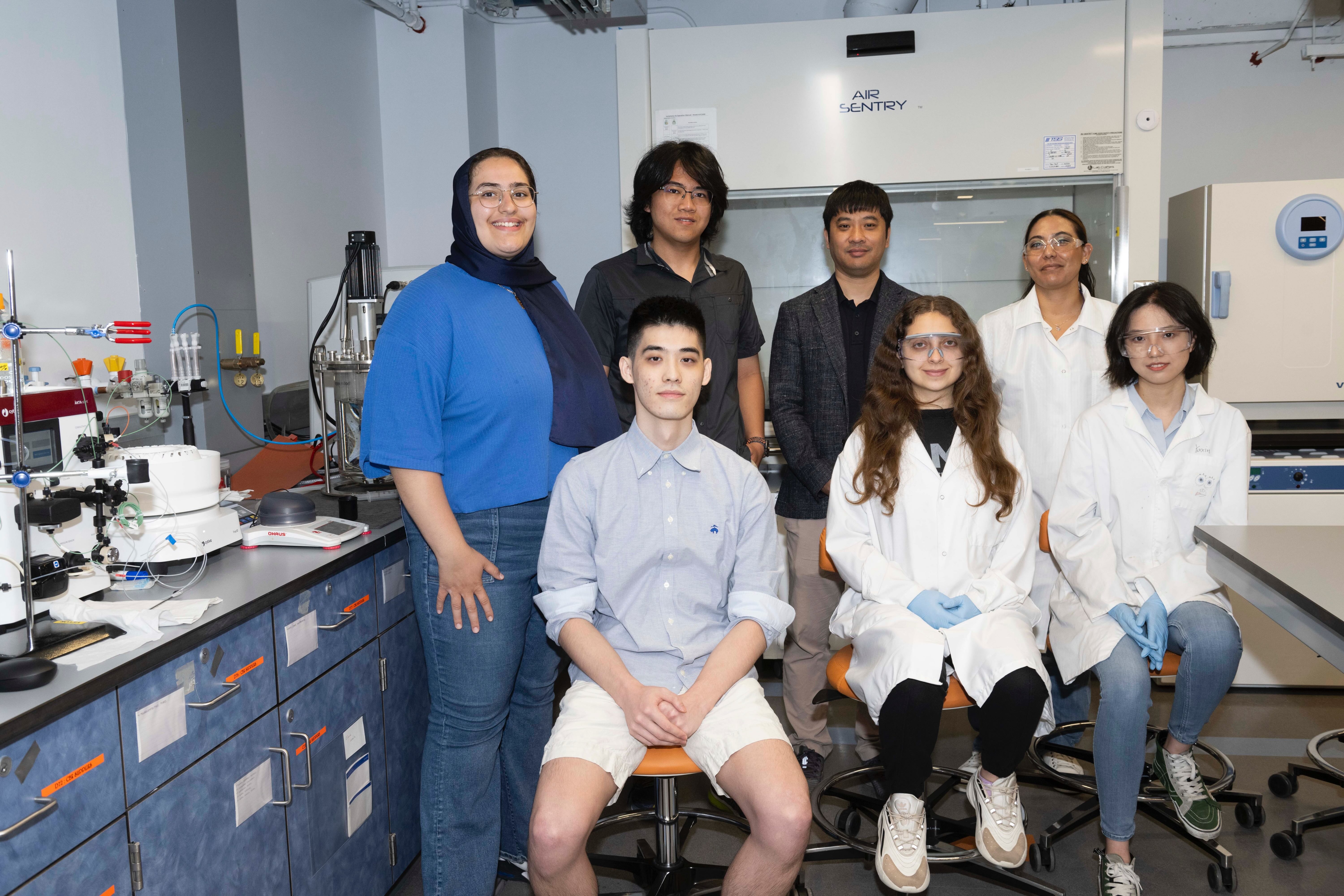
The attached image shows Prof. Wang’s Team, Summer 2024. Back row (L–R): Angie (ME sophomore), Terry (CS junior), Prof. Xin Wang, Jessica (Unit Ops Lab Manager). Front row (L–R): Lucas (ME junior), Dania (1st-year PhD, CBE), Yaxin (3rd-year PhD, CBE).