2025 AIChE Annual Meeting
(103a) A Practical Method for Simultaneously Monitoring Siloxanes and Condensable Sulfur in Biogas to Improve Process Reliability
Authors
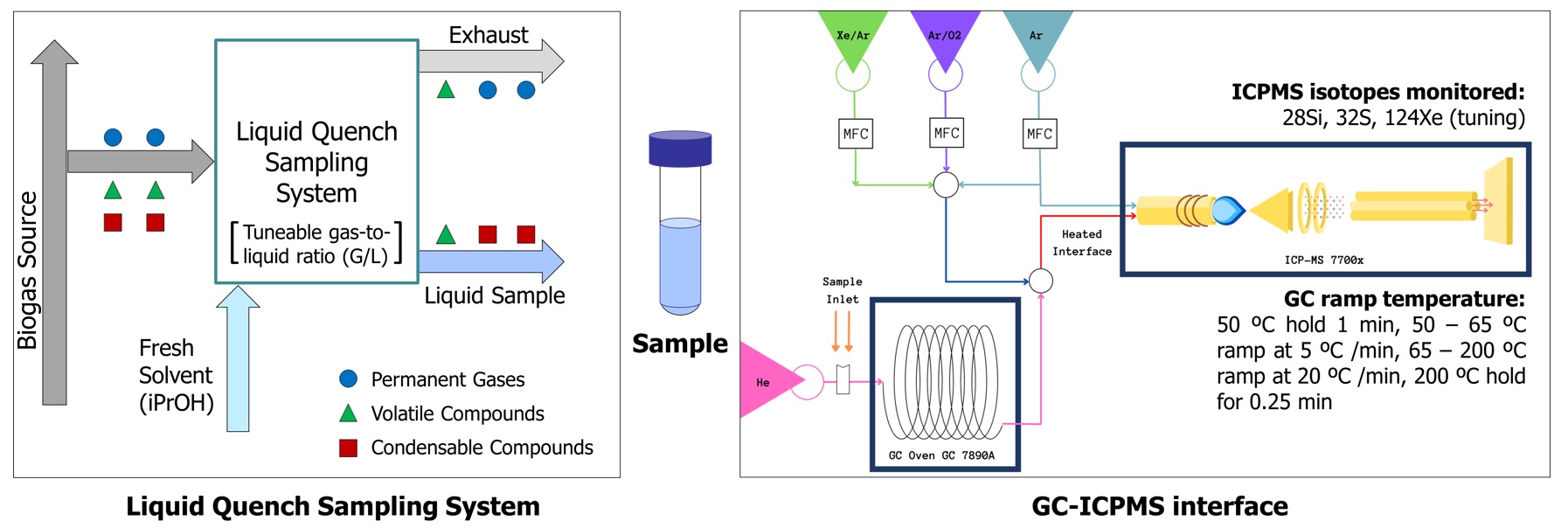
This study addresses these challenges by introducing an accessible method for the simultaneous quantification of siloxanes and condensable sulfur compounds in biogas, using gas chromatography - inductively coupled plasma mass spectrometry (GC-ICP-MS) combined with a liquid quench (LQ) sampling system. Unlike traditional setups that rely on separate workflows, this approach enables simultaneous quantification of siloxanes and condensable sulfur compounds in a single measurement. The LQ preconcentrates analytes over a wide gas-to-liquid (G/L) ratio, accommodating variable feedstocks such as wood gasifiers, wastewater treatment plants, and anaerobic digesters. Extended stability tests confirm that the captured analytes can be stored for up to four weeks, enabling remote sample collection and subsequent centralized laboratory analysis. Furthermore, it helps operators detect early breakthrough in adsorption units and reduces errors commonly associated with gaseous calibration standards.
By offering an accurate and precise overview of biogas composition, the new technique supports better infrastructure protection, helps mitigate poisoning of downstream processes like methanation unit or combined heat and power generation, and streamlines compliance with EN16723 standards. Its adaptability allows insight into seasonal or feedstock-driven fluctuations, and its modest infrastructure requirements make it especially suitable for small- to medium-scale producers. Although the method is limited to the compounds for which it has been calibrated, its combined simplicity, accuracy, and versatility far outweigh this drawback. Overall, this LQ-GC-ICP-MS approach significantly advances routine biogas monitoring, reinforcing the long-term protection of biogas infrastructure and aiding the sustainable growth of biomethane as a reliable component of the renewable energy portfolio.