2025 AIChE Annual Meeting
(438c) Optimizing PLGA Nanoparticle Synthesis in an Ultrasonic Microreactor: A Design of Experiments and Machine Learning Joint Approach
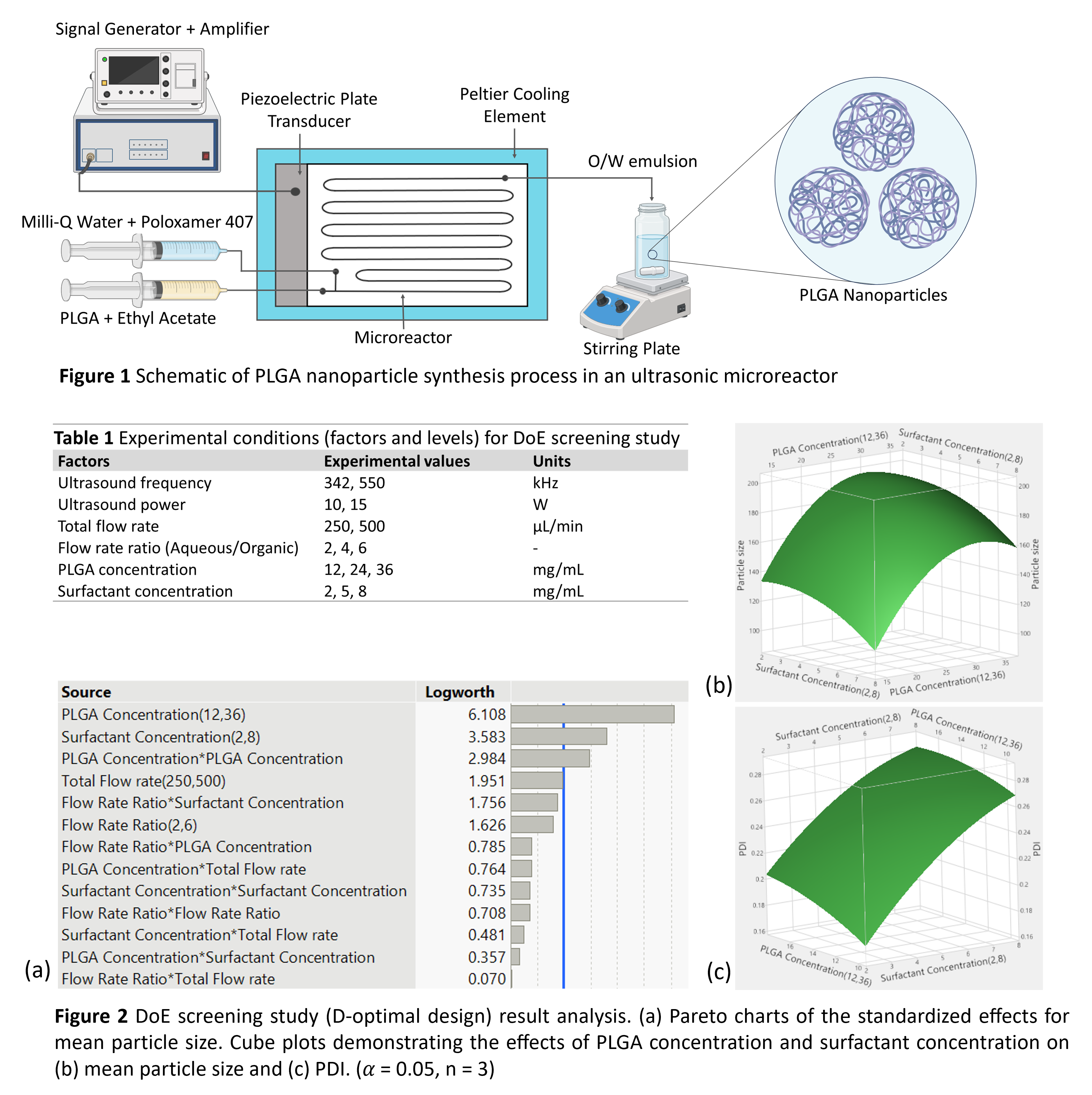
The ultrasonic microreactor set-up consists of a borosilicate glass microreactor (microchannel cross-section 1.2 ×1.2 mm2, length 700 mm, reactor volume 1 ml), a piezoelectric plate transducer glued to its bottom, and a Peltier cooling element (Figure 1). PLGA nanoparticles are prepared by the oil-in-water (O/W) emulsification-solvent evaporation method. The aqueous phase (Milli-Q water + Poloxamer 407) and the organic phase (PLGA + ethyl acetate) are supplied to the reactor at controlled flow rates. Ultrasound is activated by connecting the transducer to a signal generator, which is further linked to a power amplifier, generating a sinusoidal wave of the desired frequency and input load power. The particle size of the PLGA nanoparticles is analyzed by dynamic light scattering (DLS).
Design of Experiments (DoE) is employed to systematically screen and optimize key process parameters. Based on our previous work [6], 6 factors are selected: ultrasound frequency, ultrasound power, total flow rate, flow rate ratio, PLGA concentration in the organic phase, and surfactant (Poloxamer 407) concentration in the aqueous phase, each with 2-3 levels (Table 1). Experimental design and data analysis are conducted using JMP software. First, a screening study is conducted to identify the most influential parameters affecting particle size and polydispersity index (PDI). A D-optimal design is chosen, comprising 30 experimental runs, each replicated three times, to evaluate the impact and interactions of these factors (Figure 2). Mean particle sizes ranged from 64 ± 1 to 230 ± 30 nm, whereas PdI lowest and highest values were 0.10 ± 0.03 and 0.31 ± 0.05, respectively. Based on the screening results, a Composite Cubic Design (CCD) will refine the optimal conditions, followed by response surface analysis to identify the ideal parameters for synthesizing PLGA nanoparticles with a minimal size, ideally below 50 nm.
Finally, an artificial neural network (ANN) model will be developed using the generated DoE dataset to predict particle size and PDI. The neural network consists of three layers: an input layer with key factors, hidden layers with neurons linking input to output, and an output layer with two responses: mean particle size and PDI of PLGA nanoparticles. This model will enable the selection of optimal synthesis conditions without the need for extensive experimentation, providing a streamlined approach to achieving target particle sizes tailored for specific biomedical applications. By integrating DoE, machine learning, and ultrasonic microreactor technology, this work contributes a scalable and efficient platform for tailoring PLGA nanoparticle synthesis—bringing PLGA-based nanomedicine one step closer to clinical translation.
References:
[1] N.C. Brigham, R.R. Ji, M.L. Becker, Degradable polymeric vehicles for postoperative pain management, Nat Commun 12 (2021) 1367. https://doi.org/10.1038/s41467-021-21438-3.
[2] T.L. Doane, C. Burda, The unique role of nanoparticles in nanomedicine: imaging, drug delivery and therapy, Chem Soc Rev 41 (2012) 2885. https://doi.org/10.1039/c2cs15260f.
[3] N. Desai, Challenges in development of nanoparticle-based therapeutics, AAPS Journal 14 (2012) 282–295. https://doi.org/10.1208/s12248-012-9339-4.
[4] J.M. Metselaar, T. Lammers, Challenges in nanomedicine clinical translation, Drug Deliv Transl Res 10 (2020) 721–725. https://doi.org/10.1007/s13346-020-00740-5.
[5] H.W. Chan, S. Chow, X. Zhang, P.C.L. Kwok, S.F. Chow, Role of Particle Size in Translational Research of Nanomedicines for Successful Drug Delivery: Discrepancies and Inadequacies, J Pharm Sci 112 (2023) 2371–2384. https://doi.org/10.1016/J.XPHS.2023.07.002.
[6] A.P. Udepurkar, L. Mampaey, C. Clasen, V. Sebastián Cabeza, S. Kuhn, Microfluidic synthesis of PLGA nanoparticles enabled by an ultrasonic microreactor, React Chem Eng 9 (2024) 2208-2217. https://doi.org/10.1039/d4re00107a.