2025 AIChE Annual Meeting
(286h) New Design Rules for Gas Adsorption Applications of Stable Metal-Organic Frameworks
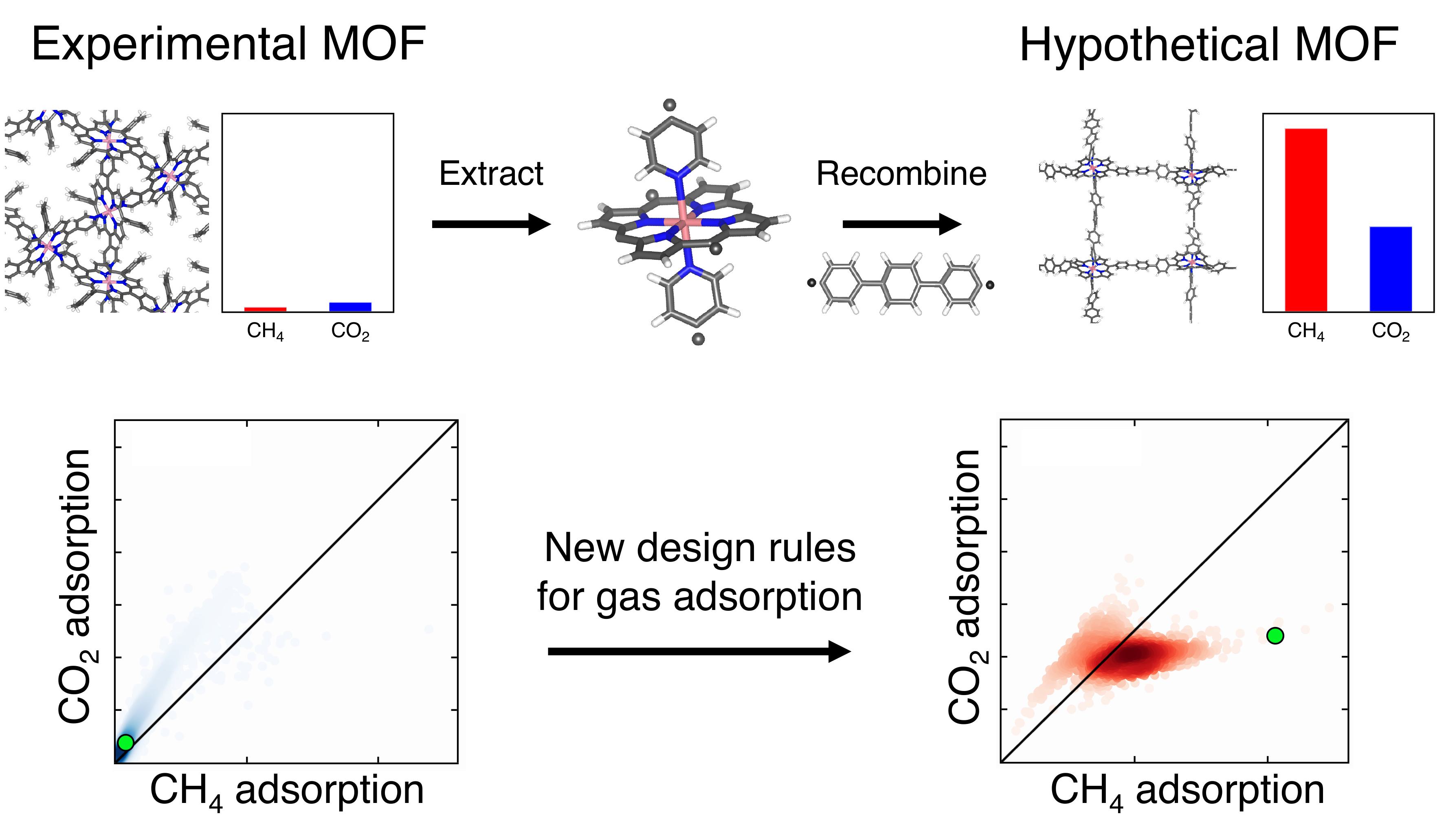
Using Grand Canonical Monte Carlo (GCMC) simulations, we evaluated CO2 and CH4 adsorption properties under practical working conditions for these mechanically stable hypothetical MOFs and compared them to those of experimentally synthesized structures in the CoRE MOF 2019 database. We found unexpected gas adsorption trends in the USMOF DB, including a preference for CH₄ over CO₂ in certain MOFs. The disparity in the distribution of adsorption properties between the experimental and hypothetical databases suggests a knowledge gap in the chemical principles governing gas uptake in hypothetical MOFs.
To further understand these trends, we trained and tested interpretable machine learning (ML) models to predict adsorption properties and evaluate the relative importance of key structural or chemical features. Our analysis revealed that specific metal nodes with open metal sites were found to show high CO2 affinity. Leveraging insights from the ML models, we propose design principles based on geometric features and node chemistry to fine-tune MOFs in the USMOF DB for either high or low CO₂-to-CH₄ working capacity. Furthermore, we aim to apply a non-dominated sorting genetic algorithm (NSGA) to identify MOFs that not only exhibit superior gas adsorption properties, but also maintain high stabilities.