2025 AIChE Annual Meeting
(327c) Multi-Objective Bilevel Optimization of Low-Carbon Cement Industries with Integrated Energy Systems
Authors
However, no previous research has explored the bilevel optimization between hydrogen-integrated energy systems and cement industry, particularly under policy-driven constraints such as ladder-type carbon tax price and TOU electricity price. Furthermore, existing literature mainly focuses individually on CO2 treatment methods with the optimal CO2 allocation between the alternative carbon utilisation methods to achieve environmental and economic trade-offs being unexplored [7]. To address these challenges, this study develops a novel bilevel optimization model, with government and integrated energy systems (IES) being the leader and cement plant as the follower [8]. By scheduling and optimizing the intraday electricity power mix and the allocation ratio between CO2 two treatment methods, this model can reduce CO2 emissions of the cement plant while promoting green hydrogen utilization. Moreover, fluctuation issues of cement production conditions, such as different chemical components of raw materials and fuels, are taken explicitly into account. Additionally, our work explores for the first time, the influence of the benchmark price of carbon tax and TOU electricity pricing. The bilevel model is transformed into a single-level model using the Karush-Kuhn-Tucker (KKT) conditions and is solved to global optimality using the state-of-the-art BARON solver [9].
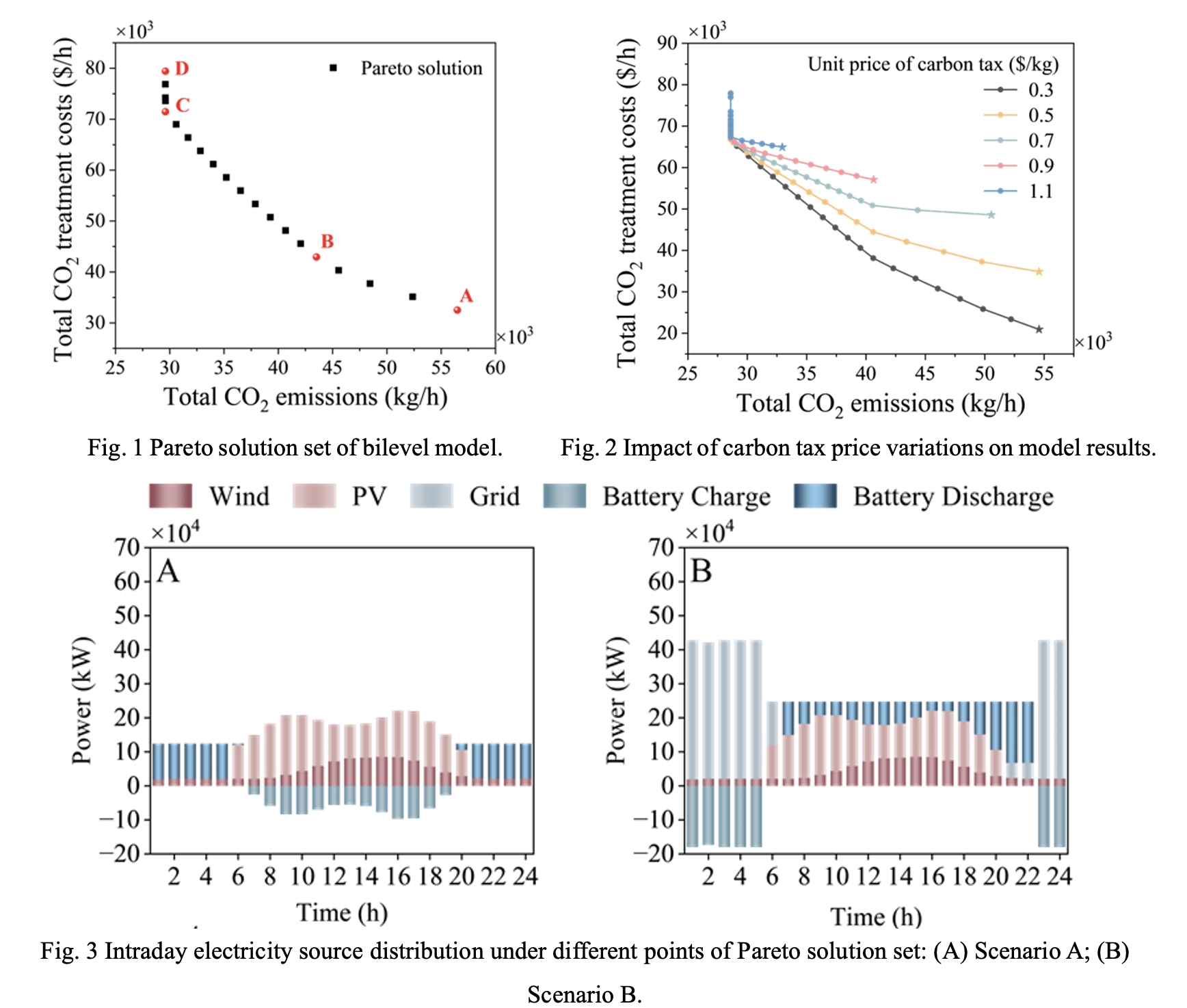
We showcase the benefits and impact of our proposed modelling framework on case study that compared to a standalone cement model, reduces CO2 emissions by 11,426 kg/h and lowers the combined carbon tax and electricity costs by $28,038/h. The Pareto frontier of multi-objective optimization model is shown in Fig. 1, illustrating that as total CO2 emissions decrease, the total CO2treatment costs tend to increase, indicating a trade-off between environmental sustainability and economic efficiency. Fig. 3. shows the optimization results of intraday power mix under points A and B from Fig. 1. Additionally, Fig. 2 reveals through sensitivity analysis that as the benchmark carbon tax price increase, reducing the same amount of CO2 requires higher costs, and the maximum CO2 emissions also vary. This is due to the trade-off between carbon tax prices and electricity costs, which alters the allocation between the two CO2 treatment methods. These insights provide a foundation for development between the cement industry and IES, providing optimal emission reduction strategies for the enterprise to design and operate the cement process, and for the government to make carbon tax and electricity pricing policies to achieve energy efficiency and emission reduction goals.
References
[1] Davis SJ, Lewis NS, Shaner M, Aggarwal S, Arent D, Azevedo IL, et al. Net-zero emissions energy systems. Science. 2018; 360: eaas9793.
[2] Cheng D, Reiner DM, Yang F, Cui C, Meng J, Shan Y, et al. Projecting future carbon emissions from cement production in developing countries. Nature Communications. 2023; 14:8213.
[3] Watari T, Cabrera Serrenho A, Gast L, Cullen J, Allwood J. Feasible supply of steel and cement within a carbon budget is likely to fall short of expected global demand. Nature Communications. 2023; 14:7895.
[4] Hao Z, Barecka MH, Lapkin AA. Accelerating net zero from the perspective of optimizing a carbon capture and utilization system. Energy & Environmental Science. 2022; 15:2139-53.
[5] Brandt J, Iversen T, Eckert C, Peterssen F, Bensmann B, Bensmann A, et al. Cost and competitiveness of green hydrogen and the effects of the European Union regulatory framework. Nature Energy. 2024; 9:703-13.
[6] Al-Ghussain L, Ahmad AD, Abubaker AM, Hassan MA. Exploring the feasibility of green hydrogen production using excess energy from a country-scale 100% solar-wind renewable energy system. International Journal of Hydrogen Energy. 2022; 47:21613-33.
[7] Martelli E, Freschini M, Zatti M. Optimization of renewable energy subsidy and carbon tax for multi energy systems using bilevel programming. Applied Energy. 2020; 267:115089.
[8] Nikkhah, H., Aghayev, Z., Shahbazi, A., Charitopoulos, V. M., Avraamidou, S., & Beykal, B. (2025). Bi-level data-driven enterprise-wide optimization with mixed-integer nonlinear scheduling problems. Digital Chemical Engineering, 100218.
[9] Nohra, C. J., A. U. Raghunathan and N. V. Sahinidis, Spectral relaxations and branching strategies for global optimization of mixed-integer quadratic programs, SIAM Journal on Optimization, 31, 142-171, 2021.
Acknowledgments
This work was supported by National Key Research & Development Program - Intergovernmental International Science and Technology Innovation Cooperation Project (2021YFE0112800). VC gratefully acknowledges EPSRC funding under the grants EP/T022930/1, EP/W003317/1 & EP/V051008/1.