2025 AIChE Annual Meeting
(31e) A Look at Chemicals Manufacturing through the Lens of Chemical Complexity: Thermochemistry May Play an Important Role in the Decarbonization of Simple Chemicals
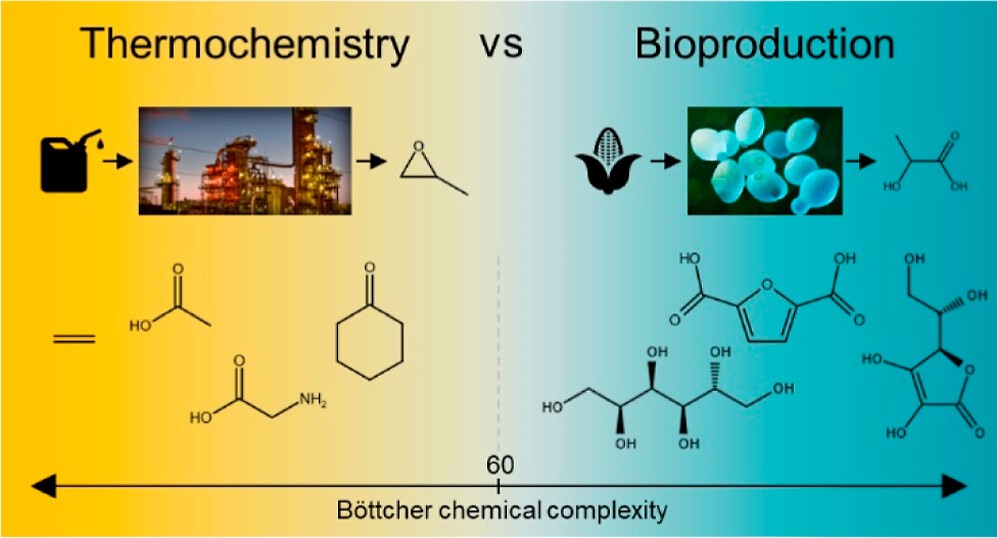
How should we innovate to decarbonize the organic chemical industry, including our polymer precursors? I’ll discuss two potential paradigms, one driven by renewable energy converting CO₂ and H₂O into organic chemicals, the other leveraging plant-derived compounds for bioproduction. Which of these will prevail? This talk will discuss the techno-economic tradeoffs between these approaches through the lens of molecular complexity.
Analyzing the prices and production methods of the top ~50 chemicals using the Böttcher number, a quantitative metric for structural complexity, reveals a key threshold at ~60. Below this complexity, thermochemical synthesis is more favorable, with an average cost of $170/(t·step) and a complexity increase of 6.4 per step. Beyond this point, bioproduction offers advantages, achieving larger complexity shifts in fewer steps. This finding suggests that for the simple chemicals that account for the majority of chemical-sector emissions, near-term decarbonization efforts should prioritize the thermochemical upgrading of simple feedstocks. Exceptions to the trends could prove to be interesting targets for innovation.