2025 AIChE Annual Meeting
(209b) Integrating Simulation and Software Development in the Unit Operations Laboratory Course for Control Experiments
Authors
Through collaborative usability testing, students evaluate their applications' functionality, interface design, and effectiveness within realistic operational contexts. This methodology enhances their technical understanding while introducing them to important UI/UX design principles, potentially expanding their career opportunities beyond traditional chemical engineering pathways.
A carefully structured project manual provides students with the fundamental software architecture while identifying specific components for student development, striking an optimal balance between guidance and independent discovery. This thoughtful instructional design enables chemical engineering students to master essential software development skills within a one-week timeframe, creating an ideal equilibrium between engagement and achievable challenge appropriate for their background.
The implementation of MATLAB and Simulink provides students with accessible tools and resources to develop foundational software design competencies within the time constraints of the course. Student engagement is notably enhanced as they continuously validate simulation results against their experimental data, reinforcing control theory concepts and revealing insights that might be missed in conventional laboratory exercises.
This approach effectively builds upon programming skills introduced in earlier curriculum components (CBE computation course), while incorporating data science training and numerical methods. The integration of these interdisciplinary elements represents a contribution to chemical engineering education methodologies.
Assessment of learning outcomes indicates that students completing this course demonstrate increased preparedness for positions in both control engineering and software development, with graduates reporting positive feedback during job interviews. The educational value of this approach has been recognized through its publication as a MathWorks case study.
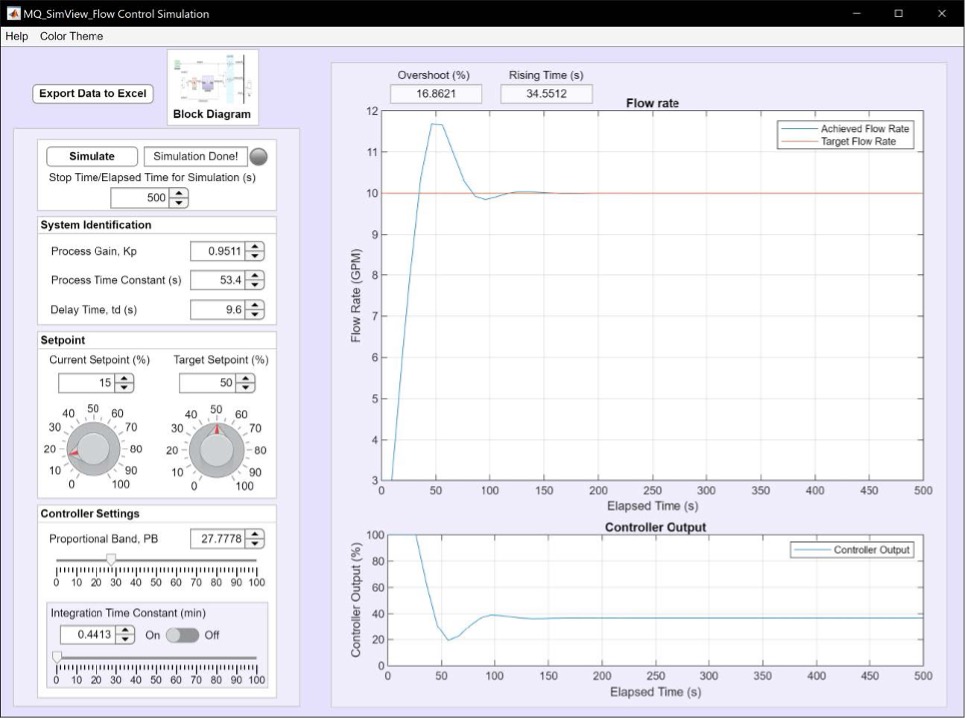
The attached image was one user interface displaying the response of the controlled system by PID control created by one of our students in spring of 2022.