2025 AIChE Annual Meeting
(327d) Integrated Hydrogen Production Utilizing LNG Regasification Cold Energy: Comparative Analysis of System Configurations
Electrolytic hydrogen production is gaining global traction as a sustainable and carbon-neutral alternative to fossil-based hydrogen derived from natural gas reforming or coal gasification. It is particularly favored when powered by renewable energy sources, aligning with the international shift toward green energy. However, the high electricity consumption associated with water electrolysis remains a major barrier to its large-scale deployment and cost competitiveness. Moreover, in many regions, access to abundant and stable renewable energy is still limited, resulting in variable hydrogen production costs and carbon footprints. Therefore, integrating locally available, waste energy streams—such as LNG cold energy—with electrolysis systems offers a promising pathway to improving energy efficiency, reducing operational expenditures (OPEX), and potentially lowering greenhouse gas (GHG) emissions associated with hydrogen production.
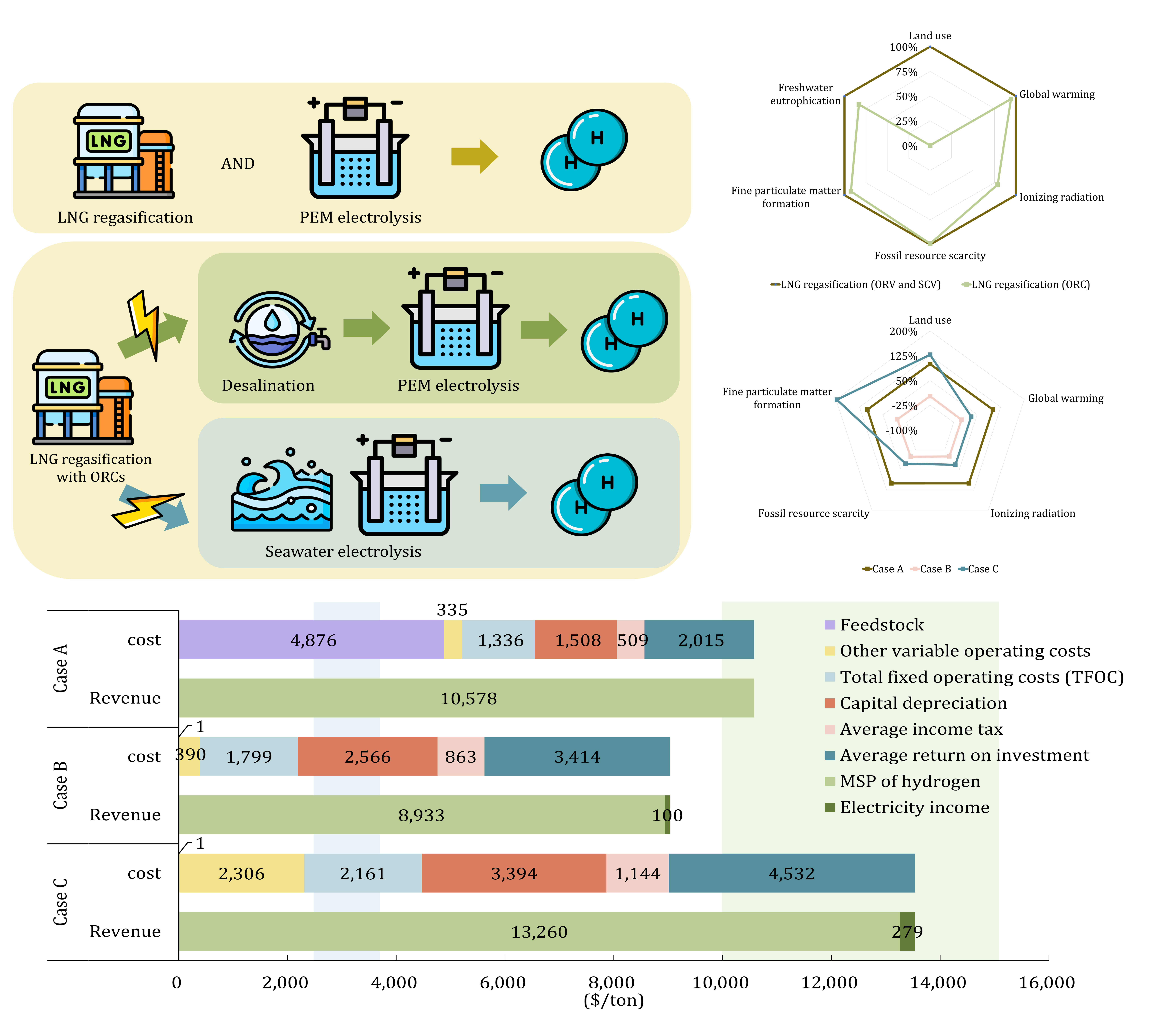
To evaluate this integration, three process configurations were developed based on the operational scale of the Tongyeong LNG terminal in South Korea, with each scenario designed to produce 28 tons of hydrogen per day. These configurations were deliberately selected to reflect increasing degrees of system integration and technological advancement, offering a comparative analysis across current and future-leaning technology pathways. Case A serves as the conventional reference configuration. In this scenario, LNG regasification is conducted using Open Rack Vaporizers (ORV) and Submerged Combustion Vaporizers (SCV), both of which are physically and operationally independent from the hydrogen production system. The hydrogen is produced using a polymer electrolyte membrane (PEM) electrolyzer, with all electrical energy required for electrolysis sourced externally from the grid. This configuration benefits from mature and well-established technologies that are readily deployable in most industrial contexts; however, it lacks any form of energy recovery or internal integration, resulting in significant operating costs and elevated environmental impacts, particularly when grid electricity is derived from fossil fuels. In addition, the system is less resilient to electricity price fluctuations and grid stability issues. Case B introduces an intermediate level of integration through the incorporation of an Organic Rankine Cycle (ORC). The ORC system captures the cold energy released during LNG regasification and utilizes it to generate electricity onsite through thermodynamic conversion. ORC technology is well-suited for low-grade thermal sources and operates by vaporizing an organic working fluid with a low boiling point, which drives a turbine connected to an electric generator. The choice of working fluid is based on criteria such as thermodynamic efficiency, environmental safety (e.g., GWP and ODP), chemical stability, and compatibility with system materials. In this configuration, the electricity produced by the ORC is used to supply power to both a seawater desalination unit and the PEM electrolyzer, enabling partial energy self-sufficiency. The integration allows for synergistic energy utilization between the regasification and hydrogen production subsystems, improving overall system performance and sustainability. Case C represents a more advanced yet less technologically mature configuration. It eliminates the desalination step entirely and instead employs Seawater Direct Electrolysis (SWDE), which enables the direct electrolysis of untreated seawater. This approach simplifies the system architecture by reducing the number of components, as it no longer requires water purification or pretreatment stages. It also reduces water-related energy and equipment requirements, offering potential benefits in compactness, modularity, and ease of deployment, particularly in remote or resource-constrained regions. However, SWDE remains at a low technology readiness level and faces several challenges, such as cell degradation due to chloride corrosion, membrane fouling, low current efficiency, and the high cost of corrosion-resistant materials. These limitations introduce technical risk and drive up capital expenditures (CAPEX), making it less competitive under current technology and market conditions.
All three system configurations were simulated using Aspen Plus V14, a widely used process modeling and simulation platform in the chemical and energy industries. The simulations yielded detailed mass and energy balances for each process, forming the basis for techno-economic analysis. Capital expenditures (CAPEX), operating expenditures (OPEX), and the minimum selling price (MSP) of hydrogen were calculated for each scenario using consistent financial assumptions. The MSP values were then benchmarked against conventional green hydrogen production (renewable-powered electrolysis) and blue hydrogen production (methane reforming with carbon capture) to assess economic competitiveness and feasibility.
The results of the economic analysis revealed that Case A had the highest MSP, at 10.58 USD/kg H₂, primarily due to its complete reliance on external electricity and the associated high OPEX. In contrast, Case B achieved the lowest MSP, 8.93 USD/kg H₂, by leveraging ORC-generated electricity to offset a portion of external power requirements, even when accounting for the additional energy required by the desalination process. Case C, despite its simplified design, exhibited the highest MSP at 13.54 USD/kg H₂. This outcome was largely attributable to the high capital cost and limited performance of SWDE technology. These findings underscore the importance of balancing system integration with technological maturity and cost structures. A sensitivity analysis was conducted to examine the impact of variations in key system parameters—such as electrolyzer efficiency, ORC power output, CAPEX uncertainty, and working fluid properties—on the MSP. The analysis demonstrated that Case C is the most sensitive to fluctuations in technical performance, indicating a higher financial risk profile. Conversely, Case B showed robust economic performance across a wide range of assumptions, reinforcing its attractiveness as a practical and near-term solution.
In parallel, environmental performance was evaluated using a Life Cycle Assessment (LCA) in accordance with ISO 14040/44 standards. The LCA adopted a gate-to-gate boundary and accounted for both upstream and operational emissions, including those from equipment manufacturing, electricity generation, and system operation. Two comparative analyses were performed: one assessing the impact of LNG regasification with and without ORC integration, and another comparing the full-system environmental profiles of the three hydrogen production cases. The results clearly showed that ORC integration substantially reduced greenhouse gas emissions by displacing grid-supplied electricity, which is often carbon-intensive. Among the three scenarios, Case B exhibited the lowest global warming potential (GWP), primarily due to its efficient energy use, internal power generation, and reliance on proven technologies. Case A showed moderate emissions due to external electricity dependency, while Case C—although conceptually appealing—had the highest GWP owing to the material intensity and lower efficiency of SWDE components.
In conclusion, this study presents a compelling case for the integration of LNG cold energy recovery with hydrogen production systems. The findings demonstrate that such integration can significantly improve economic and environmental performance, especially when coupled with mature and commercially available technologies such as ORC and PEM electrolysis. Case B emerges as the most balanced and immediately implementable configuration, offering tangible benefits in cost, emissions reduction, and system resilience. Although Case C requires further technological advancement to become viable, it holds promise for future applications that prioritize system simplification and water resource flexibility. Ultimately, the proposed integration strategies contribute to ongoing global efforts to establish efficient, low-carbon hydrogen supply chains, and they highlight the value of repurposing cryogenic energy resources that would otherwise remain unused at LNG import terminals.