2025 AIChE Annual Meeting
(653a) Hyperspectral Reporters for Long-Distance and Wide-Area Detection of Gene Expression in Metabolically Engineered Bacteria
Authors
Itai Levin, Massachusetts Institute of Technology
Christopher A. Voigt, Massachusetts Institute of Technology
Connor Coley, MIT
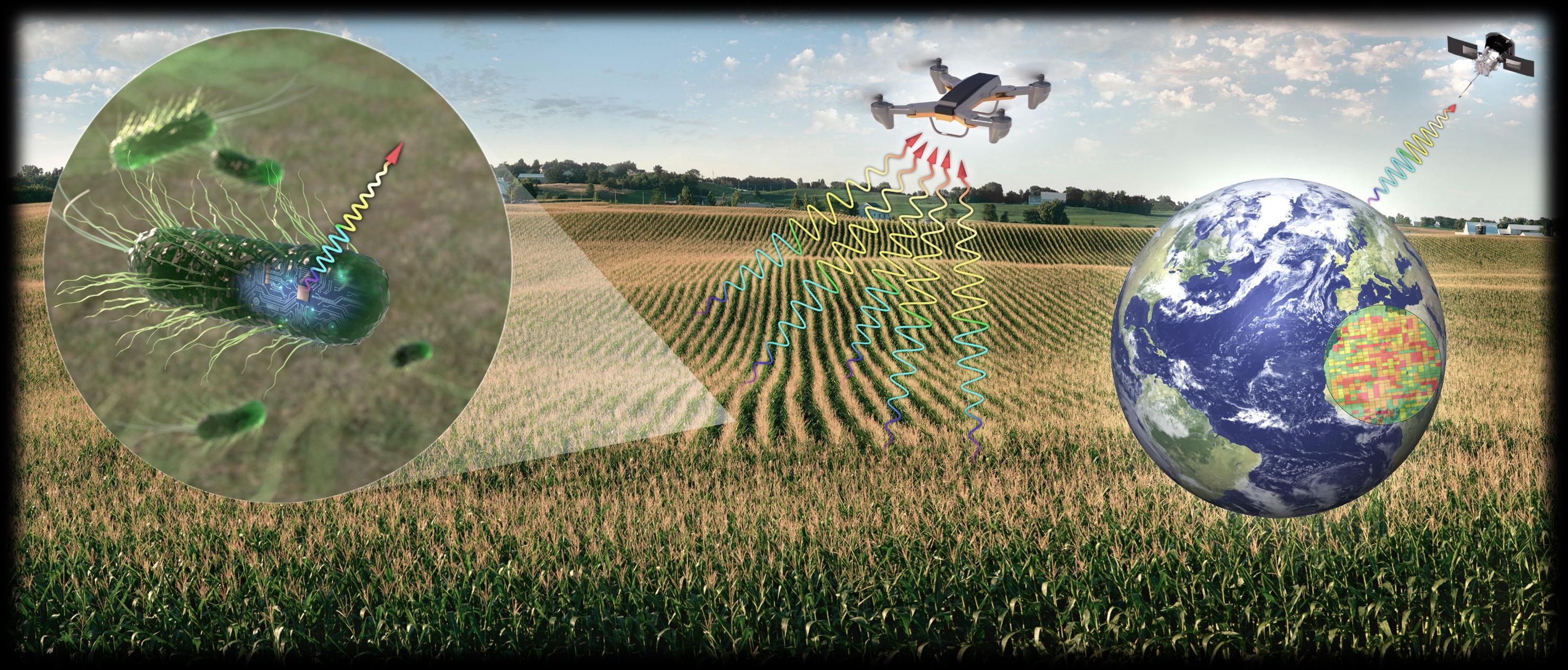
Genetically encoded reporters are suitable for short-distance imaging in the laboratory but not for scanning wide outdoor areas from a distance. We introduce hyperspectral reporters (HSRs) designed for hyperspectral imaging cameras that are commonly mounted on unmanned aerial vehicles and satellites. HSR genes encode enzymes that produce a molecule with a unique absorption signature that can be reliably distinguished in hyperspectral images. Quantum mechanical simulations of 20,170 metabolites identified candidate HSRs, leading to the selection of biliverdin IXα and bacteriochlorophyll a for their distinct absorption spectra and biosynthetic feasibility. These genes were integrated into chemical sensor circuits in soil (Pseudomonas putida) and aquatic (Rubrivivax gelatinosus) bacteria. The bacteria were detectable outdoors under ambient light from up to 90 m in a single 4,000-m2 hyperspectral image taken using fixed and unmanned aerial vehicle-mounted cameras. The dose–response functions of the chemical sensors were measured remotely. HSRs enable large-scale studies and applications in ecology, agriculture, environmental monitoring, forensics and defense. This talk will be based on the published paper introducing this technology (Chemla and Levin et al., Nature Biotechnology, 2025), but will also include exciting unpublished results using this and other tools to track the environmental release of genetically engineered bacteria for biosensing and bioremediation applications through time and from space.