2025 AIChE Annual Meeting
(629b) Granular Double Networks As a Material Platform for Mechanically Tough and Permselective Olefin-Paraffin Separation Membranes
Authors
Gabriel Sanoja - Presenter, Univeristy of California-Berkeley
Tiffany Jeng, The University of Texas at Austin
Aaliyah Dookhith, The University of Texas at Austin
Justin J. Rosenthal, The University of Texas at Austin
Joan F. Brennecke, The University of Texas At Austin
Benny D. Freeman, University of Texas at Austin
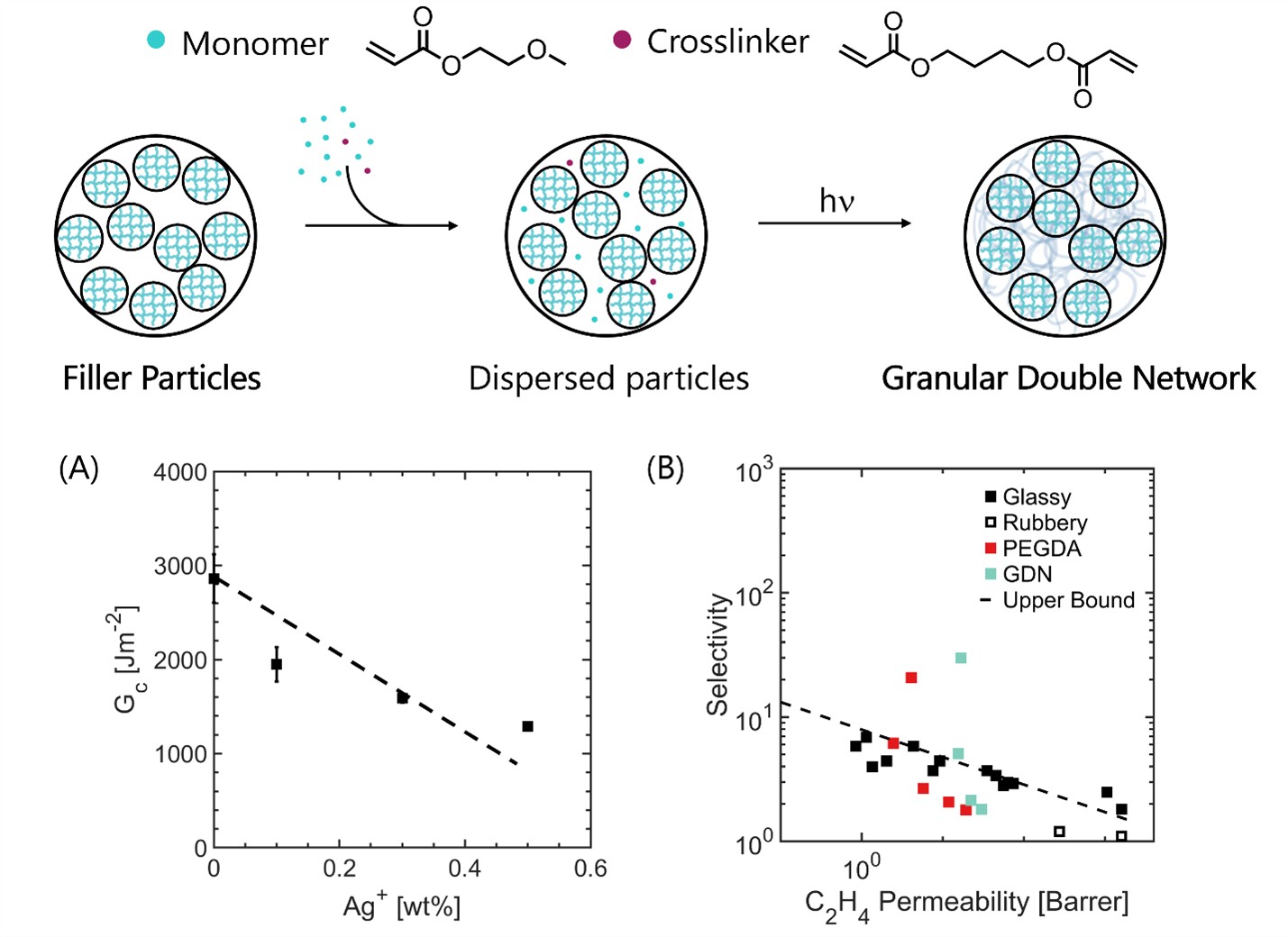
Olefins are vital chemical feedstocks, but their separation from paraffins requires cryogenic distillation, a process responsible for 0.3% of global CO₂ emissions. Membrane-based separations offer a more energy-efficient alternative because they operate at low temperatures and do not require phase changes. However, state-of-the-art membranes often face a trade-off between mechanical strength and ethylene permeability and selectivity, even when equilibrated with olefin carriers such as silver(I) salts. For example, PEGDA networks are selective but brittle, while PEBAX copolymers are tough but relatively impermeable.
This work introduces granular double-networks as a material platform to design mechanically tough and olefin-permselective membranes. These membranes integrate mechanically distinct but chemically similar phases composed of 2-methoxyethyl acrylate, 1,4-butanediol diacrylate, and silver bis(trifluoromethanesulfonyl)imide salt. They are ~150 µm thick, exhibit a Young's modulus of 0.3 MPa, a fracture toughness above 1000 J/m², and olefin/paraffin separation performance that exceeds the upper bound at silver(I) loadings above 30 wt%. Overall, these results unveil a molecular design for olefin/paraffin separation membranes that combines good mechanical properties with excellent separation properties.