2025 AIChE Annual Meeting
(191ai) Evaluation of Antihypertensive and Antidiabetic Potential of Bioactive Peptides from White, Red, and Black Quinoa
Authors
Another approach to understand CDs involves targeting key metabolic pathways, particularly through the inhibition of angiotensin-converting enzyme (ACE), and dipeptidyl peptidase-IV (DPP-IV). ACE plays an important role in blood pressure regulation by converting angiotensin I to angiotensin II, a potent vasoconstrictor that narrows blood vessels and subsequently increases blood pressure. An unregulated increase in ACE activity leads to an elevated risk of developing hypertension. On other hand, DPP-IV is an enzyme that degrades incretin hormones such as glucagon-like peptide-1 analog and glucose-dependent insulinotropic polypeptide, thereby reducing insulin secretion. Inhibiting DPP-IV enhances glucose tolerance and is considered a valuable therapeutic strategy for managing type 2 diabetes.
In recent years, there has been growing interest in bioactive peptides (BAPs), which are short sequences of amino acids derived from proteins that exert beneficial physiological effects beyond basic nutrition. This initiative is driven by the limitations and side effects of conventional treatments for chronic diseases, which often involve long-term medication use and are associated with adverse effects. As a result, there is increasing demand for safer, natural alternatives.
Quinoa (Chenopodium quinoa), a pseudocereal native to the Andean region, has gained global recognition for its high nutritional value, adaptability to adverse environmental conditions, and culinary versatility. Among its most notable characteristics is its high protein content, which enhances its role as a functional food. In particular, quinoa flour from the three varieties this project aims to evaluate (white, red, and black) contains protein levels of 15.01%, 14.70%, and 13.00%, respectively. These values are significantly higher compared to most traditional cereals, such as rice (7-9%) and corn (8-10%), underscoring quinoa´s potential as a plant-based protein source. Additionally, its richness in minerals, polyphenols, and bioactive peptides contributes to its functional properties, making it a promising ingredient in the development of nutraceutical foods.
While all quinoa varieties provide a diverse range of nutritional and functional benefits, this study focuses mainly on three: white, red, and black types. White quinoa is the most used in the food industry, due to its mild flavor and relatively high protein content. Red quinoa stands out for its elevated levels of phenolic compounds and its natural resistance to pests. Black quinoa is distinguished by its strong antioxidant capacity and concentration of bioactive compounds. When enzymatically hydrolyzed, quinoa proteins have been shown to release BAPs capable of modulating metabolic pathways associated with CDs.
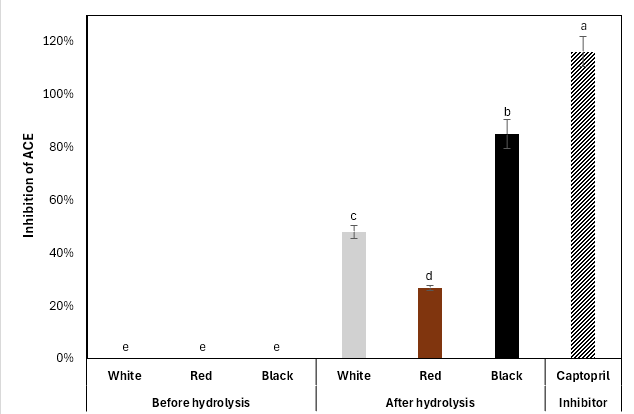
BAPs from the three quinoa varieties will be evaluated across anti-hypertensive, and antidiabetic potential. Functional enzyme inhibition assays for ACE and DPP-IV will be conducted to quantify the bioactivity of the peptides. Initial evaluations of ACE inhibitory activity revealed distinct differences among the three quinoa varieties. Black quinoa peptides exhibited the highest inhibition (85%), followed by white quinoa (48%) and red quinoa (27%). Notably, no inhibitory activity was observed in any of the non-hydrolyzed protein extracts, which emphasizes the importance of generating bioactive peptides for ACE inhibition. Although red quinoa demonstrated the highest degree of hydrolysis between the varieties, it showed the lowest ACE inhibition, which suggests that excessive hydrolysis may lead to the formation of ineffective peptides for ACE inhibition. Therefore, optimizing hydrolysis conditions is critical for maintaining BAPs functionality in the treatment of CDs.
A methodological characterization approach was employed to analyze the quinoa protein isolates and hydrolysates. Free Amino Nitrogen method was used to quantify the degree of hydrolysis. SDS-PAGE provided molecular weight profiles of proteins and peptides before and after hydrolysis, in addition to qualitative insights into protein degradation patterns. Scanning electron microscopy revealed morphological changes in the proteins before and after hydrolysis. And Fourier-transform infrared spectroscopy was used to detect functional group modifications, particularly in Amide I region, associated with peptide bond alterations.
Overall, quinoa stands out as a highly valuable crop for the development of nutritional and functional foods, due to its rich profile of bioactive compounds. The three varieties examined in this study (white, red, and black) offer a diverse array of BAPs capable of modulating key metabolic pathways involved in CDs. Our preliminary findings highlight the ACE inhibitory potential of black quinoa, emphasizing the role of controlled enzymatic hydrolysis in preserving peptide functionality. This research contributes to the growing evidence supporting the use of plant-based proteins in the development of health-promoting functional foods. By increasing the understanding of quinoa-derived peptides and their behavior in various food matrix, we aim to promote the creation of innovative products towards CDs and healthy aging.