2025 AIChE Annual Meeting
(191at) Enhancing Design Space Identification through Prediction Reliability Assessment: The Prep Framework
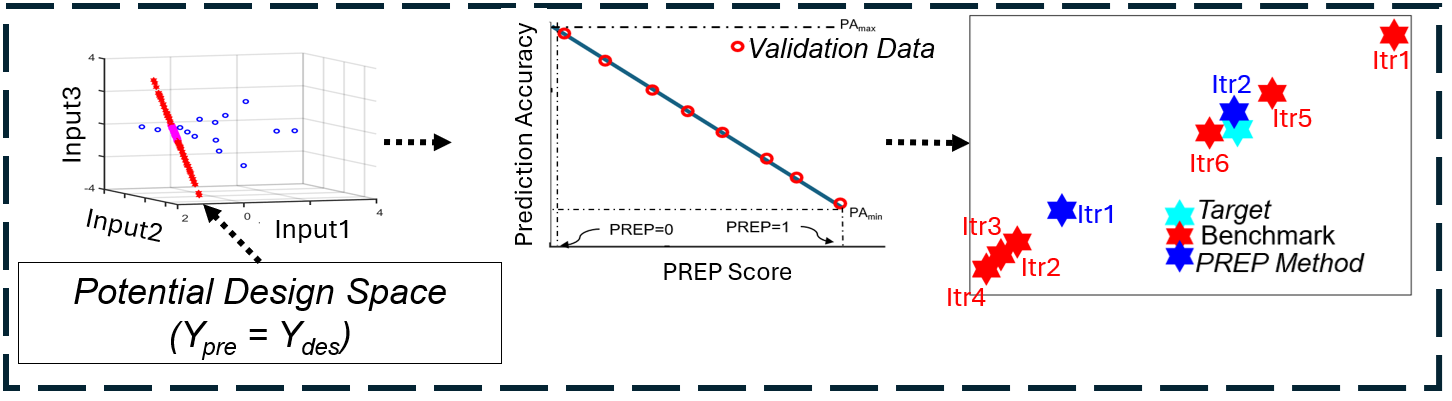
Accurate and reliable predictions are essential for effective design space identification; however, traditional data-driven modeling approaches often encounter challenges related to prediction uncertainty. Latent variable techniques such as Partial Least Squares (PLS) and Principal Component Analysis (PCA) are commonly employed to address multicollinearity and extract meaningful patterns, but they do not inherently provide direct reliability measures for predictions. To overcome this limitation, we propose the Prediction Reliability Enhancing Parameter (PREP), a framework that systematically evaluates and enhances prediction confidence by integrating model alignment metrics—including Hotelling T², Sum of Squared Prediction Errors (SPE), and latent score consistency—into a single reliability score for unseen data points. By leveraging PREP, highly reliable candidate formulations and process conditions can be identified with fewer experimental iterations. Benchmark evaluations using synthetic datasets demonstrate that PREP enables faster and more efficient design space identification compared to conventional methods, particularly in nonlinear scenarios. Additionally, in experimental studies aimed at optimizing the properties of various nanoparticles, this approach successfully guided the synthesis of nanoparticles with precise target sizes within fewer than four iterations, significantly conserving experimental resources. These results emphasize PREP’s potential as a powerful tool for accelerating design space identification and enhancing decision-making in data-driven optimization.