2025 AIChE Annual Meeting
(134e) Engineering a Hybrid Plant-Microbe System for Autonomous Electrochemical Sensing of Organophosphate Pesticides
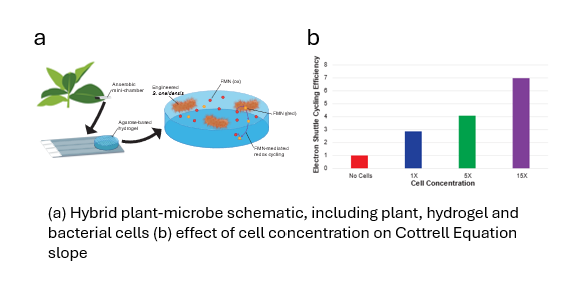
The platform combines advanced synthetic biology and microbial engineering to achieve sensitive, cost-effective, and scalable monitoring of pesticide dispersal. Engineered plants express organophosphate hydrolase (OPH) enzymes to degrade OPs directly at the site of application. Simultaneously, S. oneidensis bacteria are immobilized within an agarose-based hydrogel in the presence of flavins that act as electron shuttles to the electrode surface. Upon interaction with plant-generated p-NP, the bacteria produce electrical current, enabling remote sensing of pesticide levels.
The study focused on electrochemical characterization of the combined system and the optimization of each of its elements. Chronoamperometry was executed and analyzed using the Cottrell equation for the various conditions. The concentration of flavins was optimized to obtain the highest sensor sensitivity in the range of 1uM to 1mM, where a concentration of 100uM was found to be ideal in the trade-off between high signal-to-noise ratio and selectivity. The cell viability was studied to establish a hydrogel that will provide a nutritious environment for the measurement duration.
This autonomous monitoring system is expected to revolutionize agrochemical distribution by reducing excessive pesticide use, safeguarding farmworkers from exposure, and minimizing environmental contamination. Additionally, the platform offers potential for expansion to detect other agrochemicals, providing a versatile tool for sustainable agriculture. Our interdisciplinary collaboration leverages expertise in biosensors, microbial engineering, and plant synthetic biology to develop this transformative technology.