2025 AIChE Annual Meeting
(191am) Electron Diffraction (MicroED): A Dedicated Device and Its Applications in the Pharmaceutical Industry
Authors
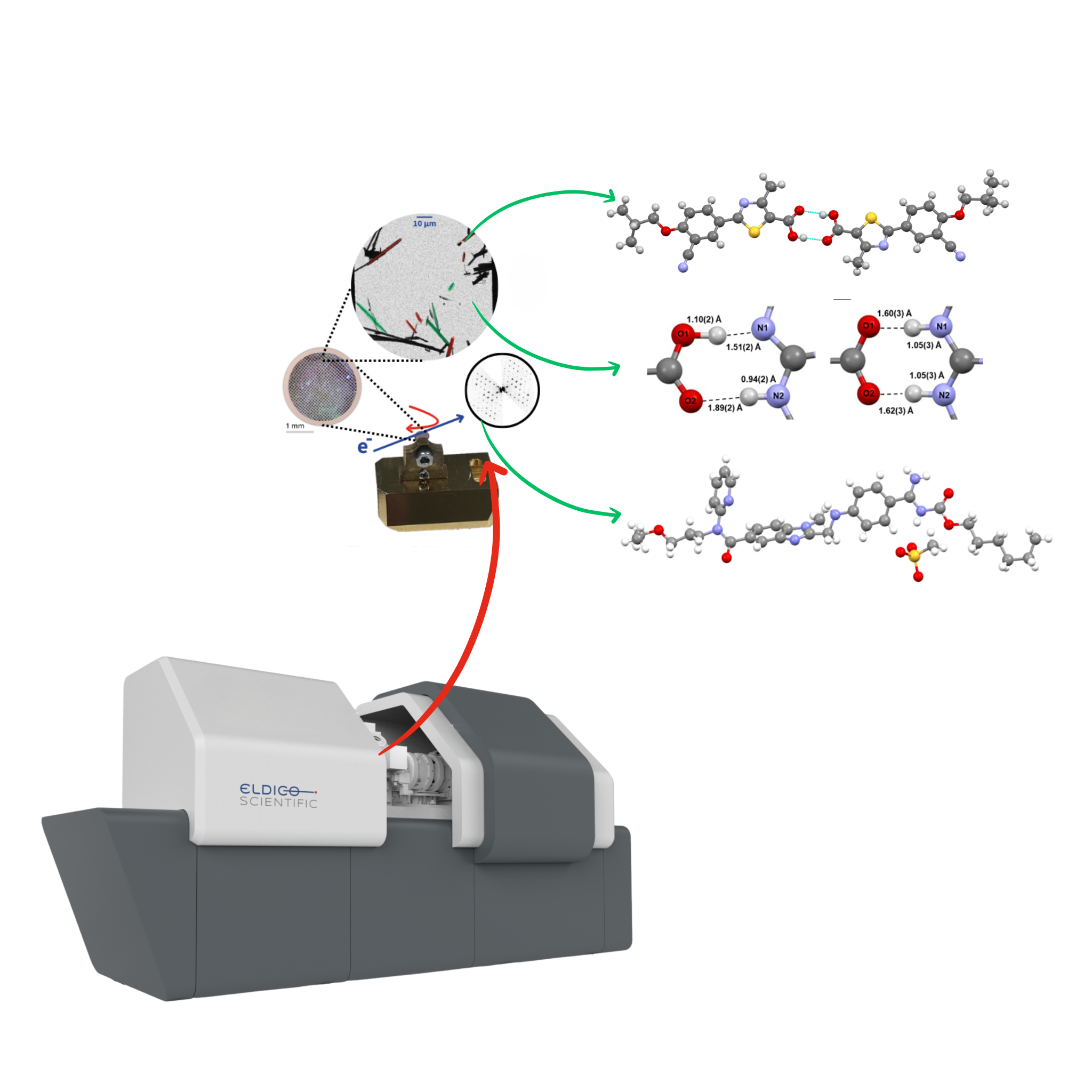
Since the Science nomination for “Breakthrough of the year 2018”,[1] electron diffraction (3D ED, known also as MicroED) for structural elucidation of organic compounds has been gaining a lot of momentum. MicroED has been rapidly evolving as a complementary technique for SC-XRD experiments.[2] Especially for those cases where single crystals of suitable size for XRD experiments are not obtained. Dedicated electron diffractometers[3] make the technique more accessible, resulting in many recent publications where these commercial electron diffractometers have been used.[4,5]
MicroED’s ease of use and its potential for various applications is presented in multiple studies, especially in the pharmaceutical industry where it is having a high impact.[6,7] We would highlight some case studies where electron diffraction has helped the pharmaceutical industry obtain structural information not available before by other means [5, 7]. Furthermore, we’ll delve and showcase other applications like:
- characterization of meta-stable polymorphic forms
- identifying crystallinity in amorphous solid dispersions
- finding new polymorphic forms
- identifying impurity polymorphic forms
- impurities and phase identification using automation
- and more.
References:
- https://vis.sciencemag.org/breakthrough2018/finalists/#rapid-structure
- Gruene, E. Mugnaioli. Chem. Rev. 2021, 121, 11823-11834.
- Simoncic, et. al., Acta Cryst., 2023, E79, 410-422.
- F. Woods, et. al., Nature Communications, 2023, 14, 4725
- D. T. Ungur, et. al., Cryst.Eng.Comm., 2024. 26, 4295 – 4304.
- Bruhn, et. al., Front. Mol. Biosci. 2021, 8, 648603.
- Sieger, et. al., European Journal of Pharmaceutical Sciences. 2023,186, 106447.