2025 AIChE Annual Meeting
(99c) Diffusivity Measurements in Nanoporous Materials Using a Temperature-Induced Desorption Approach
Authors
Measuring (transport) diffusivities requires by definition out-of-equilibrium conditions. Almost all techniques are based on monitoring the transient uptake/release following a sudden change in adsorptive concentration (i.e., moving between two equilibrium points on the same isotherm), and fitting the obtained data with a suitable model to extract diffusivities [2]. Practically, these approaches rely on fast-acting valves and sample cells and piping with a minimized dead volume. Still, each setup, irrespective of the measurement methodology, has an intrinsic time constant. This value places a limit on the fastest transient uptake/release measurements that can be performed. For fast-diffusing components (with a diffusivity >10-11 m²/s), most measurement methods run into limitations and can only provide data for (very) large crystals (i.e., 10s or even 100s of micrometers in diameter) [3]. Obtaining such large crystals is often not feasible for adsorbents such as zeolites and metal-organic frameworks (MOFs). If it is, large crystals require different synthesis conditions compared to industrially relevant materials and might not be fully representative since differences in synthesis protocols are known to affect adsorption kinetics [4]. In addition, since adsorption is exothermic, many measurement approaches suffer from local temperature increases (while the data analysis generally assumes isothermal conditions), especially for fast-diffusing components.
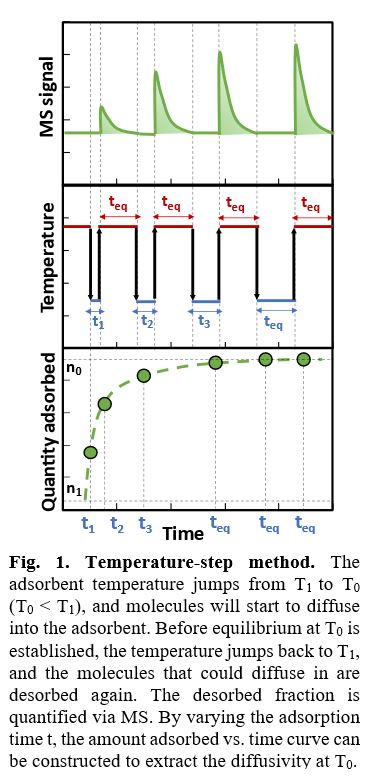
In this contribution, we will present a new method to measure diffusion in nanoporous materials based on a temperature-step approach. Instead of a concentration change in the atmosphere surrounding the adsorbent, a sudden temperature change of the adsorbent is used (i.e., moving between two isotherms instead of along one isotherm). The uptake/release following the sudden temperature change of the adsorbent is monitored using mass spectrometry (MS) to obtain data from which diffusivity values can be extracted (Fig. 1). However, the time-dependence of the MS signal of a molecule of interest upon thermal desorption is not exclusively determined by diffusion out of the adsorbent. Rather, the transient signal is affected by the volume of the sample cell and the piping connecting it to the MS. Even when minimized, these effects will become limiting for fast-diffusing systems (i.e., molecules with a high diffusivity and small adsorbent particles). Therefore, to avoid similar limitations as current methods, direct time-domain monitoring of the uptake/release profile is abandoned and a sampled measurement approach is adopted (Fig. 1). Examples of diffusivity measurements based on the newly developed temperature-step approach will be provided and compared to diffusivities obtained on the same systems using a Quartz Crystal Microbalance (QCM).
References
[1] M. F. Verstreken, N. Chanut, Y. Magnin, H. O. R. Landa, J. F. Denayer, G. V. Baron, R. Ameloot, Mind the Gap: The Role of Mass Transfer in Shaped Nanoporous Adsorbents for Carbon Dioxide Capture. JACS 146 (2024) 23633-23648.
[2] C. Chmelik, J. Kärger, In situ study on molecular diffusion phenomena in nanoporous catalytic solids. Chem. Soc. Rev, 39 (2010) 4864-4884.
[3] T. M. Tovar, J. Zhao, W. T. Nunn, H. F. Barton, G. W. Peterson, G. N. Parsons, M. D. LeVan, Diffusion of CO2 in large crystals of Cu-BTC MOF, JACS 138 (2016) 11449-11452.
[4] S. Tanaka, K. Fujita, Y. Miyake, M. Miyamoto, Y. Hasegawa, T. Makino, S. Van der Perre, J. Cousin Saint Remi, T. Van Assche, G. V. Baron, J. F. M. Denayer, Adsorption and diffusion phenomena in crystal size engineered ZIF-8 MOF, J. Phys. Chem. C, 119 (2015) 28430-28439.