2025 AIChE Annual Meeting
(183an) Development of 3D-Printed Hypromellose Structure for Poorly Soluble Drug
Authors
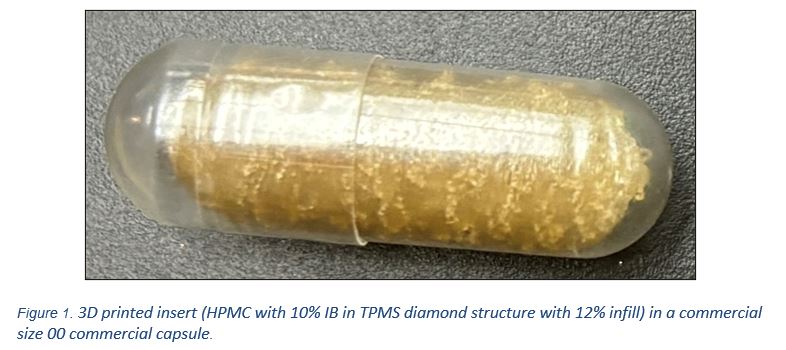
The rheological behaviors of AFFINISOL™ HPMC with 0%, 10%, and 20% IB were determined. Both AFFINISOL™ HPMC and HPMC-IB solid dispersions exhibited non-Newtonian (shear-thinning) pseudoplastic behavior. Such rheological behavior is consistent with previous publications[4, 5]. The inclusion of IB significantly reduced the complex viscosity compared to HPMC with 5% xylitol as plasticizers. This reduction was attributed to the plasticizing effect of IB, with the degree of reduction increasing as the concentration of IB increases. TPMS lattice structures were designed using nTop software and printed using Prusa MK4 printers. Figure 1 illustrates a 3D printed insert made with AFFINISOL™ HPMC containing 10% IB in a TPMS diamond structure with 12% infill, assembled in a commercial size 00 capsule. In vitro release of IB was conducted in USP phosphate buffer (pH 7.2). Similar release profiles were observed for all the diamond structures prepared in this study with 12% to 20% infill made from HPMC and 10% IB.
In summary, AFFINISOL™ HPMC HME 15LV has been successfully fabricated into 3D printed TPMS lattice structure inserts that can be assembled into capsules. Additionally, AFFINISOL™ HPMC HME 15LV has demonstrated to be a suitable matrix for incorporating drugs into 3D-printed structures. Future investigations will focus on studying how different TPMS lattice structures and densities influence drug release rates and exploring other poorly soluble drugs.
References
- Pan, S., et al., 3D-printed dosage forms for oral administration: a review. Drug Delivery and Translational Research, 2024. 14(2): p. 312-328.
- Kim, J.H., K. Kim, and H.-E. Jin, Three-Dimensional Printing for Oral Pharmaceutical Dosage Forms. Journal of Pharmaceutical Investigation, 2022. 52(3): p. 293-317.
- Hameed, P., et al., Biomorphic porous Ti6Al4V gyroid scaffolds for bone implant applications fabricated by selective laser melting. Progress in Additive Manufacturing, 2021. 6.
- Chatterjee, T., et al., Rheology of Cellulose Ether Excipients Designed for Hot Melt Extrusion. Biomacromolecules, 2018. 11(19): p. 4430-4441.
- Gupta, S.S., N. Solanki, and A.T.M. Serajuddin, Investigation of Thermal and Viscoelastic Properties of Polymers Relevant to Hot Melt Extrusion, IV: Affinisol™ HPMC HME Polymers. AAPS PharmSciTech, 2016. 17(1).