2025 AIChE Annual Meeting
(34c) Why Monomer Clustering Sharpens Coil?Globule Transition in Nonionic AB Copolymers
Author
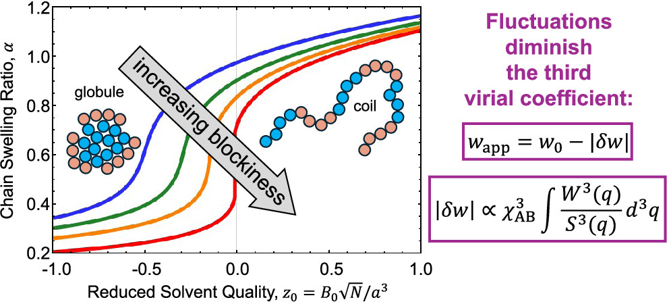
To fill this gap, we develop a statistical theory for the coil–globule transition in neutral AB copolymers with arbitrary monomer sequences. To elucidate the role of sequence, we go beyond the mean-field approximation by incorporating Gaussian (RPA) fluctuation corrections resulting from chemical differences (incompatibility) between A and B monomers. Our calculations demonstrate that local compositional fluctuations reduce the second and third virial coefficients of monomer-monomer interactions. These corrections are derived in a general form for arbitrary monomer sequences, and closed-form expressions are found for block-alternating AB copolymers characterized by block length m. Increasing the monomer blockiness is shown to (i) increase the globule density, (ii) shift the conformational transition toward higher temperatures, and crucially, (iii) narrow the coil-globule transition region. The key result is that the collapse becomes particularly sharp if accompanied (or shortly followed) by intraglobular microphase separation. The developed theory rationalizes earlier simulation and experimental results on the collapse of protein-like copolymers forming microstructured core-shell globules and provides first-principle theoretical understanding of sequence effects in nonionic AB copolymers.