2025 AIChE Annual Meeting
(34g) Volume Redistribution Mechanisms in the Directed Self-Assembly of Block Copolymers and Their Effect on Microdomain Orientation
Authors
Mingchao Ma, Massachusetts Institute of Technology
Zehao Sun, Standford University
Jaedong Jang, Massachusetts Institute of Technology
Caroline Ross, Massachusetts Institute of Technology
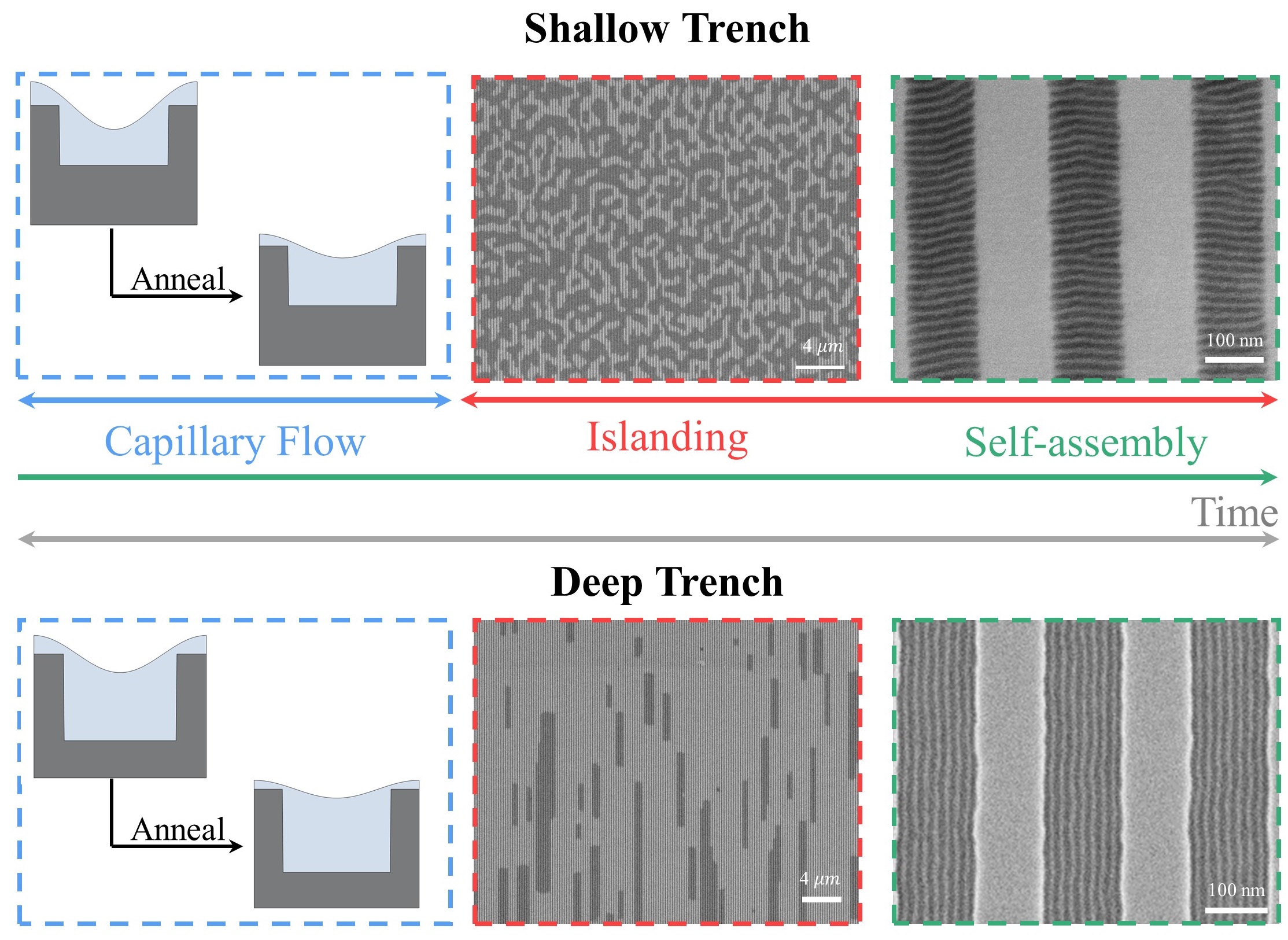
Block Copolymer (BCP) Directed Self-Assembly (DSA) generates highly ordered patterns and is considered a promising approach to complement traditional lithography tools. DSA can be accomplished by spin coating a BCP film onto a topographically patterned substrate then annealing to form microdomain arrays that are ordered with respect to the topography. This approach often generates BCP patterns that are parallel to the side walls of the topographical trenches. Developing methods that increase control over the orientation is essential to expand the utility of DSA. Here we report, for a cylindrical-morphology BCP, how cylinder orientation is affected by volume redistribution mechanisms including capillary flow and island formation and aggregation during solvent vapor annealing. Films of polystyrene-b-polydimethylsiloxane (PS-b-PDMS) BCP (11 kg/mol-b-5 kg/mol, fDMS=32.9 %, L0 = 17 nm) were coated on substrates patterned with 125 nm wide trenches. Atomic force microscopy was used to track film thickness and scanning electron microscopy was used to characterize self-assembly morphology, and cylinder orientation was quantified by analyzing the Fourier transform spectrum. The orientation of the PDMS cylinders after 1-hour acetone vapor annealing is perpendicular to the trench wall when the trench depth is 14.5 nm, and parallel when the depth is 18.0 nm. The thickness of the film in the trenches increased while that on the mesa decreased over the first minute and then stabilized for both trench depths, suggesting the time scale of capillary flow to be around one minute. Meanwhile, the cylinders showed more alignment perpendicular to the trench walls with increasing time for both trench depths. After two minutes, islands formed and aggregated, but the islanding mechanism depends on trench depth. The dimension of the island patterns suggest that islands aggregate isotropically in shallower trenches, while predominantly parallel to the trenches in deeper trenches. During aggregation, the cylinder orientation becomes increasingly perpendicular in shallow trenches, and increasingly parallel in deeper trenches. We hypothesize this to result from the interplay between the flow during capillary flow and island aggregation. For shallow trenches, the island aggregation occurs isotropically and has little effect, and capillary flow drives the perpendicular orientation. In deep trenches, the directional flow during aggregation overwrites the capillary flow effect, and replaces perpendicular orientation with parallel orientation. To verify this hypothesis, in the shallow trenches, we verified the cylinder orientation to be perpendicular despite the local island patterns by using the Watson U2 statistical test. For the deep trenches, we studied self-assembly in V-bend and circular trenches, and found consistent time scales and orientation as the straight deep trenches. In summary, capillary flow tends to align cylinders perpendicular to the trench wall, and the alignment continues to develop in shallow trenches but is replaced in deep trenches due to the different island aggregation mechanisms. Overall, the competing volume redistribution effects govern the microdomain orientation and provide a tool to control the cylinder orientation in DSA.