2025 AIChE Annual Meeting
(342f) Upcycling Waste Polyethylene into Nylon Precursors and Platform Chemicals Via a Hybrid Pyrolysis-Biomanufacturing Approach
Authors
Muhammad Umer Abid - Presenter, University of Massachusetts Lowell
Christine Boadu, UMass Lowell
Hsi-Wu Wong, University of Massachusetts Lowell
Dongming Xie, University of Massachusetts-Lowell
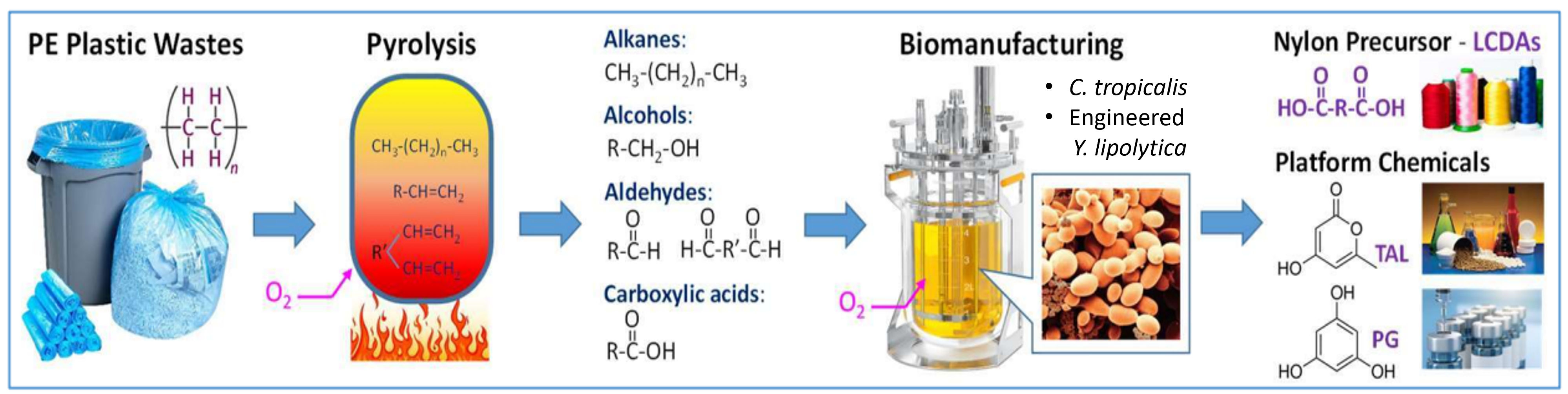
The accumulation of polyethylene (PE) waste, which accounts for over 50% of plastic waste, poses a significant environmental challenge, underscoring the urgent need for efficient upcycling strategies. While rigid high-density PE products are being mechanically recycled at a higher rate, low-density PE finds fewer viable recycling options. This research investigates a hybrid pyrolysis-biomanufacturing approach to convert PE pyrolysis products into value-added chemicals, such as long-chain diacids (LCDAs) as nylon precursors and triacetic acid lactone (TAL) and phloroglucinol (PG) as important platform chemicals. Engineered yeast strains Candida tropicalis ATCC 20962 and ATCC 20336 were employed for the bioconversion of waste PE-derived alkanes and alkenes into LCDA. Both strains exhibited successful cell growth in media containing most of the alkane/alkene substrate with different chain lengths and bonding, ranging from C8 to C17, where C. tropicalis ATCC 20962 was co-fed with glucose (β-oxidation knockout strain) and C. tropicalis ATCC 20336 was solely cultivated on alkanes/alkenes. Shake-flask growth experiments for C. tropicalis ATCC 20336 were also conducted using a mixture of alkanes/alkenes with different chain lengths. 1-L Fed-batch fermentation was carried out with Candida tropicalis ATCC 20962 to check its capability of LCDA production. The results manifested potential cell growth and indicated the strain's potential to thrive under different substrate conditions. N-decane (C10 alkane) co-fed with glucose in a 1-L fed batch bioreactor demonstrated the production of ~50 g/L of LCDA using C. tropicalis ATCC 20962, whereas N-tridecane (C13 alkane) co-fed with glucose demonstrated the production of ~40 g/L of LCDA. Yarrowia lipolytica ATCC 20362 also demonstrated cell growth in shake-flask experiments using alkanes/alkanes and a mixture of alkanes/alkenes with different chain lengths as a sole substrate. The successful cell growth demonstrated the strain’s potential to convert waste PE-derived alkanes and alkenes into TAL and PG. Genetic engineering for Y. lipolytica ATCC 20362 is being carried out, and the key genes encoding biosynthesis of TAL (g2ps1) or phloroglucinol (phlD) are being expressed to check the production of triacetic acid lactone (TAL) or phloroglucinol (PG) using waste-PE derived alkanes/alkenes.