2025 AIChE Annual Meeting
(53d) Unraveling Soot Oxidation Evolution and Water Promotion Effect over Nanoarray Organized Interfaces at Mesoscopic Scale
Authors
Jiyu Sun, University of Connecticut
Fangyuan Liu, University of Connecticut
Xingxu Lu, University of Connecticut
Bo Zhang, University of Connecticut
Yunjiang Ding, University of Connecticut
Yugang Zhang, Brookhaven National Laboratory
Pu-Xian Gao, University of Connecticut
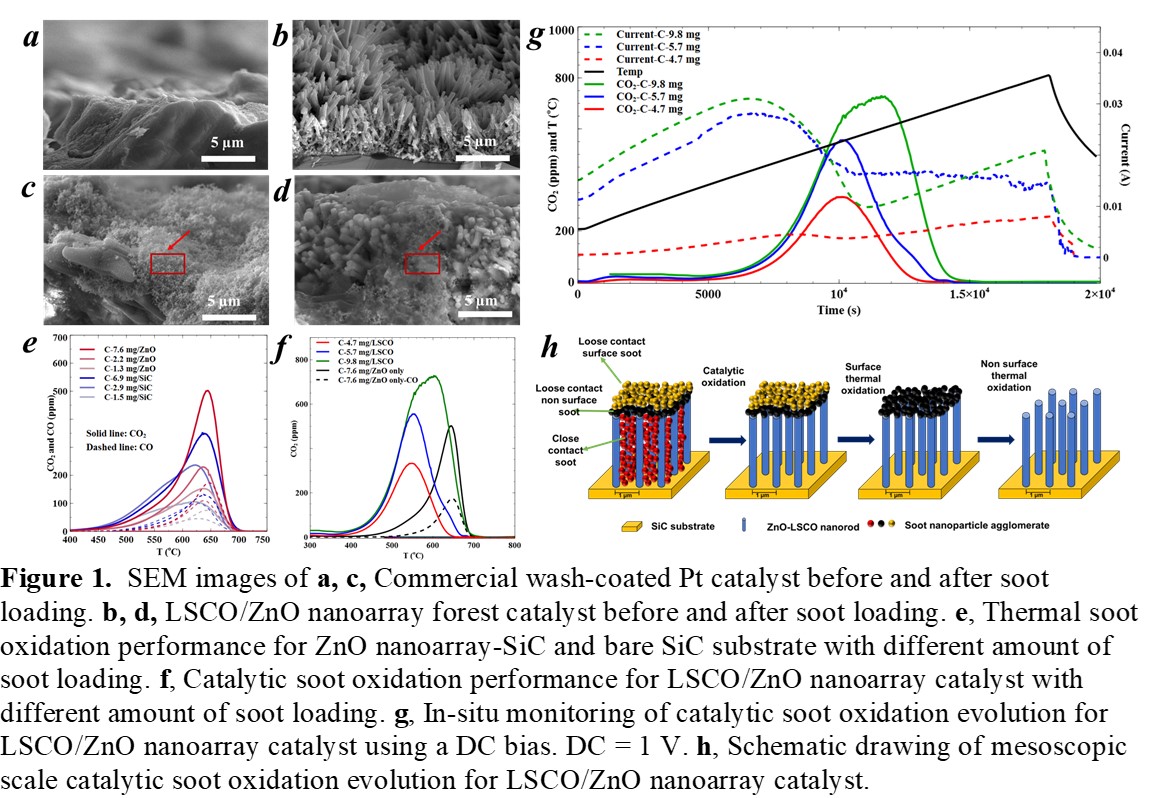
Soot, a common and complex carbon-containing solid by-product generated during various human activities residentially (e.g., cooking and heating) and commercially (e.g., oil refinery, chemical manufacturing, and power generation), not only impacts the associated process efficiency, productivity and longevity, but also poses serious health concerns to human beings. Catalytic soot oxidation offers an energy-efficient means for soot abatement. However, many challenges remain, including high temperature requirement, high platinum group metal usage, and controversial reaction mechanisms. Therefore, development of efficient low temperature soot oxidation catalysts and understanding the soot oxidation evolution are vital. Current understanding of soot oxidation evolution has been focused on microscopic (single or several soot particle oxidation), and macroscopic (soot distribution within reactor) level with limited understanding in the intermediate mesoscopic scale (micrometer scale). To bridge such a length scale gap and unravel the mesoscopic scale soot oxidation evolution, nanoarray supported perovskite monolithic catalyst has been successfully engineered with simplified and well-defined 3D nanoarray surface platform with good differentiation between close and loose contact soot. Specifically, an ordered 3D solid-solid interface is organized in the form of nanostructure array monolith surfaces loaded with soot nanoparticle aggregates (Figure 1d). With an in-situ electrical resistance and electrochemical impedance sensing modes, the ordered soot-catalyst solid-solid interfacial evolution can be in-situ monitored during oxidation reaction, revealing the readily differentiated soot-catalyst contacting modes (Figure 1g). Specifically, the array monolith defined soot-catalyst reactive interfaces evolve from close contact, loose contact, to non-contact modes sequentially with increased energetic barrier, corroborating with the temperature programed soot oxidation profiles (Figure 1f). In-situ electrochemical impedance tracking reveals a three-step soot evolution mapping on the 3D catalyst-soot interfaces (Figure 1h). The revealed soot oxidation evolution at a mesoscopic scale offers a new perspective for in-situ and real time spatiotemporally resolved monitoring of solid-solid-gas multiphase surface and interfacial reactions in operation.