2025 AIChE Annual Meeting
(659j) Unraveling the Interplay between Viscoelasticity and Damage in Soft Polymer Networks: The Case of Interfacial Fracture
Authors
Gabriel Sanoja - Presenter, Univeristy of California-Berkeley
Anthony Arrowood, The University of Texas at Austin
Matteo Ciccotti, ESPCI Paris
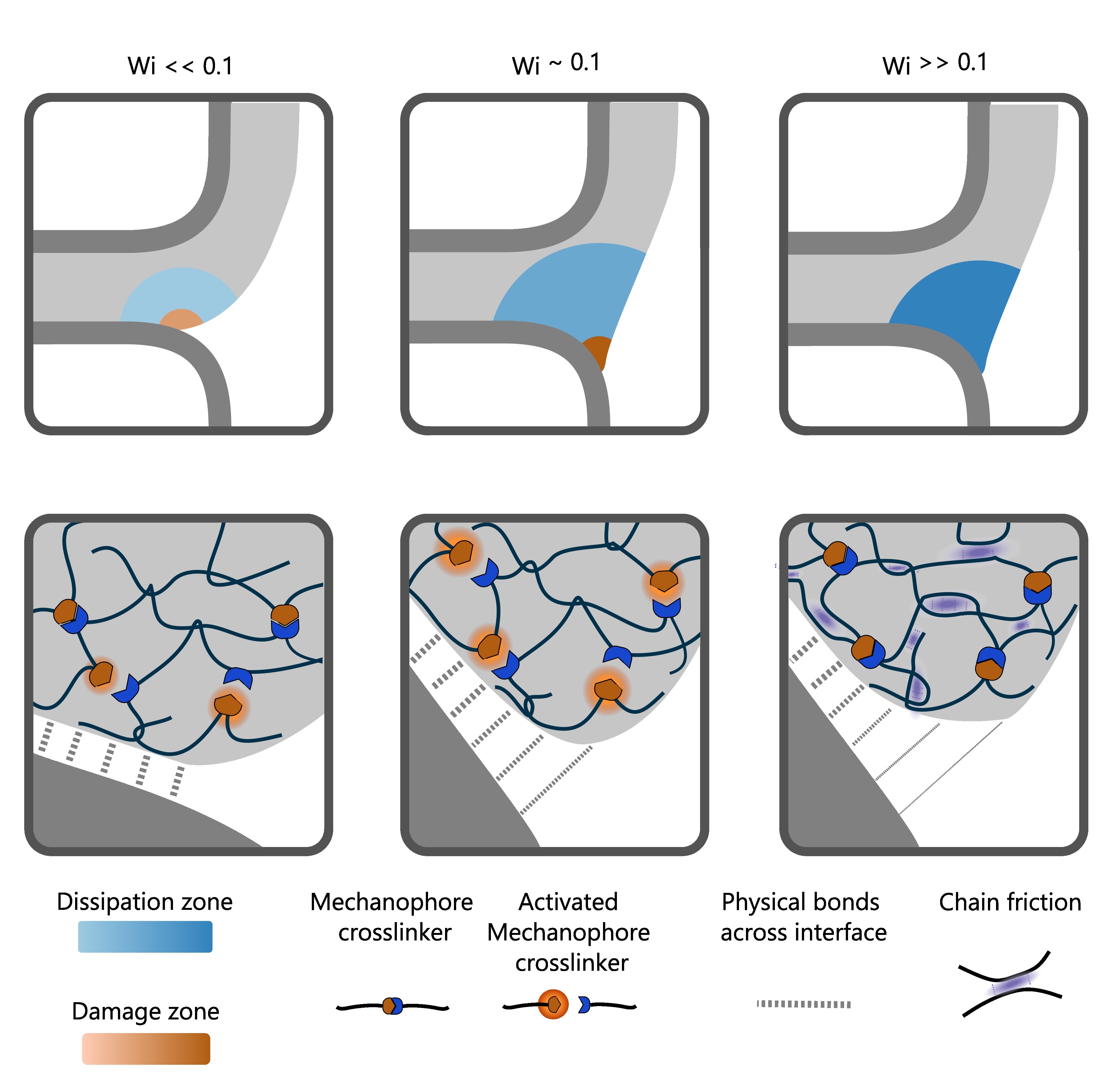
Numerous soft and tough materials have recently emerged, enabling advances in wearable electronics, soft robotics, and flexible displays. However, understanding their interfacial fracture behavior remains challenging due to difficulties in quantifying the contributions from viscoelasticity and damage to energy dissipation ahead of cracks. This study addresses this challenge by labeling a series of polymer networks with fluorogenic mechanophores, subjecting them to T-peel tests at various rates and temperatures, and quantifying force-induced damage using a confocal microscope. The results challenge longstanding assumptions underlying linear viscoelastic fracture theories, revealing a complex interplay between viscoelasticity and damage ahead of cracks, governed by the Weissenberg number, Wi. Specifically, they suggest a molecular picture of interfacial fracture in which toughness increases due to polymer chain elongation at Wi < 0.1$, and significant chain friction and hydrodynamic interactions at Wi > 0.1, with the network suffering negligible damage in the limits of Wi >> 0.1 and << 0.1 due to negligible strains at the peel front and the breakage of weak interfacial bonds. Overall, these results pave the way for developing predictive theories for interfacial fracture in networks subjected to arbitrary complex loads, thus accelerating the development of advanced materials for increasingly demanding applications.