2025 AIChE Annual Meeting
(465d) Unraveling Guest-Induced Structural Transition in a Flexible Metal-Organic Framework for C4 Alkane/Alkene Separation
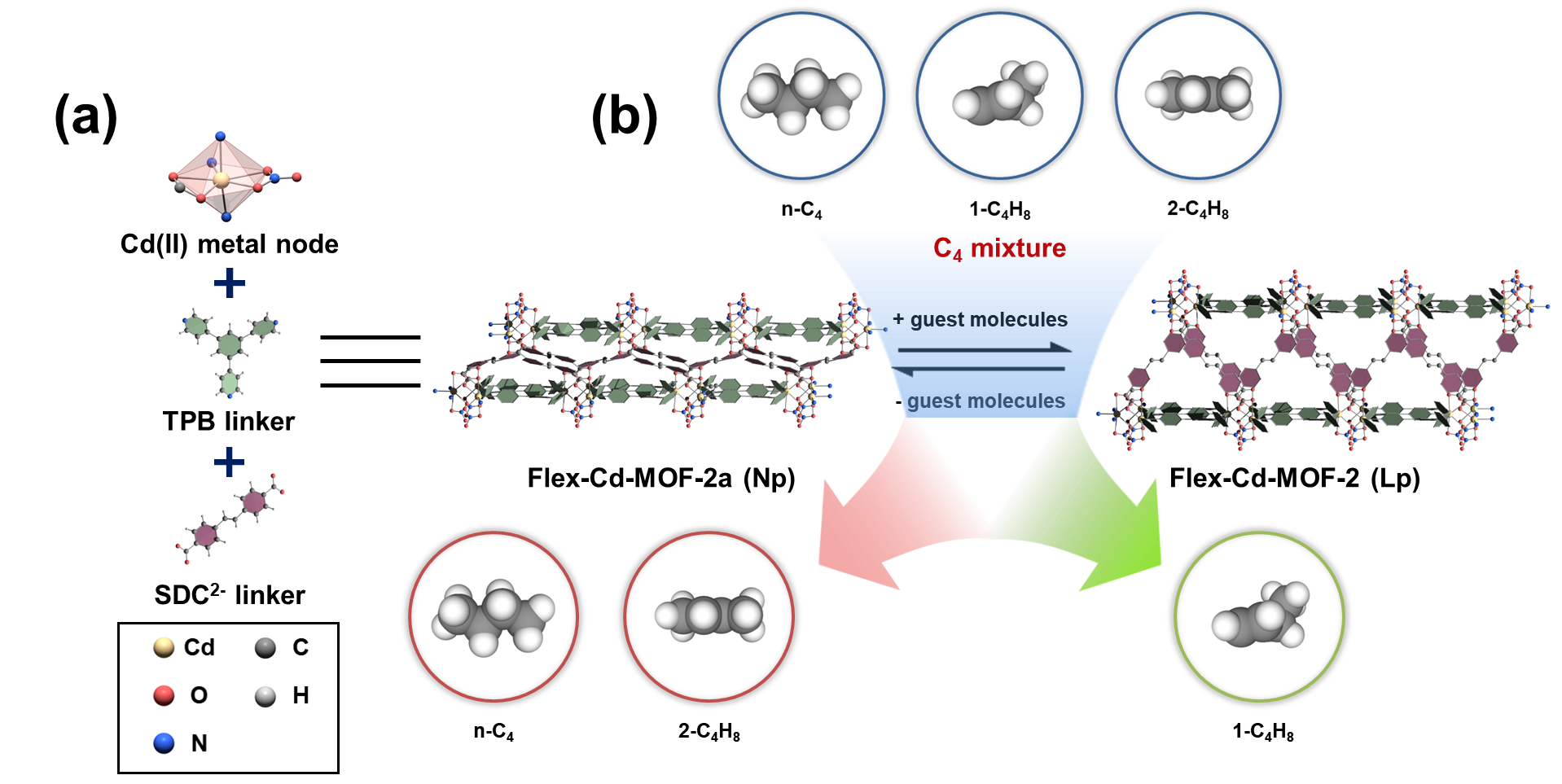
The residue from naphtha cracking contains a massive amount of C4 alkane/alkene mixtures, thus it is highly desirable to develop cost-effective and energy-efficient techniques for their separation. Flexible metal-organic frameworks (MOFs) have attracted considerable interest as potential adsorbents for petroleum residue separation owing to their salient responsive feature upon external stimuli. Nevertheless, unravelling the fundamental mechanisms driving structural transition in flexible MOFs from a molecular level poses a significant challenge. Herein, we employ flexibility-integrated molecular simulations to examine the guest-induced structural transition of a flexible MOF (Flex-Cd-MOF-2a) upon adsorption of various C4 hydrocarbons, and subsequently assess its performance in C4 alkane/alkene separation. Stepped adsorption isotherms are predicted for different C4 isomers using a modified UFF4MOF force field and a hybrid Monte Carlo/molecular dynamics simulation method. Our findings reveal that the accommodation of different C4 molecules in Flex-Cd-MOF-2a triggers distinct structural transition, as reflected by different response pressures. The unveiled host-guest interactions and the resulting structural transition provide valuable microscopic insights into the rational design of new flexible MOFs for practical industrial separation.