2025 AIChE Annual Meeting
(5h) Understanding the Relationship between Interfacial Structure and the CO2rr Microenvironment through a Nanowire-Array Model System
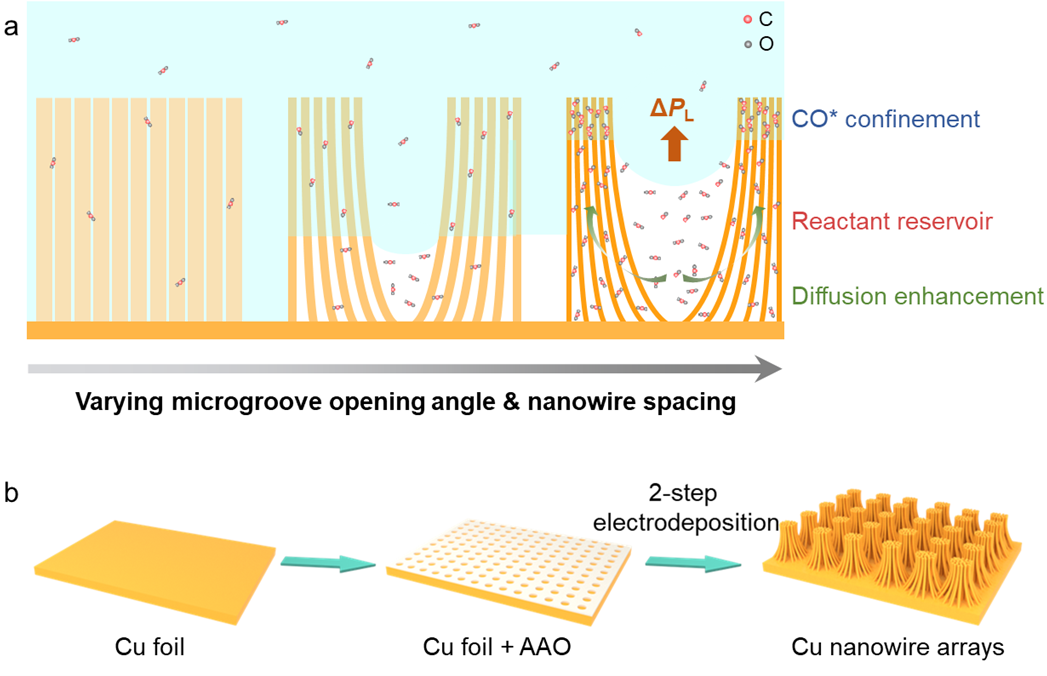
To this end, we will discuss the fundamental role of activity for CO2, CO, and H2O and the interplay with cathode structure. Here, to develop new insights, we introduce a model system featuring hierarchical Cu nanowire arrays with micro-grooves (NAMs) that synergistically stabilize the micro-wetting state, confine CO*, improve local CO2 concentration, and tune local pH. Via a combination of confocal microscopy, transport modeling, and electroanalytical methods to probe the microenvironment, we elucidate the interplay between local wetting state, local CO/CO2 concentration, and local pH, which influence reaction pathways towards multi-carbon products. Consequently, for our model system, the optimized configuration demonstrates a significant increase in electrochemically active surface area (ECSA)-normalized activity by 690%, C2+ product selectivity by 72%, and Faradaic efficiency by 36%, compared to hydrophobic Cu foil. We propose that our findings unlock new opportunities to engineer the CO2RR microenvironment through the rational organization of hierarchical interfaces.