2025 AIChE Annual Meeting
Understanding Acid Transport in Anion Exchange Membranes
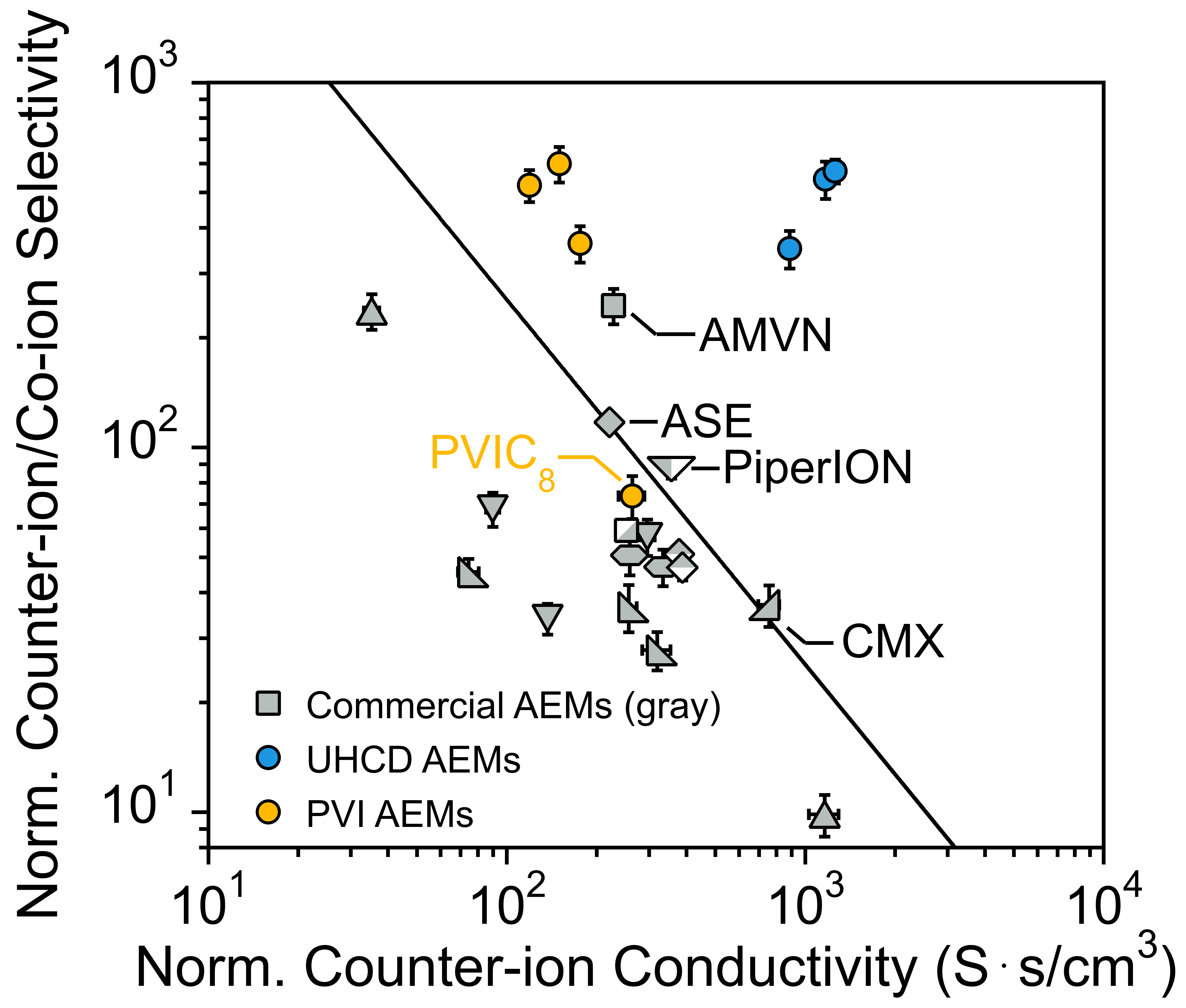
As the need for acid recovery in mining and industrial wastewater treatment applications increases, there is growing interest in the use of ion-exchange membrane (IEMs) technologies, such as electrodialysis (ED), for this application. However, applying ED to acid recovery is hindered by acid leakage across anion-exchange membranes (AEMs). This phenomenon decreases both current efficiency and recovered acid concentration. To design AEMs with better acid-blocking properties, it is important to have a better understanding of acid transport in current advanced anion exchange membranes (AEMs). In this study, the acid transport properties of 24 different AEMs, commercial and lab-made, with varying water and charge contents, are investigated. The transport properties of the AEMs are comprehensively studied based on the Solution-Diffusion and Nernst-Einstein frameworks. Results show that membranes with better counter-ion/co-ion selectivity generally exhibit better acid-blocking performance. A clear trade-off between the membrane counter/co-ion conductivity-selectivity for commercial membranes is also observed. Recently reported ultrahigh-charge-density (UHCD) and phase-separated AEMs break this trade-off, demonstrating high selectivity and exceptional counter-ion conductivity simultaneously. The results of this study highlight shortcomings in the performance of current commercial membranes for acid recovery applications and showcase how our current strategy of designing lab-made membranes with UHCD or phase separation can enhance acid blocking efficiency.