2025 AIChE Annual Meeting
(620d) Ultrastrong Coupling By Assembling Plasmonic Metal Oxide Nanocrystals in Open Cavities
Authors
Benjamin Roman, The University of Texas at Austin
Tanay Paul, The University of Texas at Austin
Zarko Sakotic, The University of Texas at Austin
Priyansh Vora, The University of Texas at Austin
Kihoon Kim, University of Texas at Austin
Lauralee Hurst, The University of Texas at Austin
Daniel Wasserman, The University of Texas at Austin
Thomas Truskett, University of Texas At Austin
Delia Milliron, University of Texas at Austin
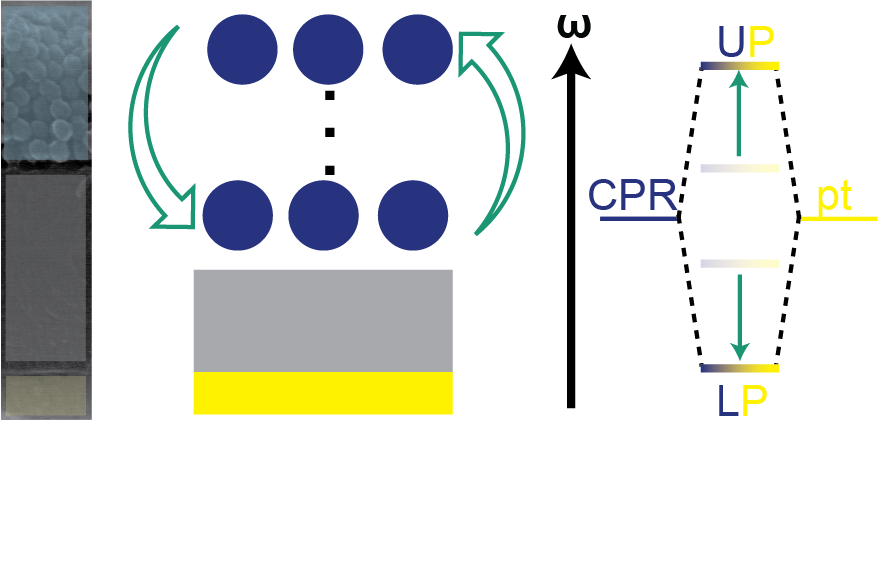
Plasmon polaritons created by coupling optical cavity modes with plasmonic resonances offer widely tunable frequencies and strong light–matter interaction. While metallic nanocrystals (NCs) are compelling building blocks, existing approaches for their photonic integration are not scalable, limiting their systematic study and potential applications. Here, we assemble colloidal tin-doped indium oxide NCs in a straightforward Salisbury screen configuration to realize an ‘open’ cavity structure, where the infrared resonance frequencies of the NC assembly and the photonic mode are independently controlled and strongly coupled. By modeling each NC layer as an effective medium, we designed cavities with plasmon polariton spectra tuned to target frequencies, for example, approximating the two atmospheric transparency windows. NCs with varying ligands and doping concentrations can be stacked in the assemblies to customize the spectral line shape and control the spatial distribution of the electric near-field within the assembly. We anticipate applications in chemosensing and photonic technologies.