2025 AIChE Annual Meeting
(587g) Ultra-Low Particulate Emissions from a Lean Prevaporized Combustor for Future Civil Supersonic Transport
Authors
Samuel E. Wonfor, Georgia Institute of Technology
Jeremiah C. Juergensmeyer, Georgia Institute of Technology
Lauren Kehoe, Missouri University of Science and Technology
William Satterfield, Missouri University of Science and Technology
Steven Achterberg, Center of Excellence for Aerospace Particulate Emissions Reduction Research Missouri S&T, 65409, USA
Klaus Woelk, Missouri University of Science and Technology
Monday Okoronkwo, Missouri University of Science and Technology
Adam Steinberg, Georgia Institute of Technology, 30332
Philip Whitefield, Missouri University of Science and Technology
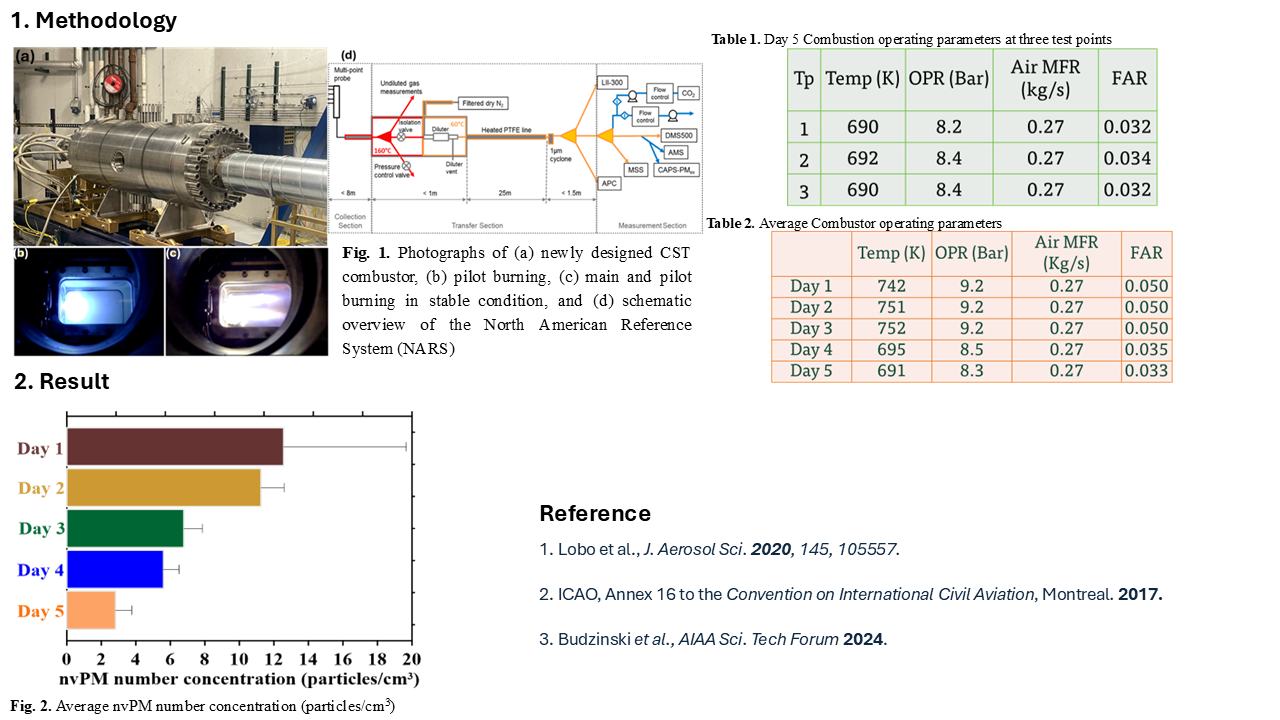
Environmental concerns—particularly non-volatile particulate matter (nvPM) emissions—remain a critical challenge in the advancement of civil supersonic transport (CST). This study investigates nvPM emissions from a novel, low-emission Lean Premixed Prevaporized (LPP) combustor developed for CST applications. Emission measurements were performed using the SAE ARP6320-compliant North American Reference System (NARS), integrating an AVL Particle Counter and AVL Micro Soot Sensor to quantify particle number and mass concentrations, respectively. Five preliminary tests (Test 1–5) were conducted at combustor exit temperatures of 742 K, 751 K, 752 K, 695 K, and 691 K, respectively. The results revealed low nvPM mass emissions—below the instrument’s detection threshold (<1 µg/m³)—and average number concentrations in the range of 6.8×10² particles/cm³. Notably, a consistent inverse relationship was observed between combustor operating temperature and nvPM number concentration, with higher temperatures corresponding to lower particle counts. Measured particle size distributions followed a lognormal profile, with geometric mean diameters ranging from 15 to 38 nm. These findings demonstrate the potential of LPP combustion technology to achieve ultra-low nvPM emissions. Ongoing work aims to further examine combustion dynamics and support improved performance modeling for integration into future CST propulsion systems.