2025 AIChE Annual Meeting
(68c) Transport through a Chiral Tiling: The Effect of Aperiodicity on Flow and Particle Capture
Author
Joel Plawsky - Presenter, Rensselaer Polytechnic Institute
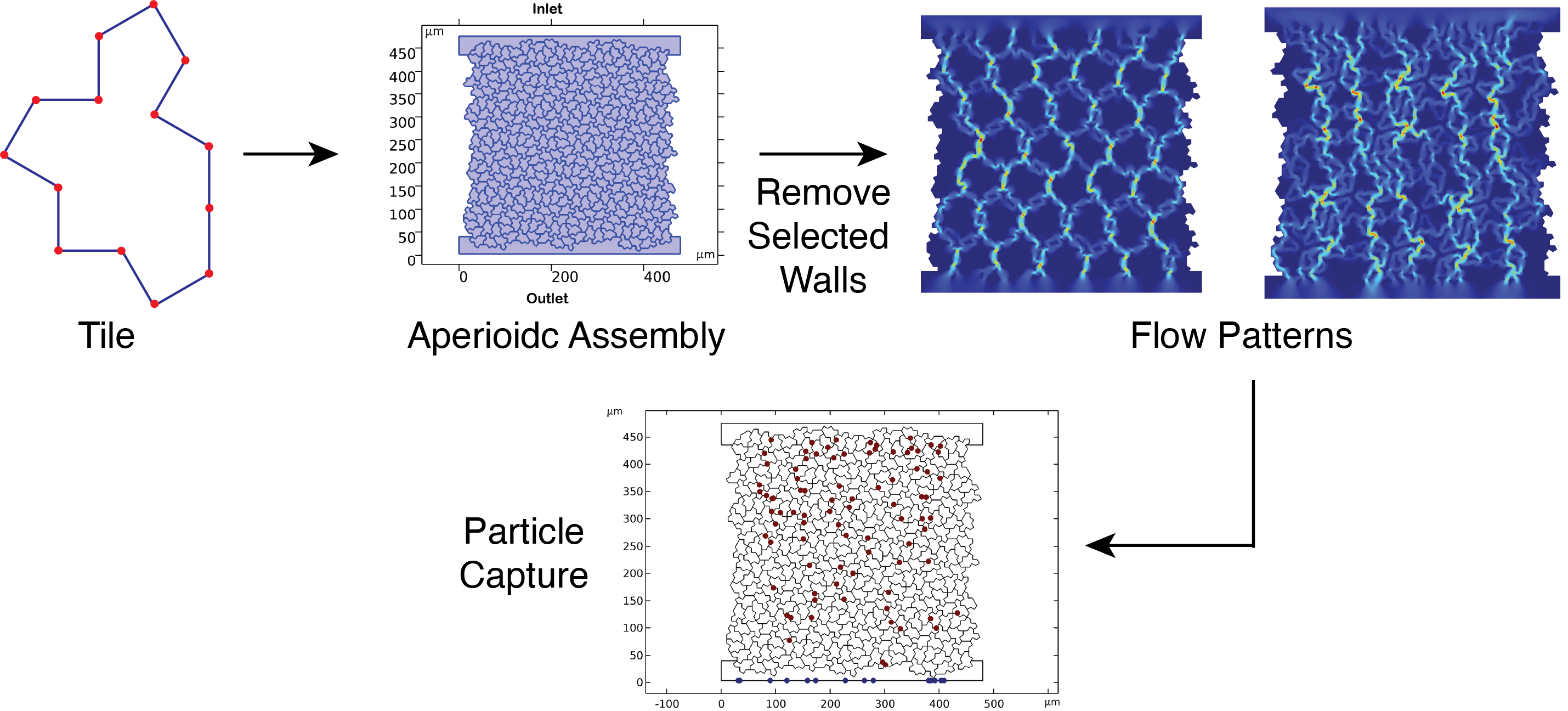
There have been many models built to describe composite or porous media. Most are built from collections of regular objects, like spheres, or space filling tilings, that are arranged or modified after the fact in a random or pseudo-random configuration. In this article, the use of an aperiodic, chiral tiling as an alternative is explored. Using these tilings, the underlying structure is not uniform, and the behaviors exhibited by this kind of system when pairs of walls are removed uniformly from each tile are considered. A number of different flow patterns arise, some with a braided structure, some with distinct channeling, and others that explored nearly the entirety of the space available. Particle capture in these systems could approach 90% and was nearly independent of the permeability of the system. The tortuous path particles were forced to travel through the structure contributed to its performance. Extruding the structure indicates that it has potential to be used to disperse a concentrated inlet. Applications are in the area of catalytic converters, heat exchangers, separations equipment, thermal interface materials, and even structural components.
I will also reminisce a bit about my experiences in the late 1980's when Alan was a new assistant professor in the chemical engineering department and how well his mentorship served me over the past nearly 40 years since I received my ScD.