2025 AIChE Annual Meeting
(402ad) Transforming Wastes into Sustainable Two-Dimensional Photothermal Materials for Enhanced Solar-Driven Water Purifier
Author
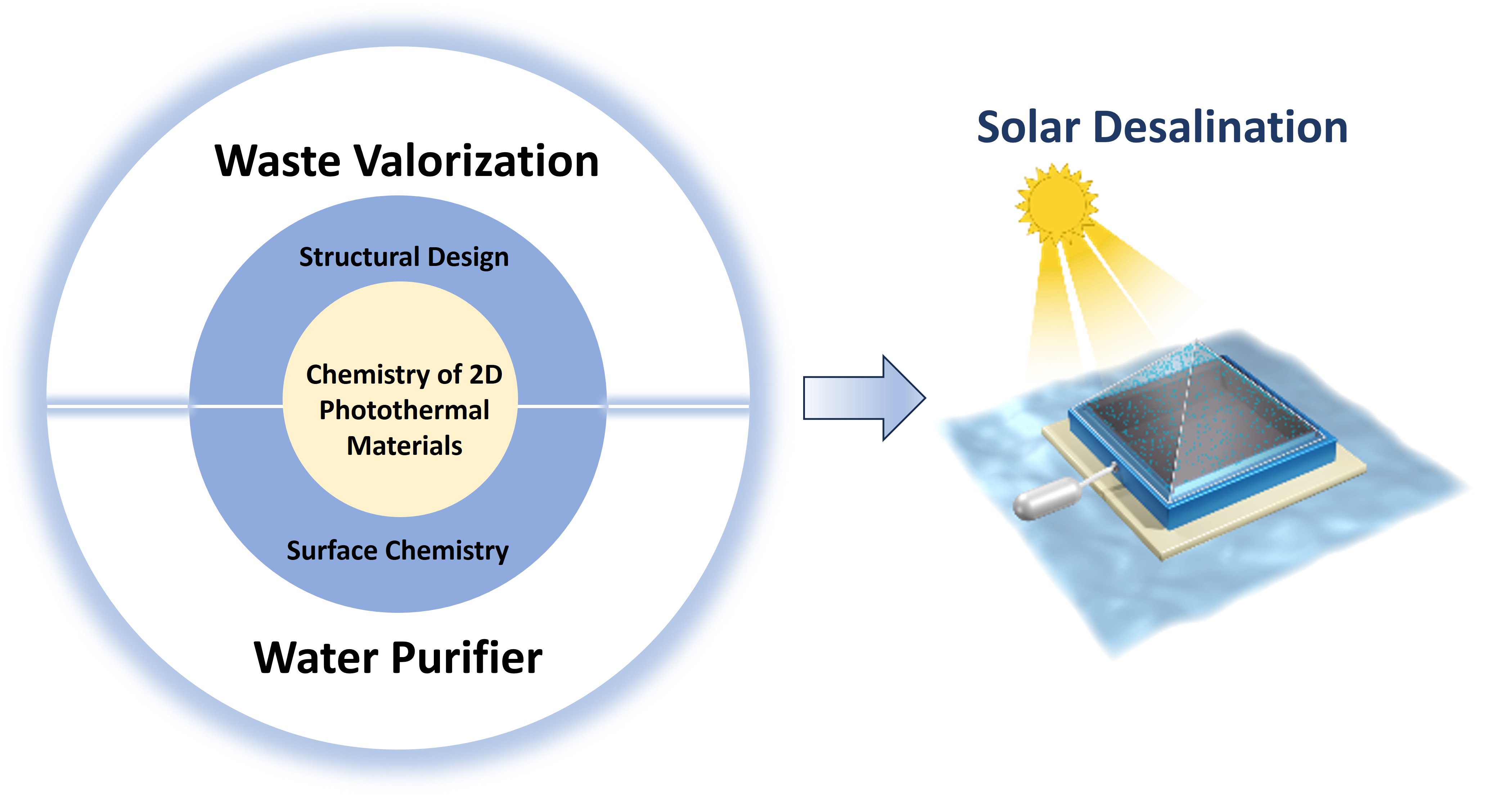
Utilizing a biomimetic design strategy, a bamboo-inspired steam generator was developed through controlled carbonization, incorporating 2D graphite flakes within a hierarchical micro/nanoporous channel network. This H-type structure optimized capillary water transport and photothermal heat localization, achieving an exceptional evaporation rate of 2.28 kg m⁻² h⁻¹ and a photothermal conversion efficiency of 90.2% under one-sun illumination. To further expand sustainable material options, fruit waste was transformed into 2D molybdenum carbide (Mo₂C) via a simple two-step carbonization route. The resulting material exhibited a high surface area (555.1 m² g⁻¹), broad-spectrum solar absorption, and an evaporation rate of 1.52 kg m⁻² h⁻¹ with 94% efficiency. Additionally, graphitic carbon 2D nanosheets were synthesized from plastic waste using a solvothermal-carbonization technique, achieving a remarkable 99% photothermal conversion efficiency and an evaporation rate of 1.50 kg m⁻² h⁻¹.
From a chemical perspective, the superior photothermal performance of these materials was attributed to their tailored surface chemistry and structural design. The oxygen-containing functional groups in carbon-based materials and metal-carbide interfaces in Mo₂C enhanced light absorption, hydrophilicity, and efficient heat transfer. COMSOL simulations were employed for the first time to model capillary-driven water transport and thermal behavior within bioinspired systems, offering fundamental insights into structure-performance relationships.
This study not only demonstrates the high efficiency of waste-derived 2D photothermal materials but also establishes a scalable, sustainable framework for next-generation solar evaporators. By integrating material chemistry, surface engineering, and structural optimization, this work highlights a circular economy approach to water purification and advances the field of chemical engineering and sustainable materials development.