
2025 AIChE Annual Meeting
(525g) Tracking Heavy Metal Contaminants in a Trickle Bed Hydrotreating Reactor with Various Catalyst Shapes Using Noninvasive Dynamic Radioactive Particle Tracking
Authors
Alexandre Velo, Yale University
Jihane Mendil, Missouri University of Science and Technology
Omar Farid, Missouri University of Science and Technology
Sebastian Uribe, Missouri University of Science and Technology
Yasunobu Kaneko, Idemitsu Kosan Co., Ltd.
Kei Sakakura, Idemitsu Kosan Ltd,
Kagota Yasuhito, Idemitsu Kosan Co., Ltd.
Ahmed Jasim, Missouri University of Science and Technology
Muthanna Al-Dahhan, Missouri University of Science & Technology-Rolla
Trickle Bed Reactors (TBR) are widely used gas-liquid-solid interaction systems in various processes, including petroleum hydrotreating (hydrodesulfurization, hydrodenitrification, hydrodemetallization, hydrocracking, etc.), hydrogenation reactions, oxidation reactions, esterification, and Fischer-Tropsch synthesis. During these operations, contaminants are inevitably introduced into the TBR, particularly in hydroprocessing applications where heavy residual oils are converted into lighter fuel oils. These contaminants contribute to catalyst deactivation through chemical, mechanical, or thermal effects such as poisoning, fouling, thermal degradation, or attrition, leading to issues like hot spots, excessive pressure drop, and potential emergency shutdowns. This study investigated the deposition sites of heavy metal contaminants in various catalyst beds, spheres, cylinders, trilobe, and quadrilobed within Trickle Bed Reactors using a newly developed modified Dynamic Radioactive Particle Tracking (DRPT) system. The Kernel Density Estimator (KDE) was applied to predict the probability density distributions of heavy metal contamination deposition in terms of bed radius and height. The results indicate that the probability density distributions for all four catalyst shapes are similar in terms of radius, whereas spherical catalysts exhibit a broader distribution range along the bed height. In packed catalyst beds, heavy metal deposition is closely linked to pressure drops along the bed height, reflecting variations in bed porosity and structural complexity. Higher levels within packed beds, where pressure drops are more significant, present greater opportunities for heavy metal deposition.
Figure Caption: Schematic of the Dynamic Radioactive Particle Tracking system.
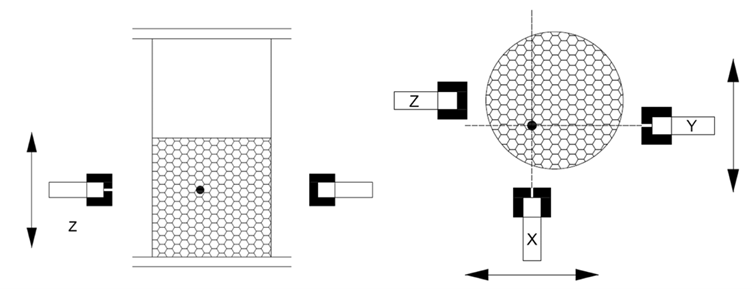
Figure Caption: Schematic of the Dynamic Radioactive Particle Tracking system.