2025 AIChE Annual Meeting
(61b) Towards Real-World Engineering Thinking: Facilitator Moves during Small Group Collaborative Learning
This study investigates how activity design and instructor facilitation intersect as students engage with both traditional and real-world engineering work in a chemical engineering thermodynamics course. The course has a studio structure where students rotate between participating in large lectures and smaller studio sections each week. In the studios, students collaborate in small groups to work on problems presented in handouts, facilitated by graduate teaching assistants (GTAs) and undergraduate learning assistants (LAs). Within the studio sessions, students work on conceptually oriented activities in some weeks and professionally oriented activities in other weeks. The conceptually oriented activities are a reformed version of activities in traditional academic settings, focusing both on procedural fluency and conceptual understanding. In these activities, students are asked to identify and solve equations to reach numerical answers but also to provide qualitative explanations for certain phenomena utilizing thermodynamics principles. The professionally oriented activities reflect real-world engineering work where the students are provided ill-structured ambiguous problems related to thermodynamics concepts. Within these contrasting activity designs, we identified two contrasting facilitation approaches—one being dialogic and the other authoritative. In dialogic facilitation, the facilitator values multiple perspectives and supports the students as agentic builders of knowledge. In authoritative facilitation, the facilitator positions themselves as the authority who knows the single correct answer and guides the students to that, similar to the instructional styles in traditional academic settings (Carlos et al., 2023).
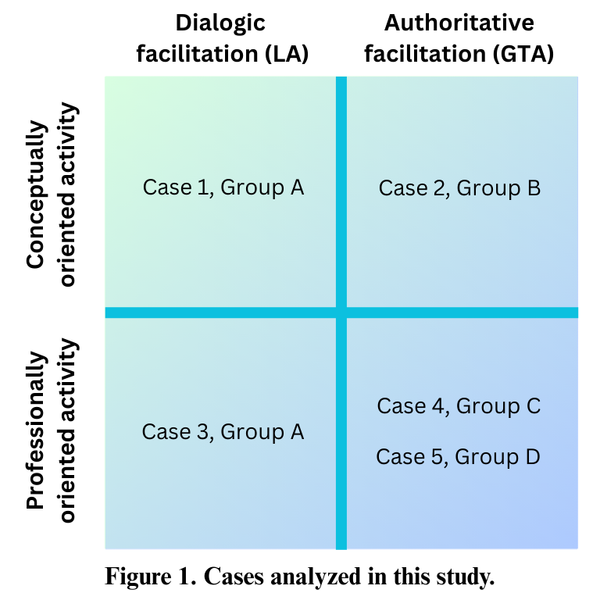
We take a comparative case study approach (Yin, 2018) using interaction analysis (Jordan & Henderson, 1995) techniques to construct and compare 5 cases of student teams during the studio. We sample one studio session from a traditional reform conceptually oriented studio activity and one from a professionally oriented studio activity. We analyze video recordings as the teams progress in the activities with a particular focus on students’ interactions with the facilitators and how the interactions influence their trajectories of sensemaking. We contrast the influence of an LA who often takes on dialogic facilitation practices with a GTA who often takes on authoritative facilitation practices as shown in Figure 1. Our study is guided by the research questions: How do different facilitation practices influence students’ engagement in real-world engineering work in a foundational engineering course? How does the influence of facilitation compare to more traditional reform activities?
During the conceptually oriented activity, despite the facilitators’ different facilitation practices, the groups followed similar sensemaking trajectories. Both groups encountered similar obstacles that required them to apply similar concepts and thinking, and eventually reached similar answers among themselves. However, in the professionally oriented activity, the two groups interacting with the authoritative facilitator followed similar sensemaking trajectories to each other but a different trajectory than the group interacting with the dialogic facilitator. In that latter case, students in the group had different understandings of the activity’s objective—one considered it as a traditional activity in an academic setting where there was only one correct answer, while the other was skeptical. The LA facilitated the students to frame the activity in a real-world setting where there are many ways to interpret and solve the problem. After the interaction with the LA, the students worked collaboratively to come up with possible paths for the solution. In contrast, when interacting with the problem alone, groups C and D each collaboratively drew on their knowledge and resources to make sense of the problem and come up with solutions. However, when interacting with the GTA, the GTA continued to pose multiple guided questions to lead the students down his way of solving the problem, prompting the groups to abandon their previous sensemaking and adopt the answer that the GTA offered to them. However, as the groups moved on to the latter part of the handout, they were able to reorient themselves, collaboratively work on the problem, and situate themselves in real-world engineering thinking.
The findings suggest that in more traditional reform activities such as the conceptually oriented activity we studied, different facilitation practices do not alter much of the students’ sensemaking trajectories. We speculate that the handouts were designed to support the students in developing their sensemaking along certain paths and these sustained despite the difference in facilitations. On the other hand, in the cases studied here, different facilitation practices in real-world engineering activity largely influenced students’ sensemaking trajectories, with authoritative practices short-circuiting the goal of exploring multiple solution paths. However, we also found that to some extent, the handout played a role in bringing the students back into exploring multiple paths. This study implies that when designing activities in foundational engineering courses so the students can engage with real-world engineering work, both the activity materials such as the handout, and the facilitation practices play important roles. Instructors should design materials that scaffold real-world engineering work, while facilitators should adopt practices that embrace the ambiguity of the problem and position the students as agents to navigate their paths of solution.