2025 AIChE Annual Meeting
(465b) Theoretical Investigation of Sarin Degradation By Single Metal Atoms Supported on Nitrogen-Doped Graphene Oxide
Authors
Jordan Bush - Presenter, United States Military Academy
Walter J. Cesarski, United States Military Academy
Sean T. Murray, United States Military Academy at West Point
Caleb C. Johnson, United States Military Academy
Victor A. Jaffett, United States Military Academy West Point
Kenneth J. McDonald, United States Military Academy
Simuck Yuk, United States Military Academy
Abstract: Today’s political environment is uncertain: lone wolf actors, coups, and bold moves by state actors all spell a need for readiness to react to any threat for soldiers and civilians. In the wake of COVID19, the world has seen the disastrous effects biological or chemical weapons can have on society. Efforts to counteract these threats are imperative. Our study focuses on the degradation of the nerve agent sarin. Although not seen in use since 1995, sarin’s lethality is concerning enough to warrant more research into an effective method to safeguard soldiers or first responders.1-3 Our fundamental understanding of how sarin interacts with other substances and decomposes remains largely unknown. Gaining mechanistic insights into the chemical degradation of sarin is essential in developing effective mitigation platforms against such chemical weapons.
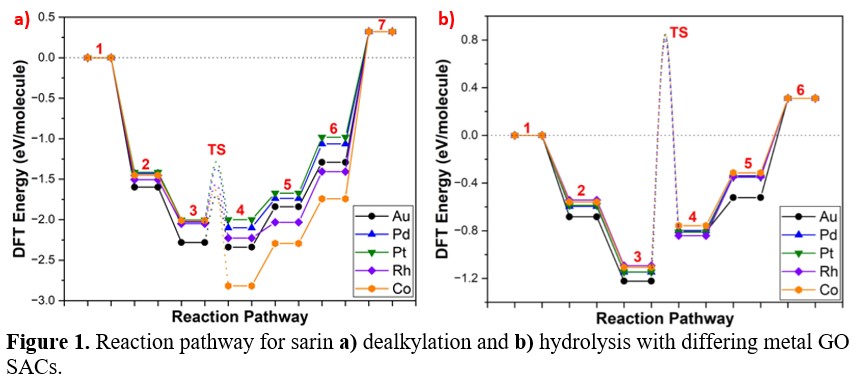
In this study, we explored the degradation mechanisms on the single atom catalysts (SACs) of various metals (Au, Pd, Pt, Rh, Co, Ag, and Cu) supported on the nitrogen-doped graphene oxide (GO) surface using density functional theory (DFT), ab initio molecular dynamics (AIMD), and nudged elastic band (NEB) calculations. Two prominent mechanisms of sarin degradation were investigated in this study: hydrolysis and dealkylation. The hydrolysis mechanism favored cleavage of the P–F bond resulting in the creation of HF and isopropyl methylphosphonic acid (IMPA). Dealkylation favored O–C bond cleavage to form propene and CH3O2PF. We found that the activation barrier of SACs is significantly lower with dealkylation pathways against hydrolysis pathways. A linear correlation is observed between the energy difference and activation barrier of sarin decomposition steps for both mechanisms. Our study shows that the choice of metal is critical for efficiently tuning the performance of SACs for sarin’s degradation on the GO. While the degradation products of sarin herein are still safety concerns, this study can support further research into safe nerve agent degradation due to SAC/support tunability.
In this study, we explored the degradation mechanisms on the single atom catalysts (SACs) of various metals (Au, Pd, Pt, Rh, Co, Ag, and Cu) supported on the nitrogen-doped graphene oxide (GO) surface using density functional theory (DFT), ab initio molecular dynamics (AIMD), and nudged elastic band (NEB) calculations. Two prominent mechanisms of sarin degradation were investigated in this study: hydrolysis and dealkylation. The hydrolysis mechanism favored cleavage of the P–F bond resulting in the creation of HF and isopropyl methylphosphonic acid (IMPA). Dealkylation favored O–C bond cleavage to form propene and CH3O2PF. We found that the activation barrier of SACs is significantly lower with dealkylation pathways against hydrolysis pathways. A linear correlation is observed between the energy difference and activation barrier of sarin decomposition steps for both mechanisms. Our study shows that the choice of metal is critical for efficiently tuning the performance of SACs for sarin’s degradation on the GO. While the degradation products of sarin herein are still safety concerns, this study can support further research into safe nerve agent degradation due to SAC/support tunability.
References:
- Okumura, T. Annals of Emergency Medicine 1996, 28 (2), 129–135.
- Kim, K. Rev. 2011, 111 (9), 5345–5403.
- Fitzgerald, G. J. J. Public Health 2008, 98, 611-625.