2025 AIChE Annual Meeting
(564e) Tangential Flow Filtration Using Reverse Asymmetric Membranes for Harvesting Adeno Associated Virus
Authors
Human embryonic kidney (HEK) 293 cells were cultivated in suspension. The initial cell seeding density was set at 0.3 x 10⁶ cells mL-1. Cell growth was monitored every 24 hours to determine the optimal time for AAV transfection. The cells were lysed using 10% (v/v) AAV-MAX lysis buffer. TFF was conducted using a BioOptimal MF-SLTM microfilter (Asahi Kasei Bioprocess) which contains a reverse asymmetric membrane. Flux stepping experiments were conducted in total recycle mode to determine the sustainable (critical) flux. Based on these experiments, the sustainable flux, maximum transmembrane pressure (TMP) and wall shear rate (feed flow rate) were determined. Finally, TFF was conducted in order to harvest AAV.
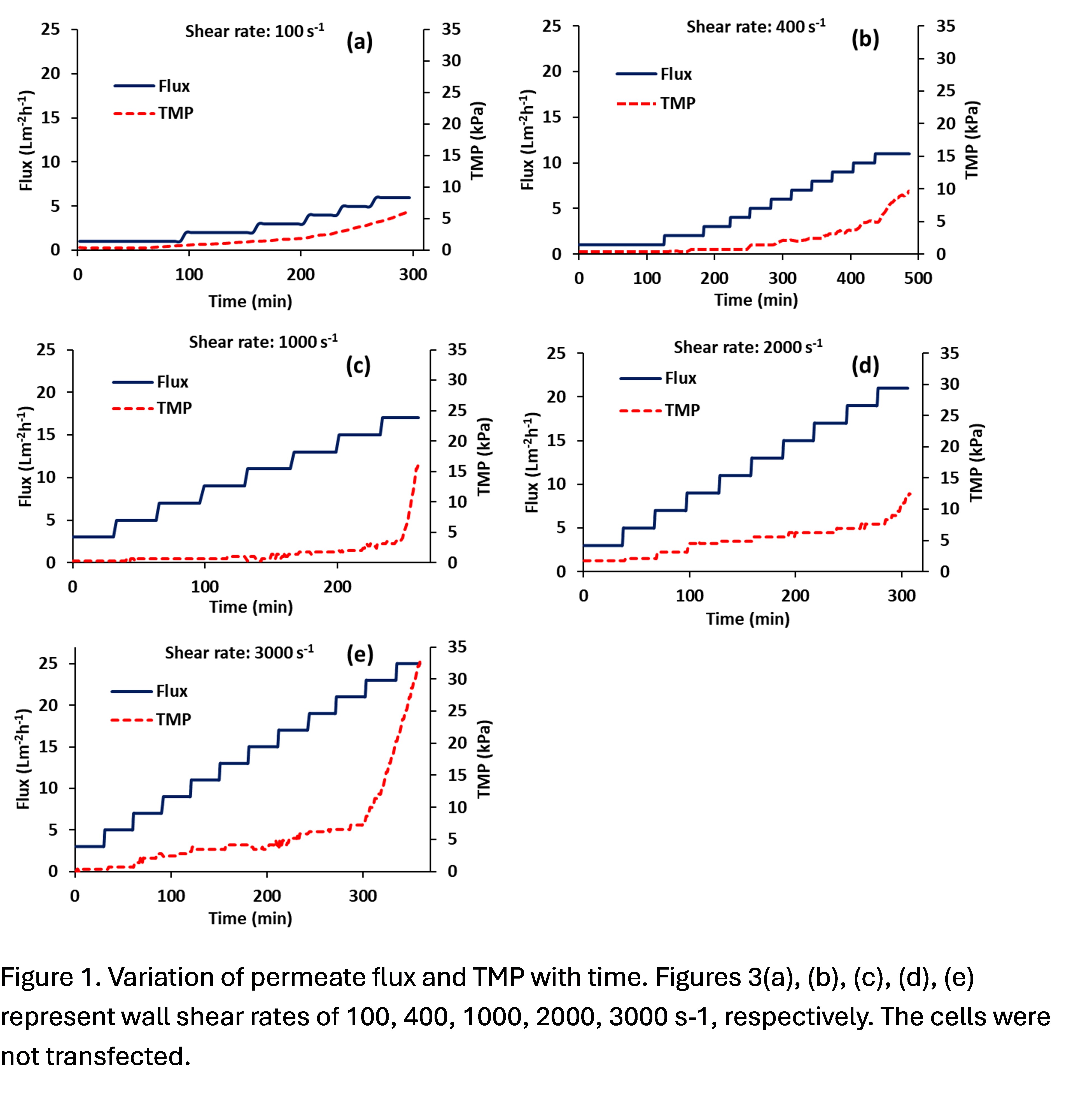
Figure 1 shows the variation in permeate flux and TMP with time for the flux stepping experiments at a range of wall shear rates. The sustainable flux is the maximum stable flux for 30 min (the time used for each flux value in the flux stepping experiments). Higher fluxes lead to a rapid increase in TMP. As can be seen, the TMP increases rapidly as the sustainable flux is passed. The sustainable flux increases with increasing feed flow (wall shear rate). Based on the flux stepping experiments, the wall shear rate was set at 2,000 s-1 and the flux at 15 Lm-2h-1. When the TMP increased to 3.5 kPa diafiltration commenced using 3 diavolumes. The TMP remained approximately constant during diafiltration which commenced after 150 min of operation. Virus recovery was 94%.
The results obtained here indicate the importance of carefully controlling the maximum flux and TMP. Flux stepping experiments under total recycle provide a rapid method to estimate the sustainable flux. Diafiltration is important to maximize recovery of virus particles.