2025 AIChE Annual Meeting
(251e) Tailoring Catalytic Activity in Dry Methane Reforming Via Atomic-Level Support Modification
Authors
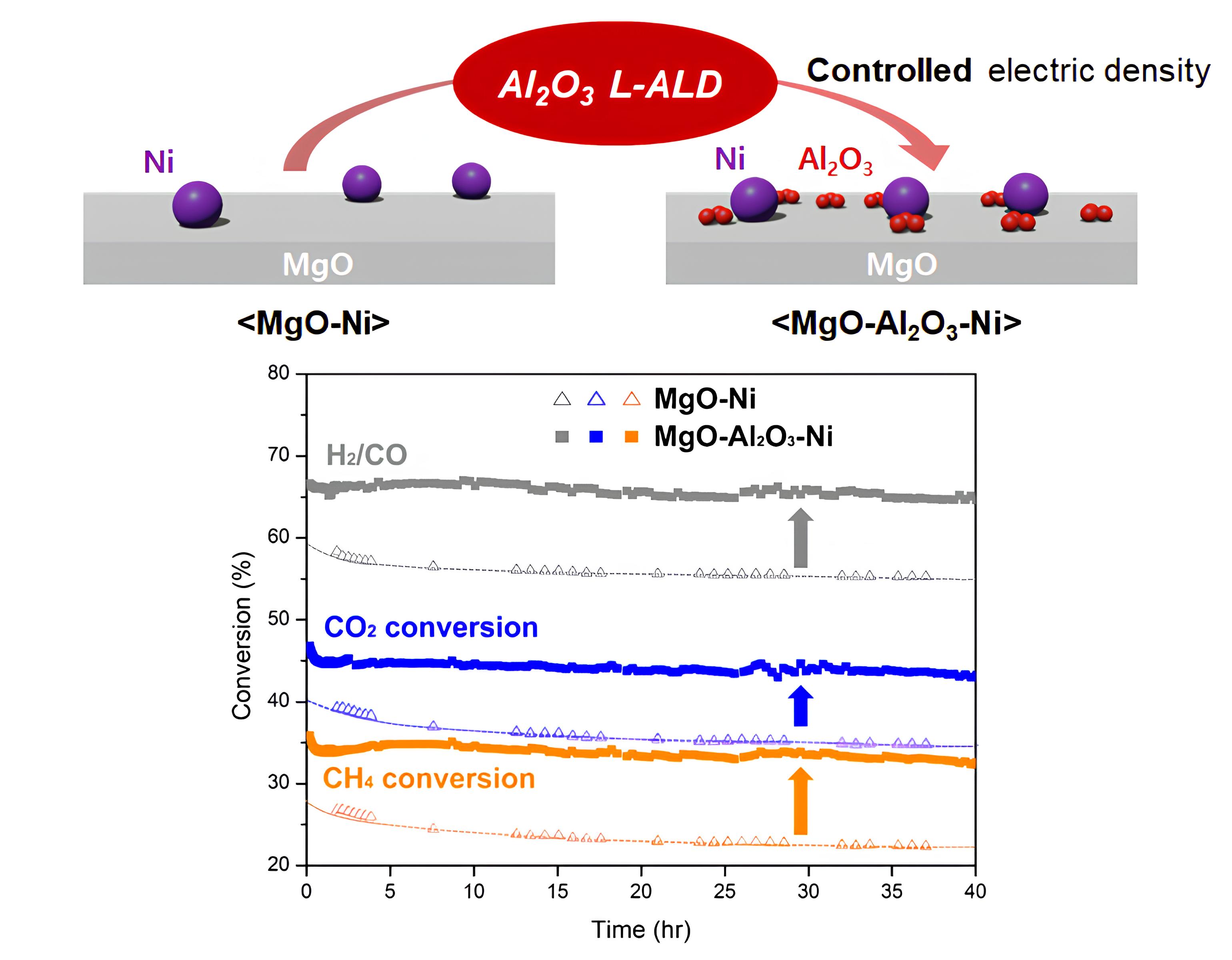
Atomic layer deposition (ALD) enables precise atomic-scale control of catalyst structures, improving stability under harsh conditions. While conventional ALD studies have primarily focused on overcoating active metals to prevent deactivation, this study employs liquid-phase ALD (L-ALD) to modify the electronic properties of the support by depositing only a few atoms. By tuning the electronic density of the support rather than forming a protective shell, we demonstrate that even a single atomic layer of Al₂O₃ significantly enhances catalytic activity. This approach leads to notable improvements in reaction performance compared to bulk-phase Al₂O₃-modified supports reported in previous studies.
To elucidate the impact of ALD modifications, we synthesized MgO–Al₂O₃–Ni catalysts with precisely controlled Al₂O₃ layers via L-ALD and characterized them using H₂-TPR, XPS, DRIFTS, and CO₂-TPD. The results reveal how atomic-level modifications influence reaction chemistry, contributing to enhanced stability and activity. This study highlights a novel catalyst design approach using ALD beyond conventional overcoating strategies, providing insights into rational catalyst engineering for high-temperature reactions and carbon utilization technologies.