2025 AIChE Annual Meeting
(236g) A Systematic Approach to Measuring Flammability Limits of Refrigerants with Low Global Warming Potential
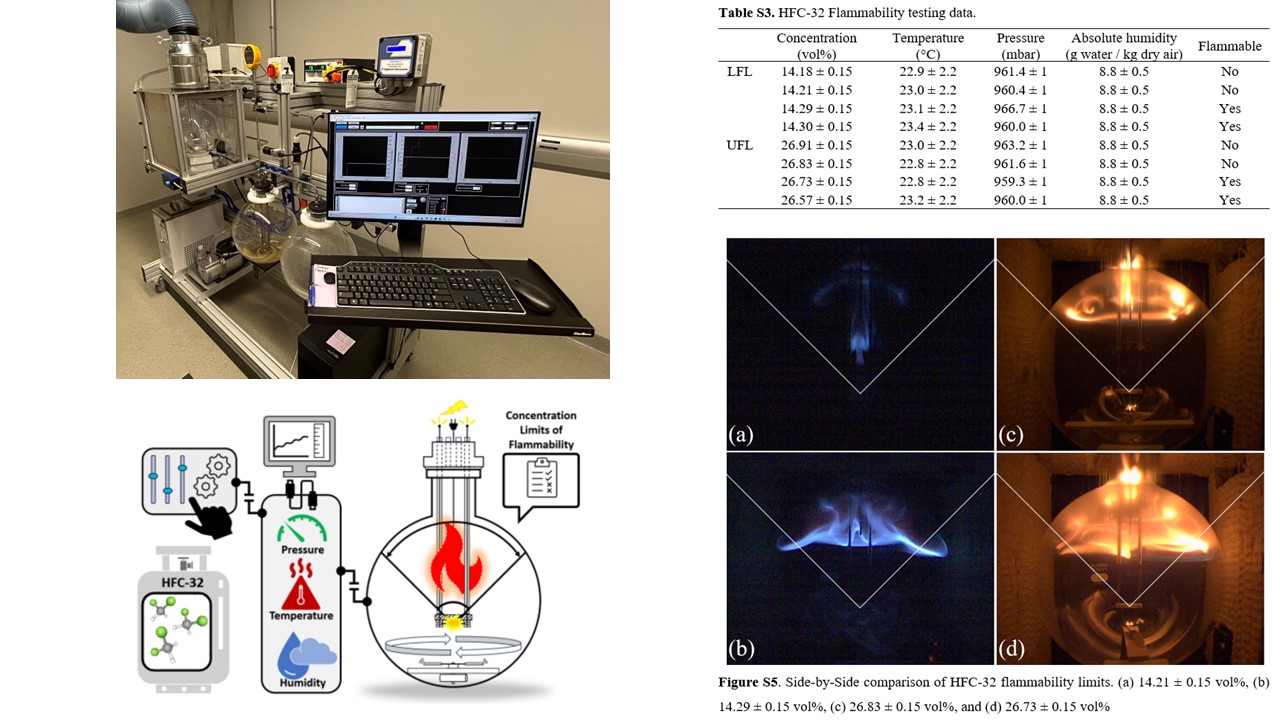
In this study, an experimental apparatus following the ASTM E681-09 test method was developed that enabled precise control over test conditions including temperature, pressure, humidity, and ignition strength. Throughout the design of the apparatus, several design factors that may influence the observed flammability limits were identified. The flammability limits of HFC-32, a popular low-GWP refrigerant, were measured to investigate repeatability, and the results were compared with literature measurements. An error analysis is underway to isolate and quantify the impact of uncertainty in test conditions on the observed flammability limits of HFC-32, providing insight into the effect of key variables and facilitating comparisons across laboratories. Unique modifications to the apparatus and procedure, such as coupled pressure rise and visual criteria, will also be explored to understand exactly how these variables affect the accuracy and precision of flammability limit measurements. After refining the ASTM E681 methodology, the flammability limits of HFO-1234yf and HFC-152a mixtures will be investigated over a range of concentrations, providing pertinent data for low-GWP refrigerants currently under consideration and commercialization.
From a database of flammability metrics generated through literature review and the aforementioned experimental apparatus, the future goal of this research is to develop predictive models capable of circumventing resource-intensive experiments. Along with accuracy and computational efficiency, the selection among thermodynamic, empirical, and machine-learning models will be based on the potential to screen for new refrigerant components and blends that optimize safety, efficiency, and sustainability in various refrigerant applications. Through this approach, we seek to establish a comprehensive understanding of the flammability characteristics for single component refrigerants and mixtures. Ultimately, the goal is to provide engineers and safety professionals with effective tools for assessing flammability hazards, thereby facilitating the design and operation of safe and sustainable Heating, Ventilation, Air-Conditioning, and Refrigeration (HVACR) systems.