2025 AIChE Annual Meeting
(196g) Synthesis of Ultra-Thin Shelled Hollow Faujasite in a Novel Non-Invasive One-Pot Approach
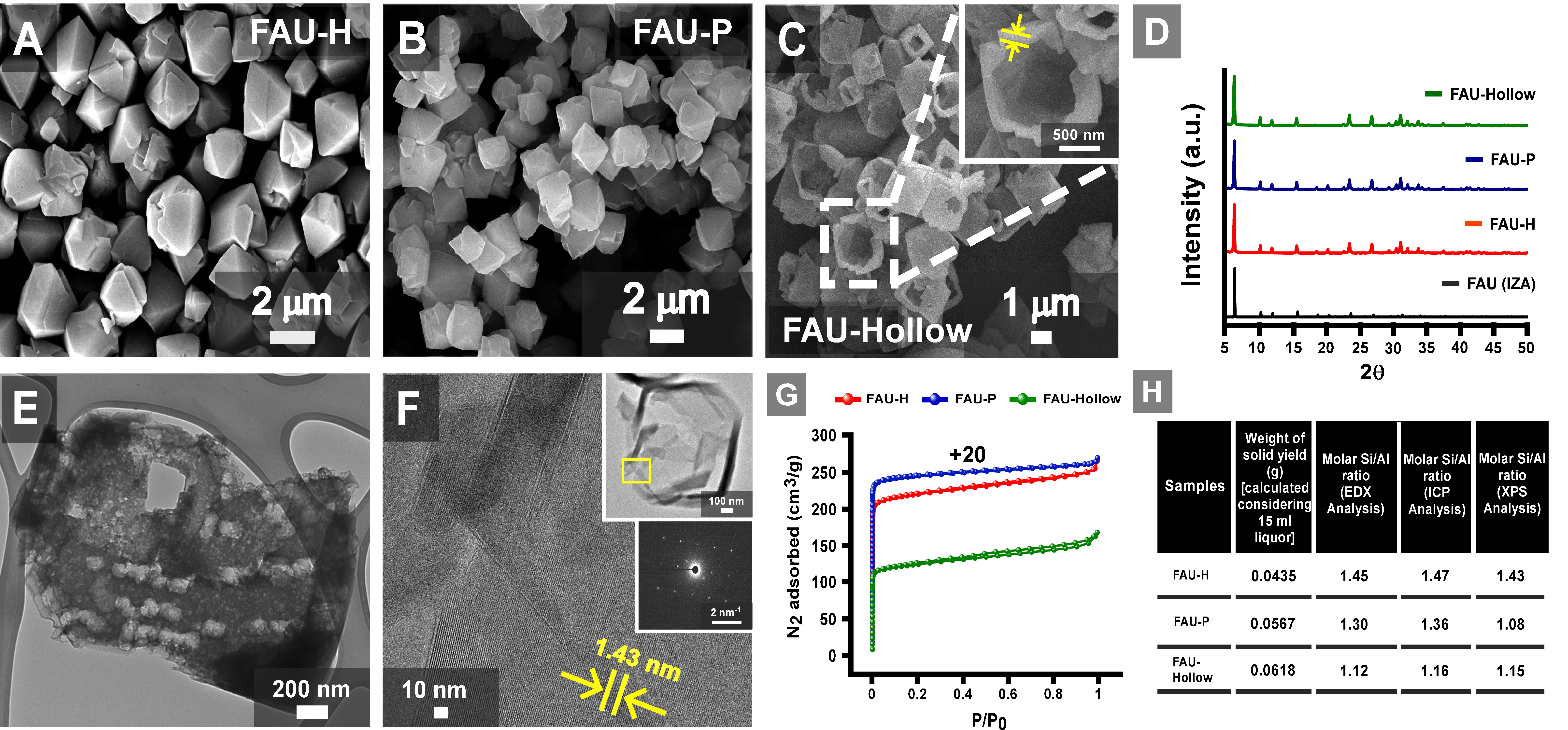
Faujasite has emerged as the game-changer zeolite with a multifaceted application ranging from gas adsorption to catalysis. For both applications, physisorption or chemisorption of the reagent molecules occurs at the specific locations inside the pores. However, molecular diffusion through the intracrystalline pathways plays a deterministic role in the performance parameters owing to diffusional constraints. From this viewpoint, we have designed a unique ultra-thin hollow Faujasite synthesized via a non-invasive one-pot modified hydrothermal route using amine base polymer as the organic modifier. In this modified pathway, hydrothermal treatment takes place in two steps: initially at a lower temperature for a specific time period, followed by at a higher temperature. The pure FAU phase has formed for both the cases with (denoted FAU-Hollow) and without using polymer (denoted FAU-P). Interestingly, the final solid yield for the FAU-P was observed to increase compared to the typical hydrothermal product (denoted FAU-H). Besides, the molar Si/Al ratio (SAR) of the surface solid particles (calculated using XPS analysis) was observed to decrease compared to bulk SAR (obtained from ICP and EDX analysis), suggesting the presence of Al-rich surface, which in turn promotes core dissolution leaving the shell intact when Polymer is used. Uniform hollow FAU particles with an average shell thickness in the range of 40-120 nm are formed in this Polymer-modified hybrid hydrothermal procedure. Interestingly, the solid yield of FAU-Hollow was observed to be greater compared to the typical hydrothermal product, suggesting the unique phenomenon of simultaneous core dissolution and shell recrystallization in this new pathway. Moreover, the crystalline shells have mesopores (from TEM/HRTEM analysis) with an average mesopore diameter of 5 nm (obtained from N2 physisorption studies, BJH plot). Overall, a new non-invasive synthesis approach is reported that generates hollow FAU, which will improve on-stream catalyst lifetime, conversion, and selectivity in hydrocarbon cracking reactions.