2025 AIChE Annual Meeting
(570f) Synergistic Mixed Functional Group Coupling for Biocrude Enhancement and Radical-Assisted Char Suppression during Hydrothermal Liquefaction
Authors
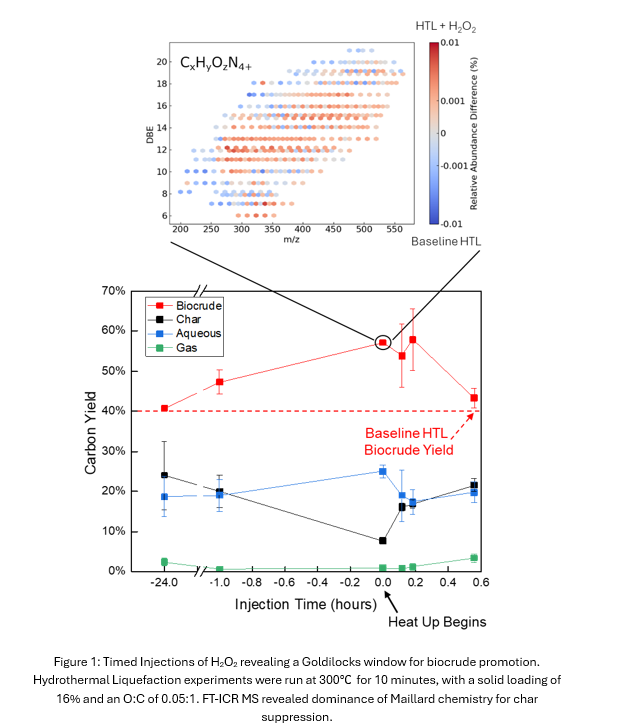
As shown in figure 1, H2O2 injections were performed before heating began (t = -24 and -1 hours), directly when heating began (t=0 hours), and at multiple times during heat-up corresponding to temperatures of 30, 100, and 300 ℃ (t = 0.11, 0.19, and 0.55 hours, respectively). Pretreatment of sludge with H2O2 was found to be ineffective, suggesting that the reactive oxygen species formed from the H2O2 addition need to be active during the process for the yield enhancement to occur. Injections performed at reaction temperature also showed negligible increase in yield, which was consistent with independent analysis of H2O2 decomposition to water and molecular oxygen (half-life 3 seconds at 300 [3]) and control experiments with molecular oxygen addition to SS-HTL.
Fourier Transform Ion Cyclotron Resonance Mass Spectrometry (FT-ICR MS) was then performed on the biocrudes comparing H2O2 addition to SS-HTL to the baseline case. Over 12,000 unique species were identified with their relative abundances quantified and compared against the non-H2O2 case. The addition of H2O2 resulted in decreased relative abundance of compounds with six or more oxygen, correlating to an increase in the number of radical reactions with polyoxygenated carbohydrates. Highly nitrogenated compounds (N4+) were also found to be more common when H2O2 addition occurred, suggesting the prevalence of carbonyl-mediated Maillard reactions.
Sources:
- LeClerc, H. O.; Tompsett, G. A.; Paulsen, A. D.; McKenna, A. M.; Niles, S. F.; Reddy, C. M.; Nelson, R. K.; Cheng, F.; Teixeira, A. R.; Timko, M. T. Hydroxyapatite Catalyzed Hydrothermal Liquefaction Transforms Food Waste from an Environmental Liability to Renewable Fuel. iScience 2022, 25 (9), 104916.
- AOPs: Lin, H.; Li, X.; Yang, Y.; Wang, D.; Zhang, H.; Yang, M. Advanced Oxidation Processes (AOPs)-Based Sludge Conditioning for Enhanced Sludge Dewatering and Micropollutants Removal: A Critical Review. Sci. Total Environ. 2022, 807, 150673.
- H2O2 Decomp: Lin, C. C.; Smith, F. R.; Ichikawa, N.; Baba, T.; Itow, M. Decomposition of Hydrogen Peroxide in Aqueous Solutions at Elevated Temperatures. J. Chem. Kinet. 1991, 23 (11), 971–987.