2025 AIChE Annual Meeting
The Synergistic Activity of Positively Charged Liposomes and LL-37 on Bacteria
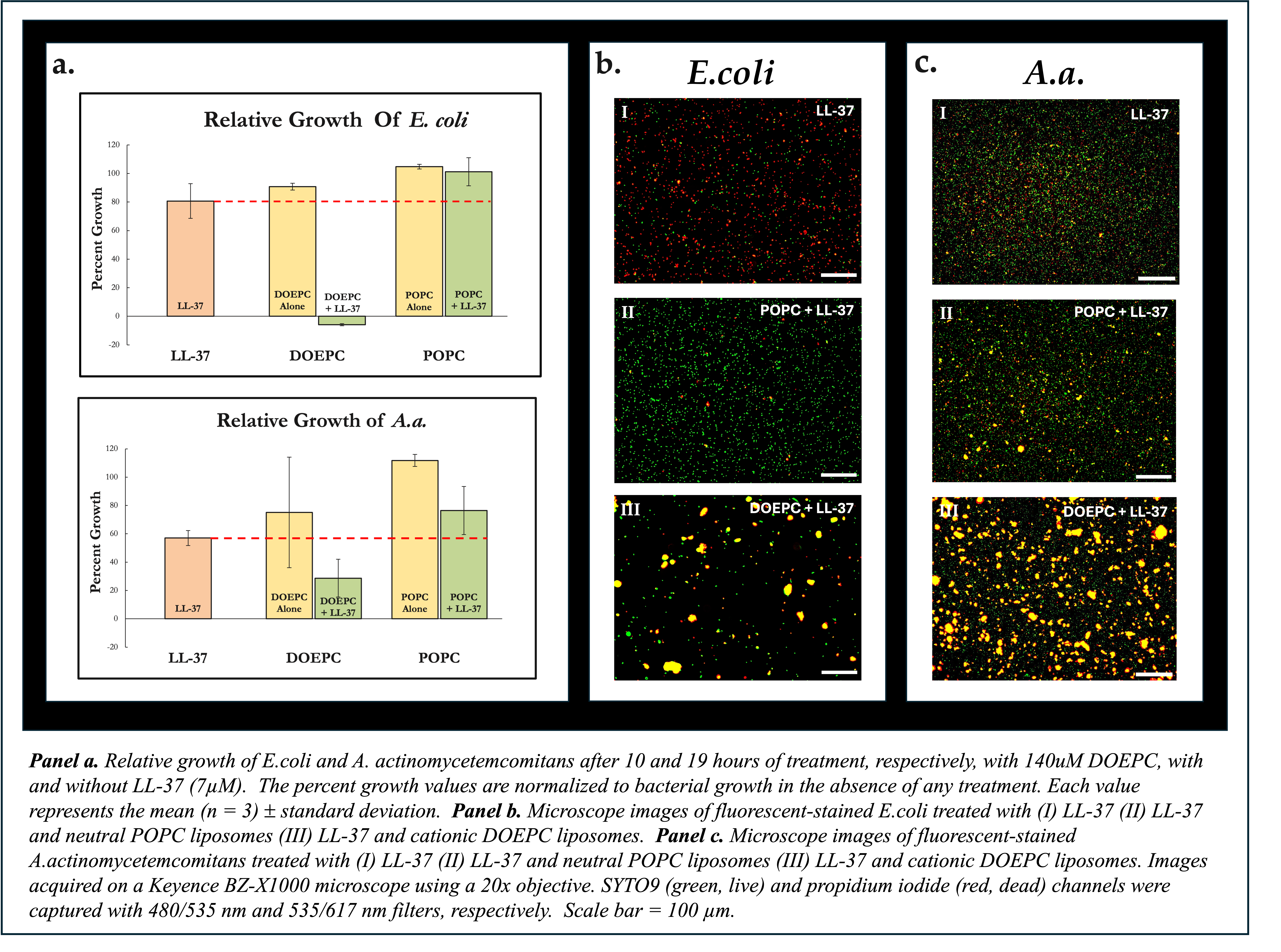
Antibiotic resistance is an escalating global health concern that demands novel therapeutic approaches. Antimicrobial peptides (AMPs) such as LL-37 exhibit broad-spectrum antibacterial activity through membrane disruption, yet their clinical translation remains limited by high concentration requirements and instability. Our lab previously observed enhanced antibacterial activity of LL-37 when co-delivered with liposomes composed of the cationic lipid DOEPC, suggesting synergistic activity. To test this, we treated Escherichia coli and Aggregatibacter actinomycetemcomitans with LL-37 and liposomes composed of varying ratios of neutral POPC and cationic DOEPC. Bacterial growth was monitored via optical density, and membrane integrity was evaluated using live/dead fluorescence staining. Results revealed a charge-dependent interaction: POPC liposomes suppressed LL-37 activity, whereas DOEPC liposomes enhanced activity in a dose-dependent manner. Liposomes alone, regardless of composition, exhibited minimal impact on bacterial growth, indicating that the observed effects are due to the combined activity of liposomes and LL-37. Fluorescence microscopy confirmed DOEPC-mediated membrane disruption and highlighted additional phenomena such as bacterial flocculation in DOEPC-containing samples. Additionally, imaging of fluorescein-conjugated LL-37 and stained bacteria confirmed a greater association of LL-37 with DOEPC-treated cells. These findings demonstrate a synergistic antibacterial mechanism between LL-37 and cationic lipids, suggesting that lipid composition can be tuned to enhance AMP efficacy.