2025 AIChE Annual Meeting
(140c) Sustainable Biological Production of Xylitol
Authors
Emma Brace - Presenter, Purdue University
Sarvada Chipkar, Michigan Technological University
Luke Baxter, Boston College
Melanie Cotta, Boston College
Isabella Doyle, Boston College
Gillian Mohr, Boston College
William Rice, Boston College
Claire Richter, Boston College
Charlotte Tonelli, Boston College
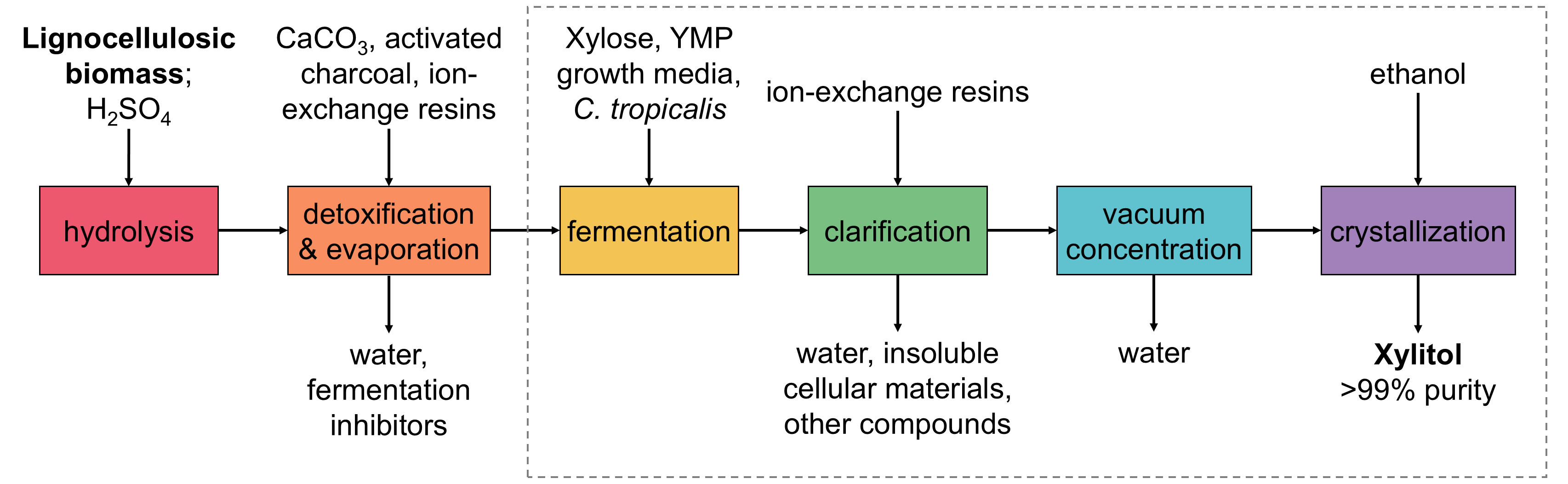
Xylitol is a valuable platform molecule due to its many applications in food, dental, and pharmaceutical industries. Xylitol can act as a sugar substitute, prevent cavities, and act as a drug carrier due to its high permeability and non-toxic nature. Xylitol has been identified as a high value platform chemical by the U.S. Department of Energy as it is a promising target molecule that could be sustainably produced from lignocellulosic biomass. Conventional commercial production of xylitol from biomass involves a thermochemically intensive process using high pressures, high temperatures, and costly catalysts to complete the final hydrogenation step. An alternative biological pathway using fermentation could contribute to a lower market price of xylitol. However, this greener alternative poses a major challenge to the purification of the xylitol due to the formation of other compounds in the hydrolysate. The objective of this work is to produce xylitol from the fermentation of Candida tropicalis and to develop an ion-exchange separation method and xylitol purification technique using crystallization of produced xylitol. In this research, xylose was fermented to xylitol using C. tropicalis with and without pH controls. During the fermentation process, cell growth was measured using OD600 spectrophotometry. The fermentation hydrolysates were passed through a commercially available cationic ion-exchange resin, Amberlite IRC-748, using a gravity column. Sugar and sugar-alcohol concentrations were then evaluated using HPLC. After optimizing the laboratory experiments (fermentation, separation, crystallization), process design, techno-economic analysis, and life cycle assessment were used to evaluate the sustainability of this biological production approach for producing xylitol. Future work includes exploring experimental evolution strategies and gene knockouts to develop a xylitol super-producing strain of C. tropicalis.