2025 AIChE Annual Meeting
(117c) Support Effects in Fischer-Tropsch Synthesis.
Authors
Our central hypothesis is that by using basic oxide supports, electron density can be injected into supported ruthenium (Ru) and cobalt (Co) nanoparticles, strengthening the binding of CO to the surface and driving the selectivity toward long-chain hydrocarbons and eliminating methanation.
Results demonstrate that support basicity significantly influences product selectivity. For Co catalysts, methane selectivity decreased from 35% to 17% when comparing Co/SiO₂ to Co/MgAlOₓ, with concurrent increases in C₅+ selectivity at 493 K. These results are attributed to the stronger CO binding on the metal catalyst surface, as evidenced by higher CO desorption temperatures and a shift in the CO IR stretching frequency to higher wavenumbers on the basic supports.
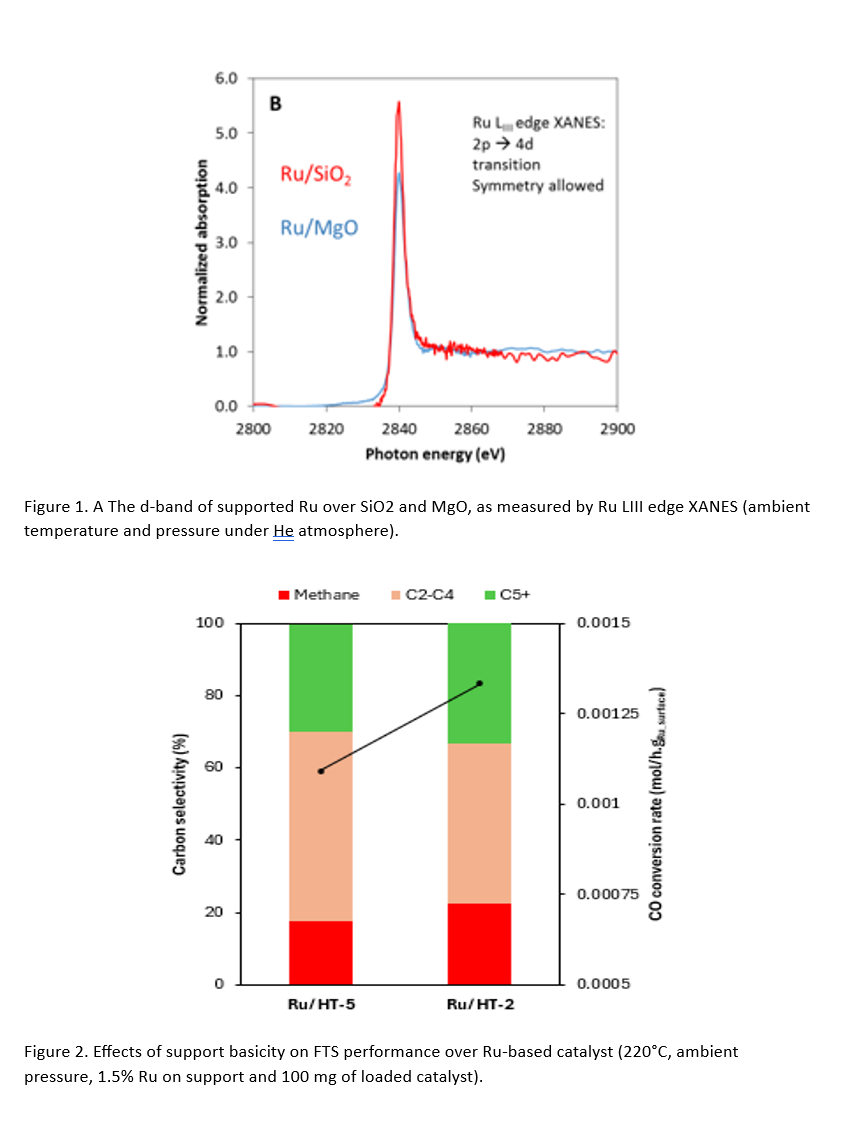
Similarly, Ru/MgO exhibited 35% lower methane selectivity than Ru/SiO₂ at differential conversion. Ru L₃-edge XANES spectroscopy revealed decreased 4d-band hole density in MgO-supported Ru compared to SiO₂-supported Ru, consistent with electron donation from the basic support. Additionally, higher support basicity, achieved by increasing the Mg ratio, enhanced electron density transfer to metal particles, strengthening CO binding and improving selectivity toward long-chain hydrocarbons. The most basic support (Ru/HT-5) effectively eliminated methanation.
This work demonstrates how tuning support basicity can optimize FTS catalyst performance at ambient pressure through EMSI effects, potentially enabling economical upgrading of stranded natural gas in small-scale operations.