2025 AIChE Annual Meeting
(460f) Study of Oxygen Transfer on Ceria for Oxidation Reaction with Single Atom Pt Catalysts
Authors
Jaebeom Han, Korea Advanced Institute of Science & Technology (KAIST)
Hyunjoo Lee, Korea Advanced Institute of Science and Technology
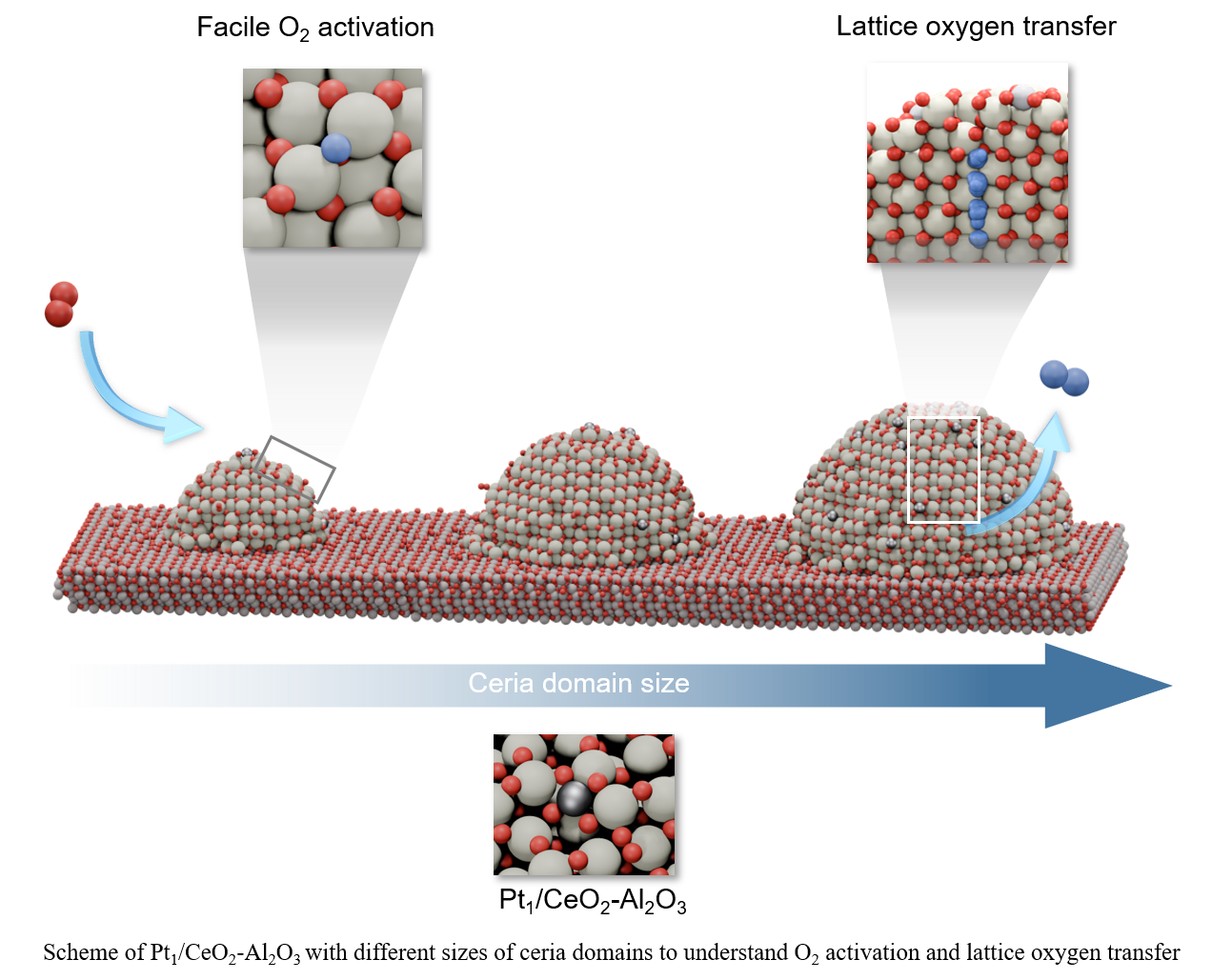
Reducible metal oxides, such as ceria, play a vital role in oxidation reactions due to their ability to activate and transfer oxygen. Mars-van Krevelen mechanism describes how reactants oxidize by surface oxygen species of the catalyst, creating vacancies. These oxygen vacancies are replenished by lattice oxygen transfer, with gaseous oxygen being incorporated into the lattice. Ceria is widely studied to follow this mechanism due to its fast Ce3+/Ce4+ redox property. In this study, we synthesized Pt/CeO2-Al2O3 catalysts with ceria domain sizes varied at 3.7, 5.6, and 7.3 nm. These ceria domains were isolated on alumina to exclude oxygen transfer between ceria domains. Pt was synthesized as single atom structure to eliminate the potential influence of Pt nanoparticles on O2 activation. We conducted CO oxidation as a probe reaction under O2-rich and O2-deficient conditions. Surprisingly, the trend in catalytic activity was reversed depending on the condition. The small ceria domains (3.7 nm) exhibited efficient O2 activation but minimal lattice oxygen transfer. Conversely, larger ceria domains (7.3 nm) displayed lower O2 activation but significant lattice oxygen transfer. This was also modeled using large-scale molecular dynamics simulations using a neural network potential trained on first-principles data. Based on these findings, we also tested the catalysts for methane oxidation by exploiting O2 activation under O2-rich condition. This study highlights how design of metal oxides can enhance the understanding of metal oxide catalysts.