2025 AIChE Annual Meeting
(141g) Studies on Nutrient Recovery, Lipid Production and Assessment of Growth Kinetics of Microalgae Scenedesmus Obliquus 5586 Under Photo-Heterotrophic Growth
Authors
Sumona Das - Presenter, India Institute of Technology Bombay
Indrajit Chakraborty, India Institute of Technology Bombay
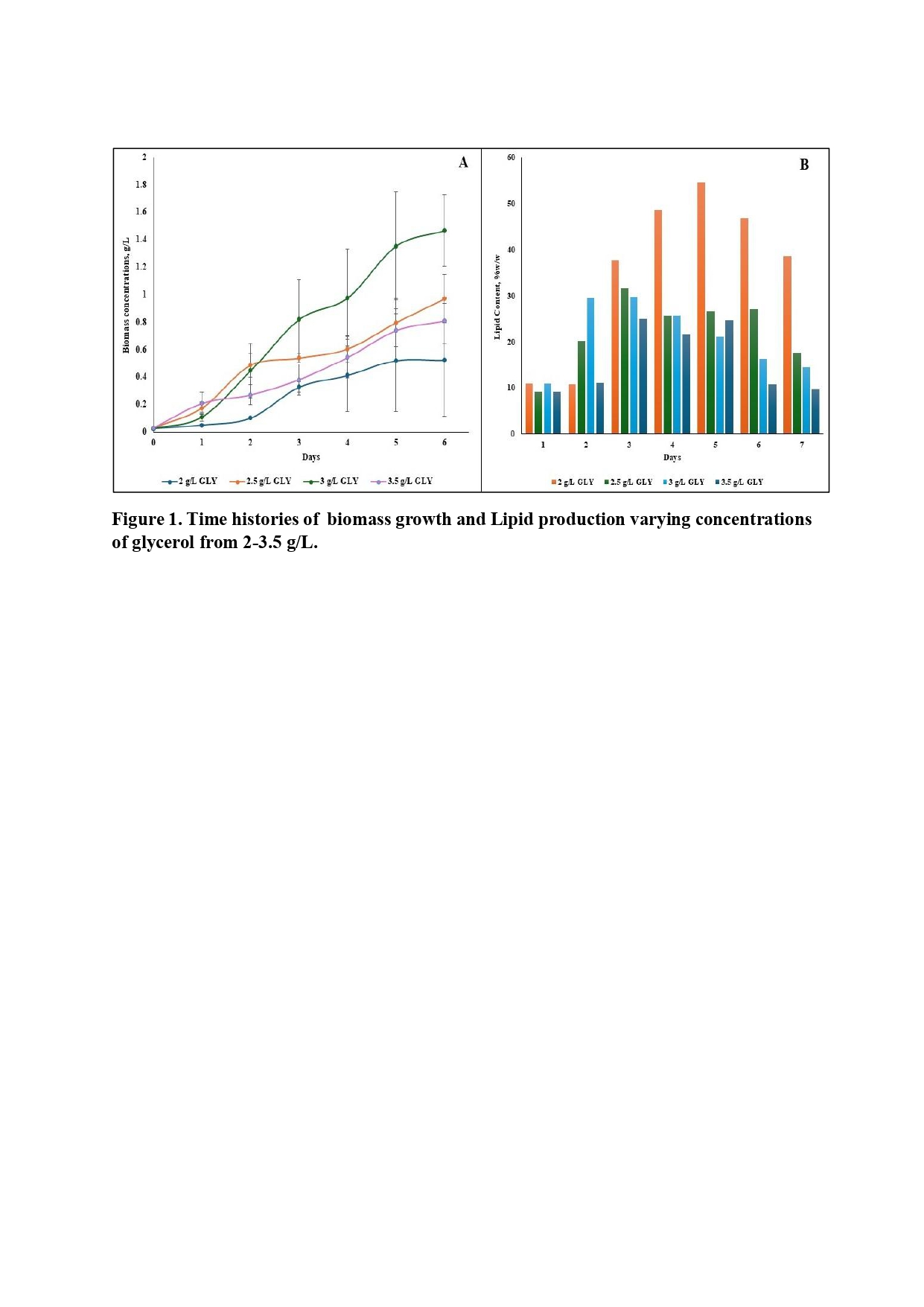
In recent years, algae have been focused as an attractive biocatalyst for both nutrient recovery from wastewater treatment as well as atmospheric CO2 sequestration. In comparison to terrestrial plants, algae exhibit fast growth rate, higher carbon and nitrogen uptake as well as sustainable source for production of lipid and phycochemicals. In this investigation, growth kinetics, total organic carbon (TOC) removal efficiency, and lipid accumulation pattern of microalgae, Scenedesmus obliquus-5586 have been determined by using glycerol as a carbon source. Batch mode experiments were performed in small algal-photobioreactors by varying the concentrations of glycerol in 250 ml Erlenmeyer flasks using modified-18 media, for photoheterotrophic growth of microalgae. Typically, algal cultivation was done for 6 days at 30°C incubation temperature under constant illumination having 4.9 kLux light intensity (photo-cycle: 20 h light:4 h dark). The biomass growth patterns and productivity by varying concentrations of glycerol between 2-3.5 g/L exhibited that the highest biomass concentration (1.470±0.259 g/L) and productivity (0.266±0.095 g/L/d) were achieved at 3 g/L of glycerol concentration (Figure 1A). Also, the highest TOC and TN removal efficiencies were estimated to be 91.76 % v/v and 50.7 % v/v, respectively, on 6th day for 3 g/L of glycerol concentration. The Monod model exhibited a good fit for the growth data (R2 = 0.9347) with the values of μmax and Ks as 0.657 d-1 and 3.47 g/L, respectively. Under carbon limited condition the maximum lipid content of 54% w/w was achieved at lower glycerol concentration i.e., 2 g/L as represented in Figure 1(B) which is 2.25 folds higher than the lipid yield achieved at 3.5 g/L concentration. The investigation exhibits the oleaginous nature Scenedesmus obliquus-5586 with higher nutrient uptake efficiency under photo-heterotrophic growth and its future potential in the 3G biofuel platform and wastewater treatment processes.