2025 AIChE Annual Meeting
(444e) Structured Steel Fiber-Zeolite Composites for CO2 Capture Via Induction Swing Adsorption Processes
Authors
To use induction heating for regeneration in adsorption processes, so called induction swing adsorption (ISA), a composite material of the adsorbent and a susceptor material must be made as adsorbent materials are typically not conductive or magnetic. This has been done by growing metal organic frameworks (MOFs) on magnetic nanoparticles (NMPs) and by combining zeolites and iron oxide powder with binders for pellet extrusion [1,2]. In these susceptor particles, heat is primarily generated by magnetic hysteresis losses due to their small particle size. By using larger conductive susceptors, more heat can be generated by Joule heating from eddy currents induced by the alternating electromagnetic field [3].
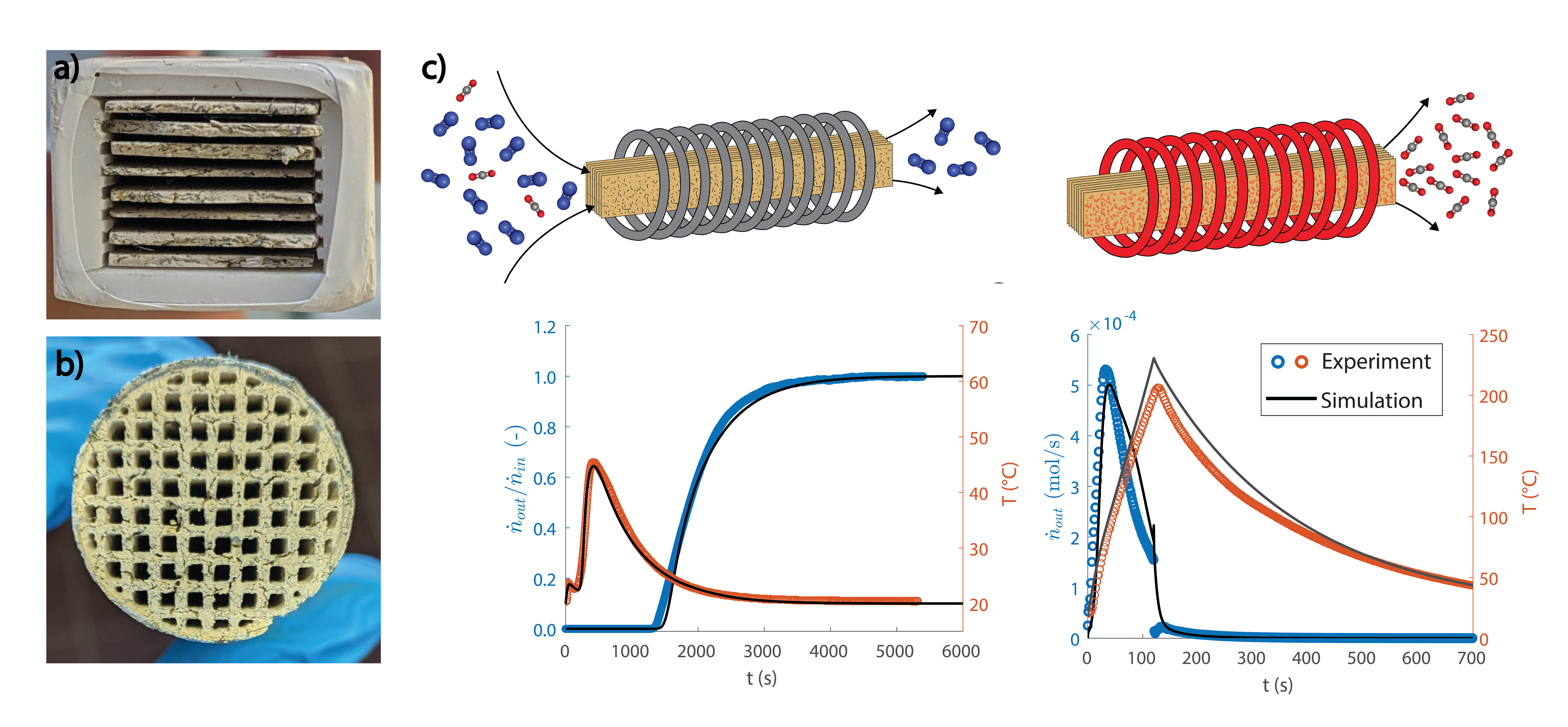
In our work, structured composite adsorbents containing 13X zeolite and steel fibers were manufactured. As traditional extrusion method are challenging due to presence of the large metal fibers, a sacrificial templating method using 3D printed negatives was used. Laminates (67 wt% 13X, 20 wt% steel fibers) with a thickness of 1.0 mm were made and spaced 0.4 mm apart (Figure 1a). Furthermore, a monolith (22.2 g, 10 cm length, 3 cm diameter) containing 11 wt% steel fibers was manufactured (Figure 1b).
The specific absorption rate (SAR, W/g) of the steel fibers and composite material was measured to be two times larger than the SAR for MgFe2O4 nanoparticles at a four times larger magnetic field strength and more than four times larger than for Fe3O4-containing pellets at comparable magnetic field strength. These very high SAR rates translate in highly efficient and rapid heating of the structured adsorbents when subjected to induction heating. Heating tests show the temperature between the laminates increases with more than 150°C in less than 60 seconds at a magnetic field strength of 11.1 mT [3].
The structured adsorbents were tested in adsorption-desorption tests for the separation of a synthetic flue gas mixture (15:85 mol% CO2/N2). Breakthrough experiments on the laminate adsorber indicate a high volumetric capacity, rapid mass transfer kinetics and a low pressure drop [4]. Various desorption strategies were investigated, where inductive heating was combined with nitrogen purge or vacuum. Desorption via N2-purge combined with induction heating results in an average desorption rate up to 44.3 mg CO2/g adsorbent/min [3]. This is at least two times larger than the highest reported desorption rates for similar experiments with composite adsorbents for ISA [2,5]. When combing induction heating with vacuum desorption, even larger desorption rates were measured (82.6 mg/g/min).
Simulations of the various ISA tests show a close match to the experimental molar flow curves, temperature profiles and pressure profiles (Figure 1c). This validated model was then used to simulate and optimize TSA and TVSA processes using a genetic algorithm (NGSA-II). The simulations allow evaluation of the structured ISA materials on a process scale and show high CO2 purity and recovery can be achieved. Furthermore, the productivity and energy consumption of the various processes were compared. The rapid heating and high desorption rates which can be achieved with these structured adsorbents make them highly suitable for rapid electrified TVSA processes for CO2 capture.
Bibliography
[1] H. Li, M.M. Sadiq, K. Suzuki, R. Ricco, C. Doblin, A.J. Hill, S. Lim, P. Falcaro, M.R. Hill, Magnetic metal–organic frameworks for efficient carbon dioxide captureand remote trigger release, Adv. Mater. 28 (2016) 1839–1844
[2] M. Gholami, B. Verougstraete, R. Vanoudenhoven, G.V. Baron, T. Van Assche, J.F. M. Denayer, Induction heating as an alternative electrified heating method for carbon capture process, Chem. Eng. J. 431 (2022) 133380
[3] M.H.B. Born, M. Schoukens, M. Gholami, J.F.M. Denayer, T.R.C. Van Assche, Steel fiber-zeolite composite laminates for carbon capture via induction swing adsorption, Chem. Eng. J. 506 (2025) 159967
[4] M.H.B. Born, J.F.M. Denayer, T.R.C. Van Assche, High capacity laminate adsorbers: enhancing separation performance beyond packed beds, Chem. Eng. J. 488 (2024) 150627
[5] K. Newport, K. Baamran, A.A. Rownaghi, F. Rezaei, Magnetic-field assisted gas desorption from Fe2O3/zeolite 13X sorbent monoliths for biogas upgrading, Ind. Eng. Chem. Res. 61 (2022) 18843–18853