2025 AIChE Annual Meeting
(353h) Structure-Property Relationships of the Quantum Dot Ligand Shell Revealed By Neutron and X-Ray Scattering
Authors
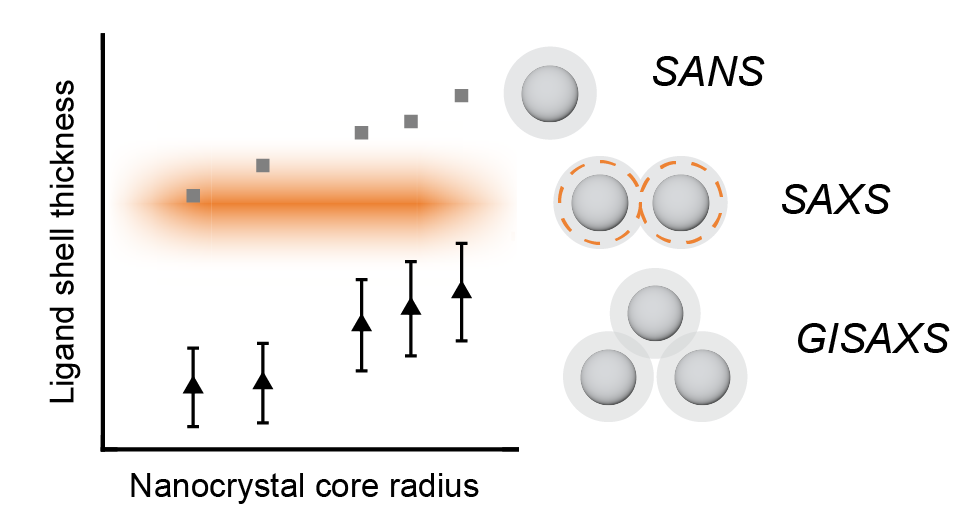
In this talk, we show how complementary neutron and X-ray scattering experiments reveal the structure-property relationships of the QD ligand shell. Monodisperse, oleyl-capped lead sulfide (PbS) QDs with core diameters between 4.8-7.4 nm were studied as a model system. We characterized the PbS QDs with small-angle neutron scattering (SANS) to extract the ligand shell thickness and composition, SAXS to characterize colloidal interactions of concentrated QD solutions, and grazing-incidence (GI) SAXS to compare interparticle distances in self-assembled PbS QD films.
The SANS measurements indicate that the thickness of the colloidal ligand shell of PbS QDs increases up to 15% with core size, despite near-identical areal ligand coverage between QDs. This trend is ascribed to curvature effects, where larger cores lead to a longer average extension of ligands in a colloid. Curvature similarly impacts the structure of self-assembled QD films, such that the apparent ligand shell thickness in a close-packed film increases with core size. On the other hand, the contribution of the ligand shell to the apparent hard-sphere colloidal interactions of QDs is independent of curvature and less than the colloidal ligand shell thickness in all samples. Through a combination of SANS, SAXS, and GISAXS, we reveal the structure-property relationships of the ligand layer of PbS QDs: from a colloid to a close-packed film.