2025 AIChE Annual Meeting
(214f) Steady-State and Transient Optimization of Monolith Reactor Design for Autothermal Oxidative Dehydrogenation of Ethane over a MoVTeNbOx Catalyst
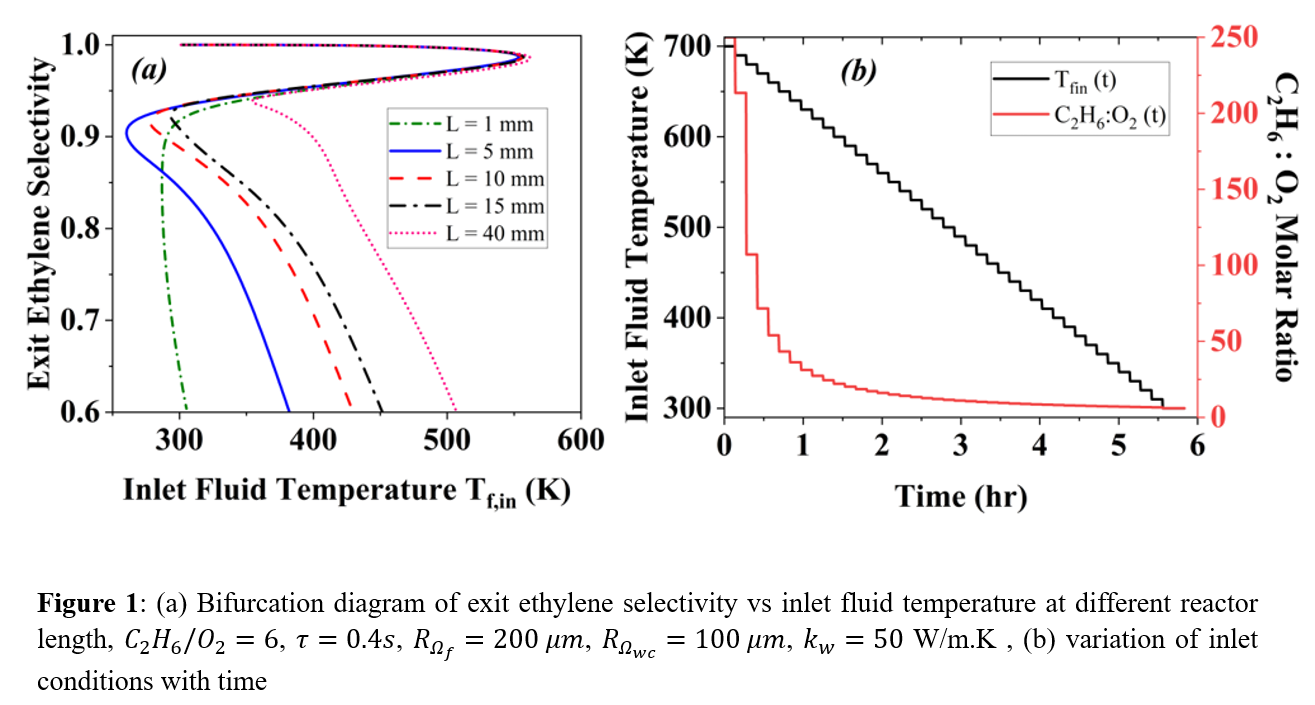
We use a multi-scale reduced order model that accounts for pore diffusion to analyze ignition-extinction behavior during ODHE in a monolith reactor coated with a MoVTeNbOx (M1) catalyst. We determine the optimal catalyst layer thickness and monolith substrate properties so as to maximize the region of autothermal operation (or per pass conversion of ethane) as well as selectivity to ethylene. Our modeling results indicate that metallic monoliths with intermediate length, high substrate conductivity and high cell density (or small hydraulic radius) are optimally suited to approach the so called “homogeneous lumped thermal reactor (LTR) limit” which leads to the best reactor performance (92% ethylene selectivity at 25% ethane conversion). It is also shown that operation of the reactor in the external mass or heat transfer controlled regime with strong interphase gradients can lower ethylene selectivity. We also report the feasibility of carrying out ODHE at high pressure (5 bar) with fixed linear velocity and examine the impact of feed dilution on reactor performance and compare the same with that obtained in the steam cracking of ethane. To sustain stable reactor operation near the extinction point, a startup protocol is proposed wherein the reactor is initially heated to a temperature that is slightly above the operating temperature, and inlet conditions are carefully adjusted such that the reactor is maintained nearly at constant temperature, thereby preventing runaway or quenching.