2025 AIChE Annual Meeting
(334b) Stabilization and H?S Removal Performance of ZIF-67-Based Pickering Emulsions for Oilfield Use
Authors
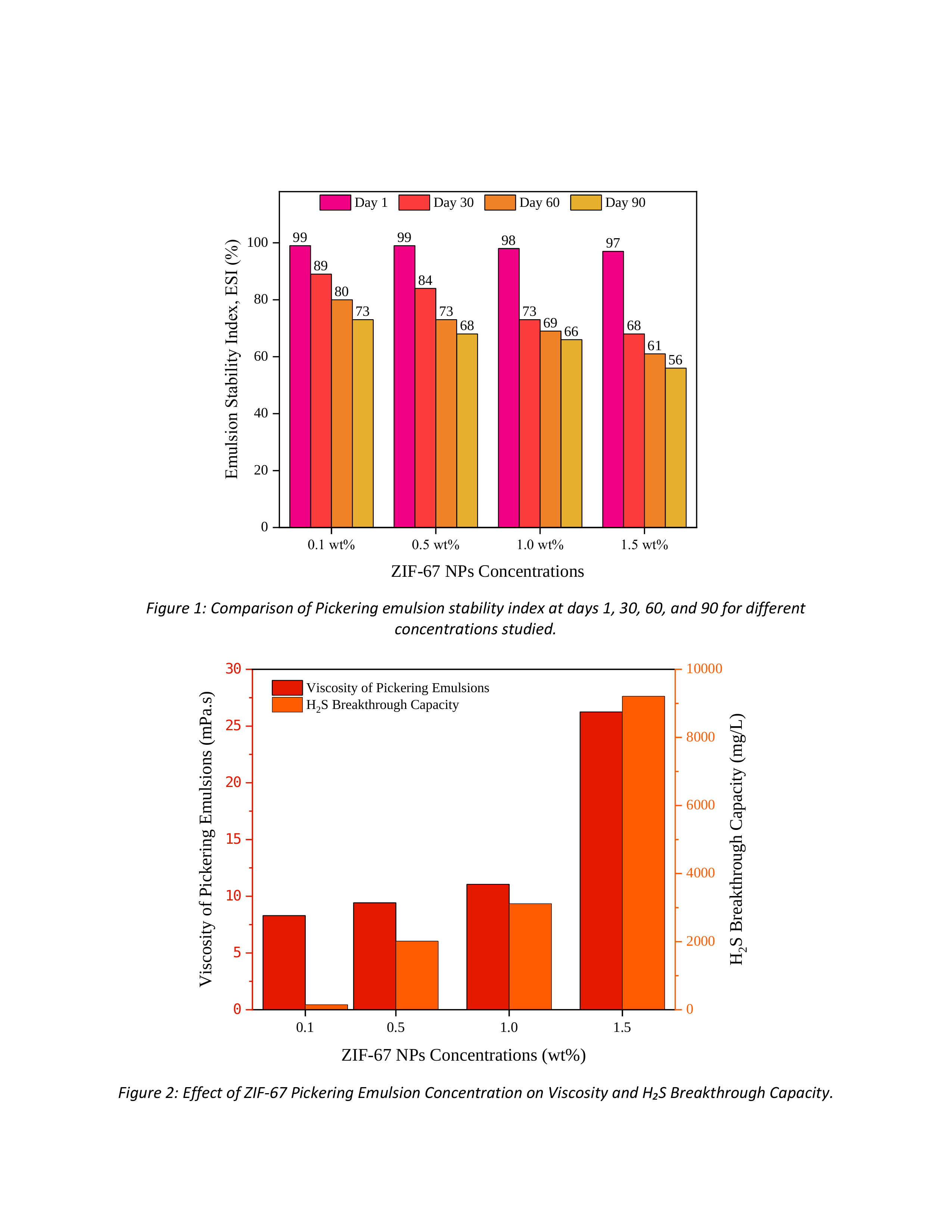
The synthesized ZIF-67 NPs were characterized via X-ray diffraction (XRD), scanning electron microscopy (SEM), transmission electron microscopy (TEM), and thermogravimetric analysis (TGA), confirming their crystallinity, rhombic dodecahedral morphology, and high thermal stability. Emulsions incorporating these NPs were further evaluated through zeta potential analysis, droplet size distribution, dynamic interfacial tension (IFT), optical microscopy, and rheological testing. Initial stability evaluations revealed that the addition of ZIF-67 significantly improved the long-term stability of emulsions compared to ZIF-free formulations. Specifically, the emulsion with 0.1 wt% ZIF-67 demonstrated superior stability over 90 days, with a relatively high emulsion stability index (ESI), indicating minimal phase separation. However, increasing the NP concentration beyond this threshold (0.5–1.5 wt%) led to particle aggregation in the aqueous phase, resulting in droplet flocculation and partial coalescence. Microscopy and size distribution data supported these findings, showing larger and more irregular droplets at higher ZIF-67 loadings—likely due to particle bridging and decreased interfacial adsorption efficiency.
Rheological analysis further revealed concentration-dependent trends. Emulsions with lower ZIF-67 content (0.1–1.0 wt%) displayed Newtonian behavior with stable viscosity across shear rates, while the system at 1.5 wt% exhibited shear-thinning behavior due to internal network formation from particle–particle interactions. Frequency sweep and viscoelastic measurements confirmed this, with the storage modulus (G′) consistently exceeding the loss modulus (G″). Both moduli increased with temperature and NP concentration, and the crossover frequency shifted to higher values, indicating enhanced network integrity and viscoelastic strength under elevated conditions.
Beyond their rheological and physical performance, ZIF-67-based emulsions demonstrated remarkable H₂S scavenging capabilities, addressing a critical challenge in hydrocarbon processing. Reservoir souring, often triggered by the activity of sulfate-reducing prokaryotes (SRP), leads to elevated levels of H₂S—a highly toxic, corrosive gas that compromises operational safety, damages infrastructure, and poses significant environmental and health hazards. Conventional chemical scavengers such as amines, aldehydes, and metal oxides are commonly used in industry but suffer from rapid consumption, limited capacity, and high regeneration costs, making them unsustainable for long-term field applications. In contrast, the ZIF-67-based emulsions offer a robust alternative through a dual-function mechanism that integrates both gas capture and fluid stabilization.
Breakthrough experiments using methane streams containing 100 ppm H₂S showed that the emulsion with 1.5 wt% ZIF-67 achieved a high scavenging capacity of 9207.7 mg H₂S/L emulsion (671.53 mg H₂S/g ZIF-67), significantly outperforming conventional scavengers. This performance is attributed to the high surface area, tunable porosity, and strong sulfur affinity of ZIF-67, as well as the emulsion’s ability to maintain gas–liquid contact through enhanced viscosity and network stability. The homogeneous NP dispersion further promoted efficient gas-particle interactions, enabling both rapid uptake and prolonged retention of H₂S.
In conclusion, this study highlights the dual-functionality of ZIF-67 nanoparticles in Pickering emulsions, demonstrating their capacity to improve both physical stability and H₂S removal performance. While lower nanoparticle concentrations favored long-term stability and uniform droplet morphology, higher concentrations enhanced viscoelastic behavior and gas scavenging capabilities. This work represents the first comprehensive exploration of ZIF-67-based emulsions for sulfur gas mitigation, offering a scalable and multifunctional platform for challenging operational environments. Future studies should focus on optimizing NP loading, exploring regeneration potential, and evaluating scalability to fully harness the industrial relevance of this novel emulsion system.